Who Controls Romania's 127,000 Prosumer Batteries? — NRG-IA
Prosumatori & Eficiență Author: Ioana BuzoaicaWith Romania nearing 360,000 prosumers, the debate shifts to how the grid can contractually buy battery flexibility without overstepping private rights.
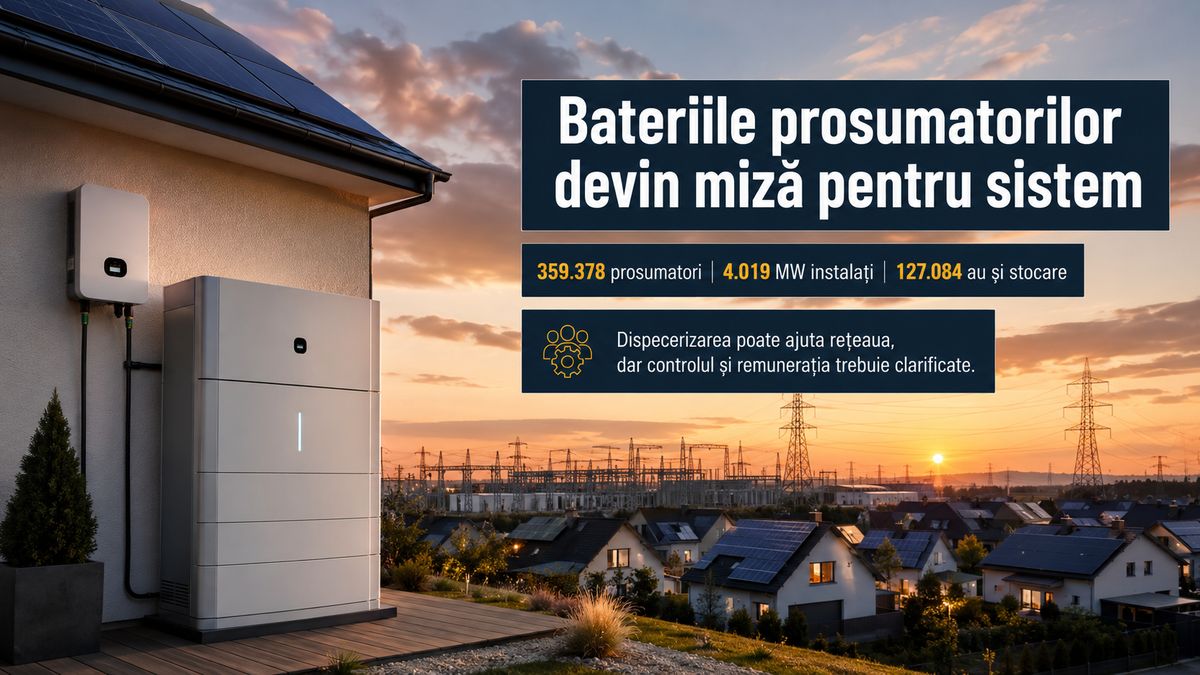
In just a few years, Romania has built a distributed energy infrastructure of a scale that is beginning to reshape the operation of the National Energy System. At the end of June, there were 359,378 registered prosumers, with a cumulative installed capacity of 4,019.17 MW , and 127,084 of them also owned storage systems . Nearly a third of Romania's prosumers therefore possess not only the capacity to generate electricity, but also the ability to decide when to consume, store, or feed it back into the grid. This capability is becoming increasingly valuable in a system where the challenge is no longer just how much energy Romania can generate in a day, but at what hour it is produced and at what hour it is needed . This is precisely the starting point of the current debate on integrating prosumers' batteries and inverters into a form of dispatching that would allow for a more efficient utilization of distributed flexibility. The technical necessity is clear. However, the economic and legal conditions of such a mechanism must be defined with equal precision. Because there is a fundamental difference between a battery that can help the grid and a battery placed at the grid's disposal: the contract, consent, limits of control, and owner remuneration. Over 4 GW of Solar PV Have Already Reshaped the System Curve The rise of prosumers has brought Romania thousands of megawatts of generation capacity without the state or major energy utilities having to build it themselves. The effect is obvious on sunny days. Behind-the-meter generation reduces the load seen by the grid in the middle of the day, while utility-scale solar farms simultaneously inject large volumes of power. Transelectrica is already documenting this phenomenon through what the system operator calls the "Daytime Trough" : a sharp drop in the system's observed load during solar hours, followed by a rapid rebound in demand once solar generation begins to fade. Compliance with the capacity approved in the technical grid connection permit does not eliminate this effect. A prosumer can operate perfectly within their technical limits while, at the same time, hundreds of thousands of installations reacting simultaneously to the same sun can profoundly alter the system's aggregate curve. The issue is not that individual prosumers are illegally injecting too much power. The operational challenge is the synchronization of over 4 GW of distributed generation . Yet, this exact synchronization can also transform prosumers into a flexibility resource. If a portion of these batteries charge during solar surplus and discharge after sunset, they reduce the gap between the two operating regimes. Romania Can Have a Surplus at Noon and Face Energy Scarcity Just Hours Later August 15 provided a very clear demonstration. At 12:10, dispatchable solar farms were producing approximately 2,445 MW , equivalent to 84.7% of the instantaneous demand of 2,887 MW indicated in the system. At the same time, Romania was exporting around 1,960 MW . Prosumers were separately generating significant amounts of electricity, part of which was consumed directly by households and businesses, making it invisible to the grid-measured demand. A few hours later, after solar generation declined, the economic reality had changed radically. On the Intraday Market, the weighted average price for the 14:00–15:00 interval had been 59.36 RON/MWh, whereas for 20:00–21:00 it soared to 1,027.64 RON/MWh . This spread cannot be attributed to a single cause, nor exclusively to prosumers. However, it illustrates the vastly different value that electricity can have at two different times of the same day. A residential battery can participate precisely in shifting energy between these two periods. And when the number of batteries exceeds 127,000, the discussion is no longer about a few energy-independent households. It becomes a system-wide issue. Dispatching Can Mean Coordination, Not a Transfer of Ownership The term "dispatching" can cause significant confusion. In a technical sense, coordinating a battery does not mean the system operator becomes its owner. In an aggregation-based model, the owner can contractually allow a supplier or an aggregator to control, within certain limits, when the battery charges or discharges. Thousands of small installations can thus be digitally pooled into a virtual power plant — Virtual Power Plant or VPP — which reacts as a much larger energy resource. Such a fleet can absorb energy when the system has a surplus and deliver it when power becomes scarcer and more valuable. Romanian legislation already recognizes the concepts of active customers, aggregation, flexibility, and the possibility of participating through an aggregator. Romania is therefore not starting from scratch. The current challenge lies in defining the economic model. A dispatching formula may make technical sense, but the term alone does not specify whether participation is voluntary or mandatory, who issues…
Ioana Buzoaica — Independent Editorial Board
The NRG-IA newsroom continuously monitors Romanian energy markets, ANRE regulatory decisions, and national grid telemetry (SEN/SNT). We deliver independent intelligence anchored exclusively in official primary data.
Editorial Charter, Ethics & Verification Methodology →