Romanian Batteries Hit 660 MW, Matching Nuclear Reactor — NRG-IA
Energie Regenerabilă Author: Ioana BuzoaicaRomania's utility-scale batteries delivered 660 MW during the August 12 evening peak, matching a Cernavodă nuclear reactor's capacity.
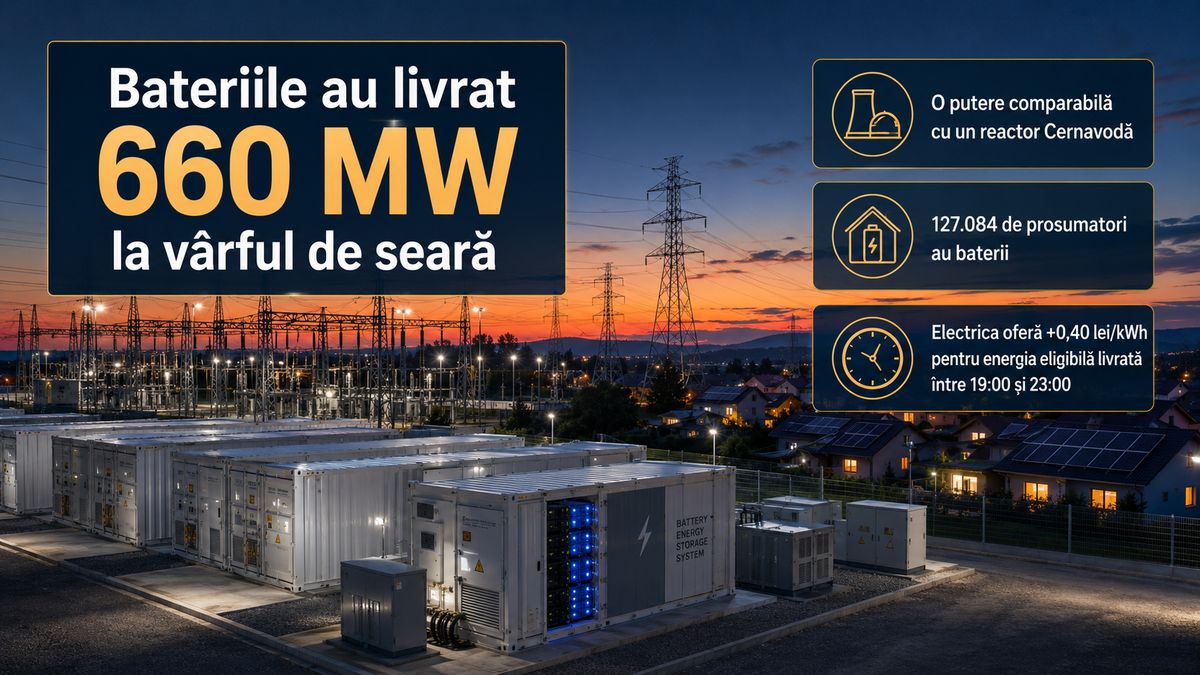
Dispatchable utility-scale battery storage connected to the National Energy System (NES) delivered 660 MW at 21:08 on the evening of August 12 , precisely during the period when Romania faces its most challenging supply-demand balance. This figure shifts the scale of the storage debate: Cernavodă Unit 2 has a net reference capacity of 650 MW , meaning that, at that specific moment, batteries provided power comparable to that of a nuclear reactor. The comparison is all the more relevant as, the following morning, Nuclearelectrica began a controlled shutdown of Unit 2 due to the continuously falling Danube water levels. This left Romania with both Cernavodă units unavailable, temporarily removing approximately 1.3 GW of net nuclear capacity from the system's equation. The 660 MW output does not mean that batteries effectively replaced Reactor 2 after its shutdown: the documented figure comes from the evening of August 12 , when the reactor was still operating. However, it demonstrates something that until recently existed mostly in investment plans—that the current storage fleet can provide, for a limited period, an instantaneous output on par with a large conventional generation unit . 660 MW shifts the scale of storage in Romania As of August 1, Romania's storage installations had reached 989 MW of installed capacity and 1,975 MWh of energy capacity , according to the latest Transelectrica data cited by energy publications. In just a few months, batteries have grown large enough to appear in the NES balance not with tens, but with hundreds of megawatts precisely during the hours when the grid needs flexibility the most. However, the distinction between power and energy remains critical. A nuclear reactor can provide hundreds of megawatts continuously, as long as it is available and fueled. A battery can only deliver that same power for as long as it has stored energy. If the entire 1,975 MWh capacity were available and could be discharged continuously at 660 MW, the result would theoretically equate to about three hours of operation at that level. In reality, the duration depends on the state of charge, distribution across projects, efficiency rates, technical limitations, and the commercial strategies of each operator. This difference explains why 660 MW is both a spectacular figure and one that must be interpreted correctly: batteries can cover a very large portion of the evening peak power demand, but they cannot continuously substitute the output of a nuclear reactor. The Cernavodă shutdown turns the demonstration into a real-world grid test Nuclearelectrica began the controlled shutdown of Unit 2 on August 13, after the Danube's water level continued to drop. The company stated that the reconnection of the units will be decided based on hydrological developments and the maintenance of nuclear safety margins. For the NES, the temporary loss of nuclear power shifts the pressure precisely to the intervals where storage is most valuable. At noon, solar generation can push supply very high and prices very low. After sunset, this generation drops off rapidly, while consumption remains high. Batteries make it possible to shift a portion of the energy available in the middle of the day to the evening hours. On August 12, at the moment they were delivering 660 MW, the Day-Ahead Market price was approximately 1,300 RON/MWh , whereas during certain daytime intervals, energy had traded at much lower values. This transforms storage into a dual-purpose tool. For the investor, the spread between midday and evening prices creates an economic arbitrage opportunity. For the grid, the same battery shifts energy precisely from a period of abundant supply to one where demand is harder to meet. The 660 MW does not come from prosumer batteries Here, an essential distinction emerges regarding the true scale of the phenomenon. The approximately 650–660 MW observed in the NES comes from dispatchable utility-scale storage facilities , not from household batteries. Former Energy Minister Sebastian Burduja explicitly clarified, when asked about the roughly 650 MW figure, that it refers solely to dispatchable installations and that energy stored by prosumers represents an additional resource. This separation makes the system outlook even more interesting. Romania already has nearly 1 GW of dispatchable storage capable of delivering hundreds of MW during critical windows, on top of which lies a second layer of batteries spread across tens of thousands of households and small businesses. Romania already has 127,084 prosumers with batteries Official ANRE data as of June 30 shows 359,378 prosumers , with a total installed generation capacity of 4,019.17 MW . Of these, 127,084 had storage installations , of which 123,231 were residential users. Thus, roughly one in three prosumers already has a battery. However, ANRE publishes the number of installations, not their aggregate energy capacity in MWh or total available discharge power in…
Ioana Buzoaica — Independent Editorial Board
The NRG-IA newsroom continuously monitors Romanian energy markets, ANRE regulatory decisions, and national grid telemetry (SEN/SNT). We deliver independent intelligence anchored exclusively in official primary data.
Editorial Charter, Ethics & Verification Methodology →