MIT Battery-Concrete: Over 2 kWh/m³ for Built-In Storage — NRG-IA
Tehnologie & Inovație Author: Ioana BuzoaicaMIT is developing concrete that supports structures and stores electricity. A 10x density boost turns foundations, walls, and roads into energy storage.
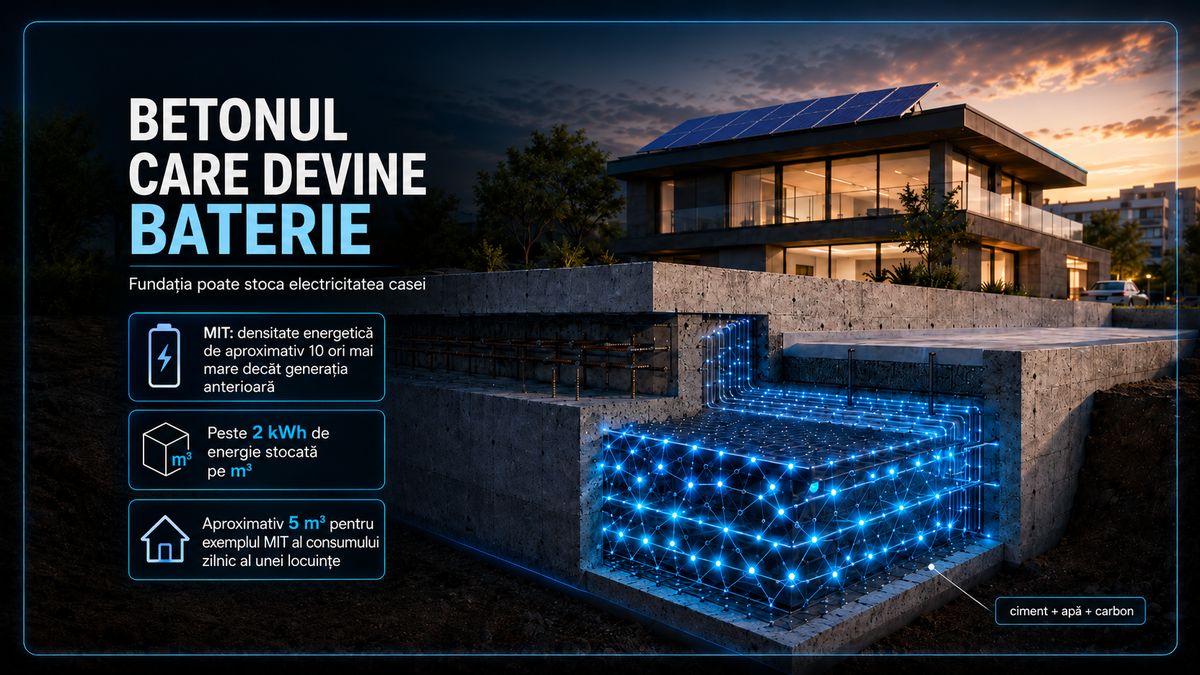
A house could end up storing its solar energy right in its foundation. A road could function simultaneously as transport infrastructure and an electricity reservoir. And a portion of the concrete poured anyway into buildings, parking lots, and bridges could receive a second function: energy storage. This is the direction opened up by researchers at the Massachusetts Institute of Technology, who have developed a material based on cement, water, and carbon black capable of functioning simultaneously as a structural element and a supercapacitor. In the latest generation published by the team, the energy density has increased approximately tenfold compared to the previous version , and the configuration with the highest-performing electrolyte tested can exceed 2 kWh of stored energy per cubic meter of material . This progress changes the scale at which the technology can be envisioned. In 2023, the MIT team estimated that approximately 45 m³ of material would have been required to store around 10 kWh, a value used then as a benchmark for the daily consumption of a household. Following the improvements presented in 2025, the same capacity could be achieved, according to MIT's estimate, with approximately 5 m³ . This is a volume comparable to that of a massive basement wall or a portion of a house's foundation. Concrete doesn't get a battery. Concrete becomes the storage device The MIT technology is called electron-conducting carbon concrete , abbreviated as ec³. The material does not function like a lithium-ion battery hidden inside the concrete. The structural mixture itself becomes the active component of a supercapacitor. Carbon black is a highly fine and conductive form of carbon. When introduced into the cement and water mixture, it forms an extremely branched conductive network during the hydration of the cement. On a microscopic scale, the structure resembles a fractal network spreading through the material's pores. This geometry is essential: it creates a very large internal surface area on which electrical charge can accumulate. Two elements made of ec³ can function as electrodes, separated by an insulating material and in contact with an electrolyte. When the system is charged, the ions in the electrolyte redistribute on the surface of the carbon network, and energy is stored primarily electrostatically at the interface between the electrode and the electrolyte. The result is a structural supercapacitor : the same mass of material can bear a mechanical load and participate in storing electricity. This overlap of functions is why energy density should not be mechanically compared to that of a conventional battery. A battery occupies a volume specifically built for storage. A building's foundation must be constructed anyway. If a portion of that volume can also acquire an energy function, the economics of the system change fundamentally. From 45 to approximately 5 cubic meters for the same energy benchmark The greatest evolution compared to the first generation of ec³ came from better control of the internal structure, the electrolyte, and the manufacturing process. In the initial configurations, the cured electrodes had to be subsequently soaked in electrolyte. The new approach allows the electrolyte to be introduced directly into the water used for mixing, making it possible to produce thicker electrodes and achieve a more efficient use of volume. The highest-performing configuration tested by MIT uses an organic electrolyte and reaches over 2 kWh/m³ . The figure represents the energy that can be stored in a volume of material, not the power delivered instantaneously. At this density, approximately 5 m³ would correspond to the roughly 10 kWh used in the MIT example for a household's daily needs. The leap from approximately 45 m³ to about 5 m³ in just two generations of research is one of the program's most significant results. Prototypes have already moved beyond the simple LED The MIT team also built a 12 V and 50 F supercapacitor module, formed by connecting several elements, which is sufficient to power a 12 V fan and a gaming console via USB. The researchers then moved in an even more relevant direction for future buildings: they created a 9 V ec³ structural arch. The arch supported both its own weight and an additional load while supplying electricity to an LED. The demonstration confirms precisely the feature that differentiates this technology from conventional storage systems: the energy material can simultaneously play a real mechanical role. During testing, an additional effect emerged. As the mechanical load on the arch was altered, the electrical behavior changed, and the LED began to flicker. MIT believes this phenomenon could open up another line of research: using the material for structural health monitoring as well. In such a scenario, concrete could end up performing three functions within the same structure: bearing the load, storing electricity, and providing information about the…
Ioana Buzoaica — Independent Editorial Board
The NRG-IA newsroom continuously monitors Romanian energy markets, ANRE regulatory decisions, and national grid telemetry (SEN/SNT). We deliver independent intelligence anchored exclusively in official primary data.
Editorial Charter, Ethics & Verification Methodology →