Shifting Evening Demand Cuts Imports After Cernavodă Shutdown — NRG-IA
Protecția Consumatorului Author: Ioana BuzoaicaShifting evening power use can immediately cut expensive imports. The Cernavodă shutdown amplifies a structural issue: solar peaks at noon but fades at dusk.
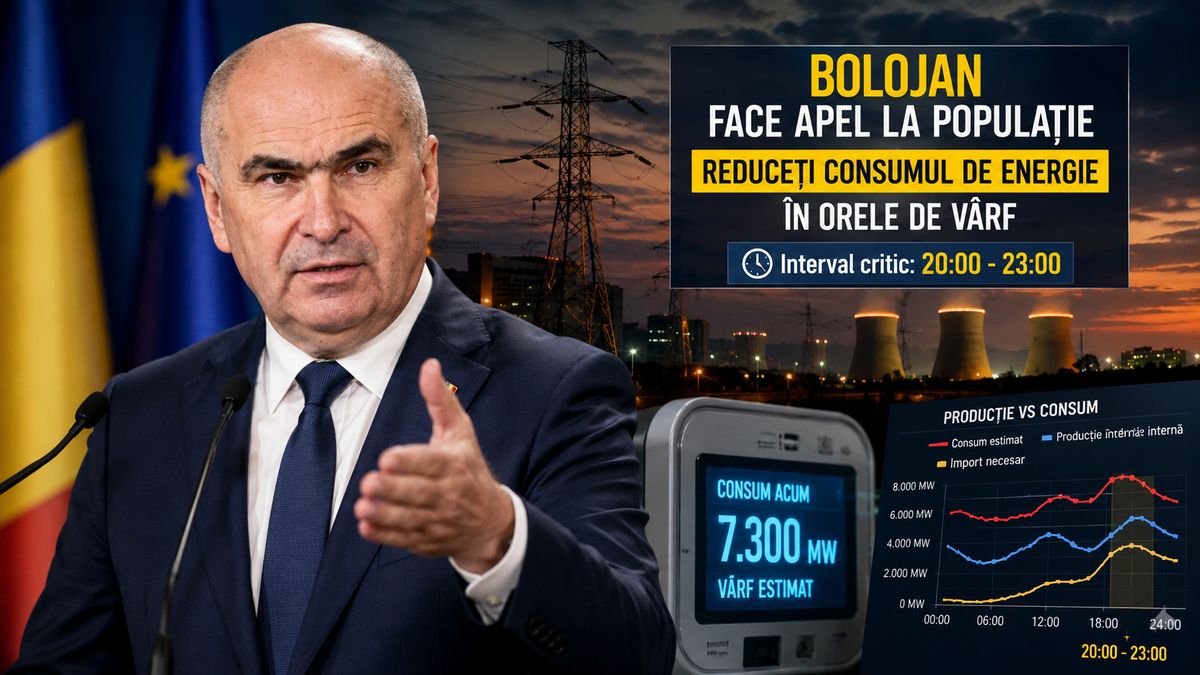
Ilie Bolojan has placed evening consumption at the heart of Romania's energy challenge: the country has abundant and cheap solar energy at noon, but ends up importing expensive electricity after sunset. The shutdown of both reactors at Cernavodă exacerbates this imbalance, as it temporarily removes approximately 1,400 megawatts that would normally be continuously available, including during peak demand periods. In practical terms, demand-side optimization means households and businesses reducing or postponing non-urgent electricity use during the critical evening window. Washing machines, electric water heaters, EV charging, certain air conditioning systems, and flexible industrial processes can be shifted before or after the hours when demand peaks, solar generation drops to zero, and additional power must be purchased at higher prices. This adjustment does not replace the output from Cernavodă, nor does it shift the responsibility of system operations onto the public. However, it represents the measure with the fastest impact: every megawatt shaved off evening demand is a megawatt that Romania does not need to source at that moment from imports, hydropower, gas-fired plants, coal, or batteries. Peak demand could reach approximately 7,300 megawatts The Ministry of Energy estimated peak consumption for this period at around 7,300 megawatts, with domestic production ranging between 4,000 and 4,300 megawatts. The deficit was to be covered by commercial imports, with authorities anticipating no blackouts for residential consumers. This estimate was released in the context of the shutdown of Cernavodă Unit 1. The subsequent disconnection of Unit 2 could widen the gap between consumption and domestic generation by up to an additional 700 megawatts, unless other power plants ramp up production or wind generation and demand trends prove favorable. This is a technical projection, not a guaranteed import level. Together, the two reactors have a gross electrical capacity of approximately 1,413 megawatts and, under normal conditions, provide nearly a fifth of the electricity generated in Romania. Their value to the grid lies not just in their annual output, but in the fact that they generate power almost constantly, regardless of the hour, daylight, or wind. On an evening with a demand of 7,300 megawatts, the absence of all nuclear generation equates to nearly a fifth of instantaneous demand. The system does not need to find a single power plant to replace this capacity, but rather must combine multiple sources, each with its own technical and economic constraints. Why the 20:00–23:00 window is the most challenging During the day, utility-scale solar installations and prosumers can significantly reduce the load drawn from the grid. As the sun sets, this generation drops rapidly, but household consumption remains high, driven by air conditioning, cooking appliances, lighting, water heaters, washing machines, and electronics. Ilie Bolojan previously illustrated this discrepancy by contrasting the near-zero energy prices during certain midday hours with prices of 700–800 RON per megawatt-hour that could occur during the 20:00–22:00 peak. The solutions announced by the Government—smart meters and battery storage—aim precisely at shifting energy and consumption from cheap hours to expensive ones. The Cernavodă shutdown adds a new layer of difficulty to this structural issue. Until now, nuclear generation continued to deliver roughly the same output after sunset. Without it, the drop in solar generation must be compensated for simultaneously with the loss of approximately 1,400 megawatts from the nuclear plant. Voluntary demand reduction does not need to be spectacular to make a difference. A nationwide reduction of 100 megawatts sustained for three hours translates to 300 megawatt-hours that no longer need to be imported or generated from more expensive sources. At 500 megawatts, the difference reaches 1,500 megawatt-hours in a single evening. Imports cover the gap, but depend on the entire region The primary source of compensation is the European market. Romania can import energy from neighboring states as long as there is commercial supply, available cross-border transmission capacity, and secure technical conditions for transport. Importing is not an emergency measure. It is part of the normal functioning of the European market, where Romania buys energy when domestic production is insufficient or more expensive, and exports when it has a surplus. The problem arises during evening hours when multiple countries in the region simultaneously seek additional power. Solar generation drops across a wide area, high temperatures sustain cooling demand, and drought affects hydropower plants and thermal plants that rely on river water for cooling. Bolojan previously warned that import options from Central and Western Europe are limited by transmission capacity, particularly along the Romania–Hungary–Austria corridor. Power may…