AI Boom Turns Energy Strategic: Data Centers Seek Megawatts — NRG-IA
Geopolitică & Energie Author: Ioana BuzoaicaThe AI boom turns energy into a strategic asset. As data centers reach GW-scale, competition shifts from chips to grids, power, and storage.
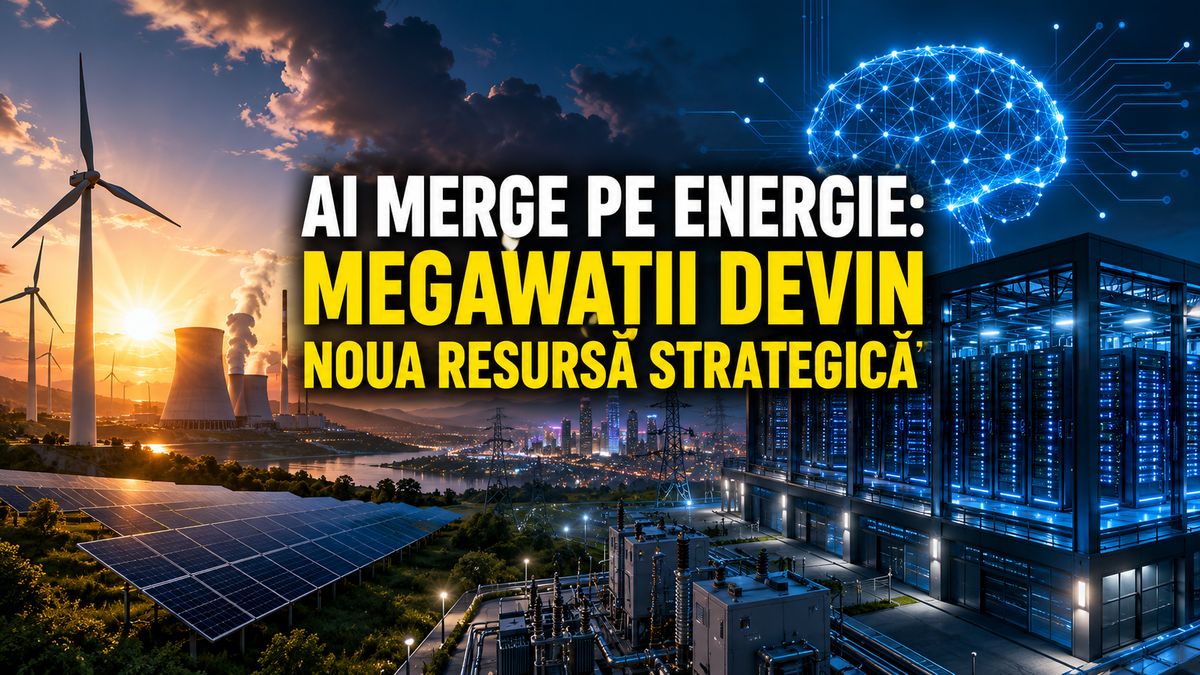
The artificial intelligence boom is beginning to reshape the economic order of digital infrastructure. Until recently, attention was focused on AI models, chips, servers, and software platforms. In 2026, the real bottleneck has become increasingly clear: electricity. The data centers required to train and run AI models need massive amounts of power, delivered continuously, in locations where the grid can support the load and cooling can be efficiently managed. Estimates cited by OilPrice point to global investments of around $7 trillion in infrastructure associated with the AI boom by 2030, with over $5 trillion directed toward physical infrastructure: data centers, servers, power, cooling, and grids. Beyond the spectacular headline figure, this number conveys an industrial reality: artificial intelligence is not built solely in the cloud, but on grid-connected land, transformers, high-voltage lines, and power sources. Energy is becoming the limiting factor for AI In the first phase of the AI boom, the competition was over chips. NVIDIA became the symbol of this race, and access to GPUs was treated as the primary constraint. The second phase, however, is far more physical. An AI data center is not just servers placed in a building. It means grid connection, available power, redundancy, cooling, stability, long-term contracts, and scalability. This shift inverts investment logic. In the past, developers looked for land, buildings, and digital connectivity, and only then solved the power supply. Now, for major AI centers, the question is asked in reverse: where are megawatts available, how quickly can the connection be made, and which source can deliver continuous power at a competitive price? Megawatts are thus becoming a strategic resource. Companies that control access to cheap, stable, and scalable power have an advantage in an economy where AI consumes more and more electricity. It is not just about the cost of energy, but its availability. A data center project may have capital, clients, and equipment, but without sufficient grid connection, it remains stalled. Data centers enter the ranks of major energy consumers A modern AI campus can reach consumption levels in the hundreds of MW. Some projects discussed in the industry approach or even exceed the 1 GW threshold, a level comparable to the consumption of a large city or the output of a major power plant. This scale changes the relationship between technology and the energy system. For grid operators, AI data centers are not typical consumers. They demand high power, a relatively constant load profile, high power quality, and round-the-clock availability. At the same time, they are emerging in areas where the grid was not necessarily designed for industrial loads of this magnitude. This pressure is already visible in developed markets. Connection times can reach several years, and the shortage of transformers, grid equipment, and transmission capacity is becoming as significant an issue as the lack of land or permits. In the AI economy, the power grid is no longer background infrastructure. It is becoming one of the primary conditions for growth. Tech giants are buying power, not just servers Major tech companies have begun to react. Microsoft, Google, Amazon, Meta, Oracle, and other hyperscalers no longer treat energy as a passive cost. They are seeking long-term contracts, dedicated sources, nuclear projects, renewable energy, batteries, and sites located close to large generation capacities. This move shows that the market is entering a phase where digital companies are becoming major energy players. They do not necessarily build power plants in the traditional sense, but they influence the financing, location, and timeline of energy projects. A large PPA, a partnership with a nuclear power plant, or choosing a site near an energy source can change the economics of a project. Nuclear power is returning to the conversation for this very reason. AI needs continuous power, not just variable generation. Renewables remain essential for decarbonization and cost, but AI centers also require dispatchable capacity, storage, flexibility, and grids capable of managing constant consumption. Countries with cheap power and cold climates become more attractive The geography of AI will increasingly be decided by energy. Nordic countries are attractive for data centers because they combine hydropower, low temperatures, stable grids, and low emissions. Cooling costs less, electricity can be cleaner, and the availability of large capacities can accelerate investments. This logic is not limited to Northern Europe. Any state that can offer stable power, grid-connectable land, fast-track procedures, and predictable costs can enter the competition for data centers. Conversely, states with slow grids, connection bottlenecks, and price uncertainty risk losing investments, even if they have a skilled workforce or a good geographical position. Energy is becoming a key…
Ioana Buzoaica — Independent Editorial Board
The NRG-IA newsroom continuously monitors Romanian energy markets, ANRE regulatory decisions, and national grid telemetry (SEN/SNT). We deliver independent intelligence anchored exclusively in official primary data.
Editorial Charter, Ethics & Verification Methodology →