Brent Tops $117 After Hormuz Attack; Transit Reduced by 77% — NRG-IA
Geopolitică & Energie Author: Ioana BuzoaicaBrent hit $117.62/bbl on Oct 30 after a tanker attack in Hormuz. US data shows oil transit fell 77%, rattling fuel markets.
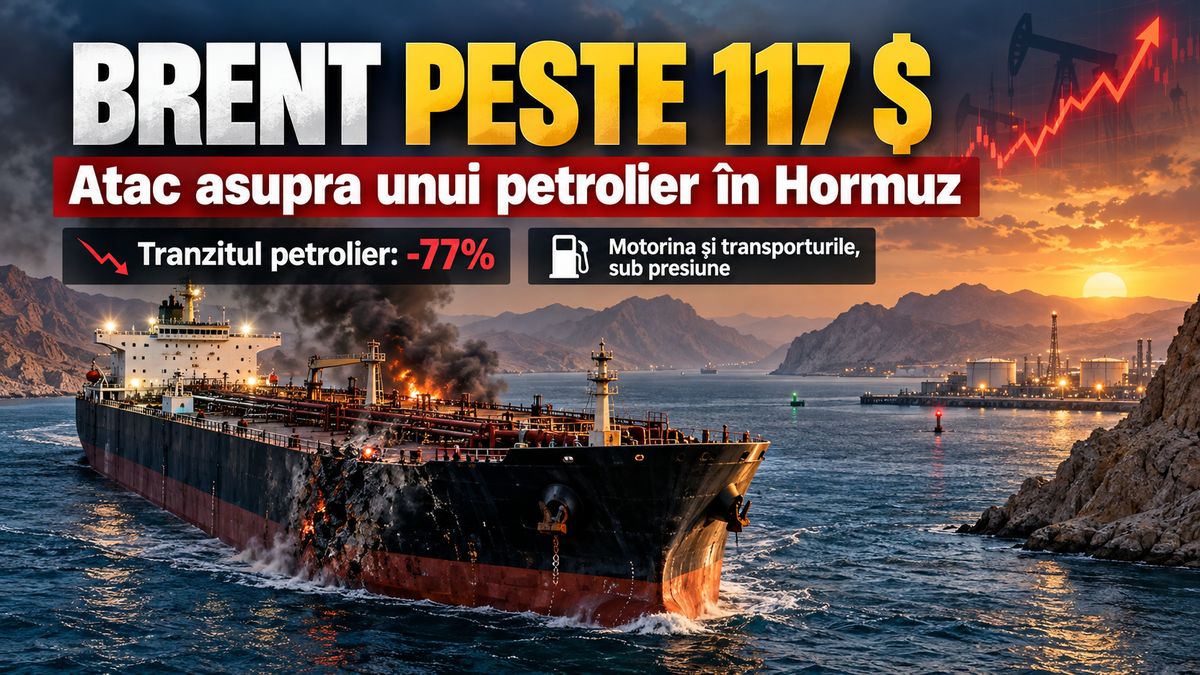
Brent crude rose to $117.62 per barrel on Friday, October 30, 2026, following an attack on an oil tanker using explosive devices in the Strait of Hormuz, the strategic maritime artery carrying vast volumes of Persian Gulf crude. The incident has intensified global supply fears at a time when the Middle East conflict has already drastically reduced seaborne oil shipments and kept fuel prices under sustained upward pressure. According to Reuters, the $117.62 quote was recorded for the December Brent contract, which expires on Friday. The January 2027 contract traded at $113.58 per barrel. Crude oil is thus heading for its fourth consecutive monthly gain, up nearly 14% in October based on mid-session trading evaluations. Beyond the immediate market knee-jerk reaction, the full scale of the crisis is underlined by data from the U.S. Energy Information Administration (EIA). Shipments of crude oil and petroleum products through the Strait of Hormuz plunged from 21.6 million barrels per day (bpd) in the final quarter of 2025 to just 4.9 million bpd in the second quarter of 2026. This approximately 77% drop underscores the massive impact of war-related disruptions on one of global energy trade’s chief arteries. Oil Tanker Attacked with Limpet Mines in the Strait of Hormuz The incident that brought supply risks back into sharp focus occurred on Thursday, October 29, roughly 25 nautical miles (46 kilometers) northeast of Khasab, Oman. The Panama-flagged tanker Louise 1 was approached by a small vessel, from which two explosive devices were attached to the ship's hull above the waterline. According to details released by the UK Maritime Trade Operations (UKMTO) and reported by Reuters, the explosions sparked a fire in the engine room and temporarily disabled the tanker. The crew was unhurt, the fire was extinguished, and the vessel subsequently resumed its journey. No environmental damage was reported. The weapons used were identified as limpet mines, designed to attach directly to a ship's hull. The attack demonstrates the ongoing vulnerability of commercial shipping in congested maritime corridors, where small craft can inflict significant damage using relatively low-tech means. Reuters described it as the first known successful attack using such devices in the Strait of Hormuz since the outbreak of war in February. The perpetrators have not been publicly identified. However, the incident coincides with escalating maritime threats and recent Houthi-claimed strikes against Saudi energy infrastructure, including the Ras Tanura and Rabigh refineries and the Abqaiq processing facility. The full extent of damage to these facilities from the latest claimed strikes has not been independently verified in all cases. Hormuz Once Handled 21.6 Million bpd of Oil. Flows Have Fallen to 4.9 Million The Strait of Hormuz connects the Persian Gulf with the Gulf of Oman and international shipping lanes. Its geographical location makes it a critical bottleneck for energy exports from regional producers, including Saudi Arabia, Iraq, the United Arab Emirates, Kuwait, and Qatar. Prior to the war, total shipments of crude oil, condensate, and refined products through the strait exceeded 21 million bpd. According to EIA data, that volume dropped to 14.9 million bpd in the first quarter of 2026 and fell further to 4.9 million bpd in the second quarter. The drop relative to the final quarter of 2025 represents a decline of roughly 16.7 million bpd. The contraction in traffic has affected both crude transport and refined fuel shipments. Transited petroleum product volumes through Hormuz dropped from 5.7 million bpd in Q4 2025 to 1.1 million bpd in Q2 2026, an 81% decline. This metric is particularly crucial for the middle distillate market, notably diesel, which fuels global transport and industrial activity. While these figures capture the situation in the first half of the year—and flows subsequently showed a slight recovery—recent attacks and ongoing maritime risks highlight the fragility of any return to normal energy trade. Each new incident shapes the calculations of shipowners, insurers, and traders arranging cargoes through a conflict zone. Bypass options remain severely constrained. Existing pipelines designed to circumvent the Strait of Hormuz can absorb only a fraction of the volumes usually exported via this sea lane. Consequently, maritime security remains indispensable to restoring Persian Gulf oil flows. Why Crude Oil and Diesel Rise Together, but at Different Speeds Oil pricing reflects both current supply-demand fundamentals and geopolitical risks surrounding future availability. When tankers are attacked, export terminals threatened, or trade routes rendered unsafe, market participants must price in potential delays, higher freight and insurance premiums, and the risk of physical supply shocks. These risk premiums priced into benchmark futures often precede any quantifiable net loss in physical supply. While Louise 1…
Ioana Buzoaica — Independent Editorial Board
The NRG-IA newsroom continuously monitors Romanian energy markets, ANRE regulatory decisions, and national grid telemetry (SEN/SNT). We deliver independent intelligence anchored exclusively in official primary data.
Editorial Charter, Ethics & Verification Methodology →