Brent Drops 5% on Trump-Iran Talks as Hormuz Risks Persist — NRG-IA
Geopolitică & Energie Author: Ioana BuzoaicaOil fell sharply as Brent dropped 5.11% to $83.44 and WTI fell 5.79% to $79.77 on US-Iran talk prospects, though Hormuz transit risks remain active.
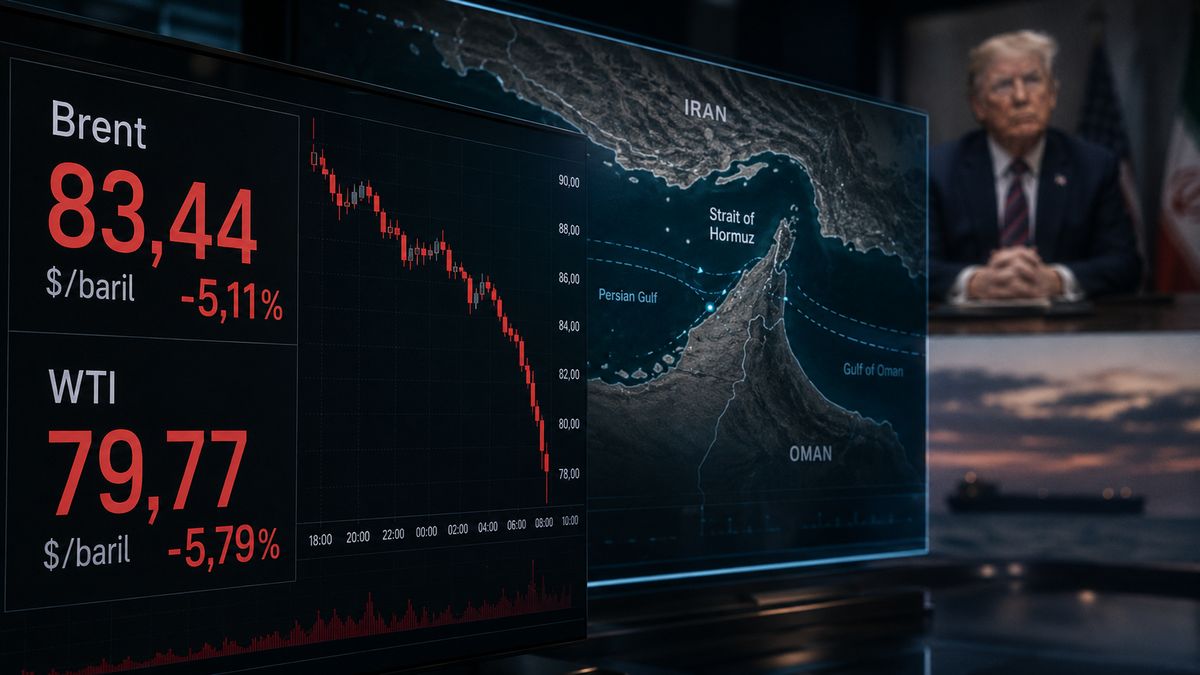
Oil prices fell by more than 5% on Monday morning, August 3, after US President Donald Trump announced that negotiations with Iran would begin in the afternoon, without setting a deadline for reaching an agreement. At 04:08 GMT, Brent crude futures were down $4.49, or 5.11%, at $83.44 a barrel, while West Texas Intermediate shed $4.90, or 5.79%, to trade at $79.77 a barrel. The move marks a rapid shift in investor sentiment following a July in which both oil benchmarks surged by over 20%, fueled by renewed confrontations between the United States and Iran and attacks on vessels in the Gulf region. However, prices are not reacting to an actual reopening of the Strait of Hormuz, but rather to the increased probability that negotiations will lead to de-escalation and a broader resumption of energy transit. Negotiations scheduled, but no deadline set Trump told reporters upon his return to Washington that negotiations with Iran would begin Monday afternoon. He did not specify where the talks would take place or who would participate, and avoided setting a deadline for Tehran to accept a deal. The announcement advances diplomatic developments that began over the weekend. On Saturday, Trump announced the suspension of a planned US strike on Iran, stating that Tehran and other Middle Eastern nations had requested time to finalize an agreement. In the US president's words, this deal should lead to the "immediate, complete, and total" reopening of the Strait of Hormuz and resolve the dispute over Iran's nuclear program. NRG-IA has separately analyzed this shift in direction and the conditions under which Washington temporarily pivoted from a military option to negotiations. Monday's new development is the market's sharp reaction and the emergence of a concrete timeline for talks. However, a deal is not yet confirmed, and the parameters that Washington and Tehran attribute to the future agreement are not yet aligned. Iranian Foreign Ministry spokesperson Esmaeil Baghaei stated that Iran's talks with Oman concern establishing a new route through the strait, separating these negotiations from the issue of opening or closing Hormuz. Meanwhile, Iranian Foreign Minister Abbas Araqchi held talks with officials from Saudi Arabia and Pakistan regarding diplomatic efforts. The difference in phrasing matters: Washington speaks of a complete reopening of the strait, while Iranian public statements describe negotiations over navigation mechanisms and routes. A convergence of these positions has yet to be confirmed. Oil prices price in de-escalation ahead of physical flows The price reaction shows that the market has quickly shed some of the geopolitical premium built into oil prices. However, there is no comparable movement yet in physical transit through the Strait of Hormuz. Kpler data cited by Reuters shows that the number of commercial vessels transiting the strait fell to 10 on Saturday , down from 19 on Friday , which had marked the highest daily total since mid-July. Some vessels may sail with their Automatic Identification Systems (AIS) turned off and therefore cannot be immediately tracked, but available data continues to indicate traffic well below the route's normal operations. On Sunday, Kpler identified the transit of a vessel carrying liquefied petroleum gas loaded in Iran. However, these isolated transits do not equate to the restoration of a normal and predictable flow for commercial shippers. Prior to the hostilities, approximately one-fifth of global crude oil and liquefied natural gas flows passed through Hormuz, making maritime safety a direct driver for global energy markets. Three attacks reported since Saturday keep maritime risk high While oil prices fall on the prospect of negotiations, the security situation has not normalized. United Kingdom Maritime Trade Operations (UKMTO) has reported three attacks on tankers since Saturday. Two of the incidents were already known over the weekend and were included in the NRG-IA analysis published on August 2: in one case, a tanker was struck by an unknown projectile, damaging its engine room; in another, a vessel's master reported an explosion and water impact in close proximity, with no confirmed damage. However, the updated tally shows that the diplomatic signal has not yet been followed by a cessation of maritime incidents. For shipowners, operators, and insurers, risk is not determined solely by the existence of talks, but by the actual ability to transit the area under predictable and safe conditions. An incident involving an LNG carrier extends the stakes beyond oil Pressure on shipping is not limited to oil tankers. GasLog confirmed on Monday that the liquefied natural gas carrier GasLog Shanghai is stable and all crew members are safe following an incident on July 31 as the vessel was exiting the Strait of Hormuz. GasLog did not specify the nature of the incident or whether the vessel or cargo sustained damage. Consequently, there is no basis to claim that…