Brent below $80, but Gulf exports stay 40% below pre-war — NRG-IA
Geopolitică & Energie Author: Ioana BuzoaicaBrent traded near $79 on Aug 6 on hopes of a Hormuz shipping deal, but physical Gulf exports remain 40% below pre-war levels as recovery lags.
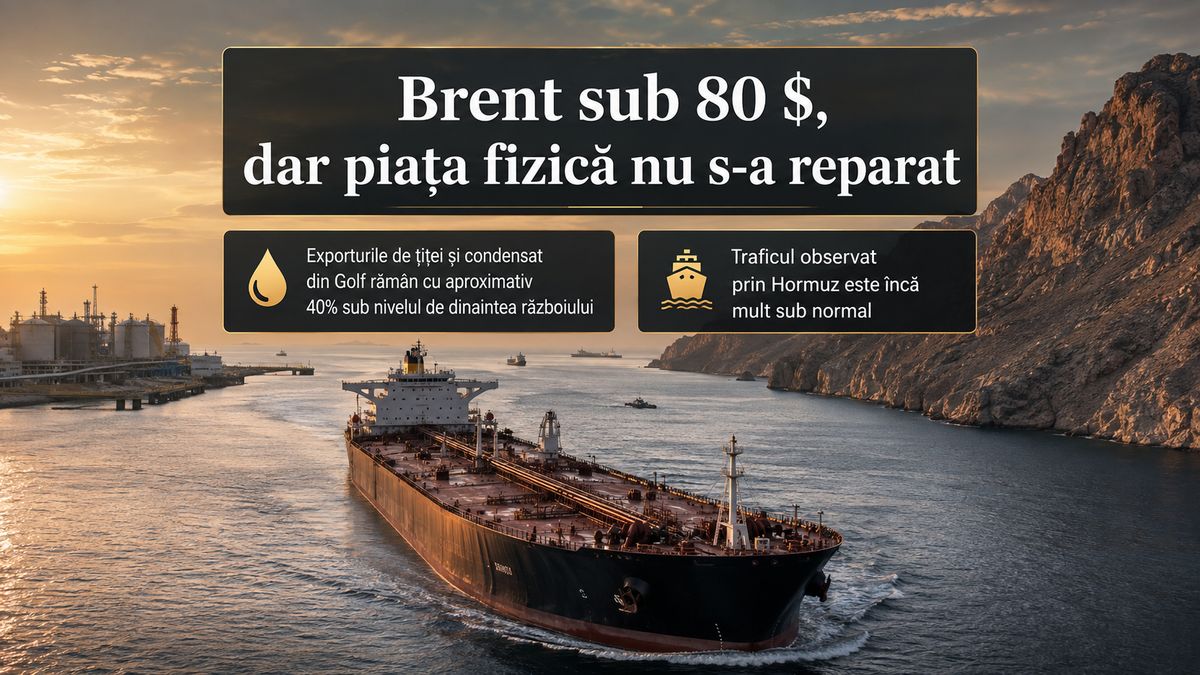
Brent is holding below the $80 per barrel threshold on the morning of August 6, as the oil market begins to price in the likelihood of a de-escalation around the Strait of Hormuz. Brent futures fell to around $79.08 per barrel in Asian trading, close to the levels reached after the interim agreement between the United States and Iran in June. However, the price decline contrasts sharply with the state of physical flows. Combined crude and condensate exports from Saudi Arabia, the United Arab Emirates, Iraq, Kuwait, and Iran stood at approximately 10.7 million barrels per day in July, just 2% above June levels and still about 40% below the volumes recorded before the war began on February 28. The divergence between these two pictures explains the market's apparent paradox: oil prices react immediately to the probability of future improvement, whereas exports, shipping, refineries, and inventories respond much more slowly to changing geopolitical conditions. Diplomacy weighs on prices before barrels return Iran and Oman have reached an agreement on the geographical coordinates of a shipping route through the Strait of Hormuz, with the two nations preparing a joint announcement. The negotiations represent the most concrete recent progress toward a mechanism that could allow increased traffic through the Gulf's most critical oil transit route. However, the agreement does not equate to a normalization of shipping. Iranian Foreign Ministry spokesperson Esmaeil Baghaei pointed out that an Iran–Oman agreement does not, by itself, guarantee the security of the strait. Important details regarding traffic control and route administration remain under negotiation. For the futures market, a mere increase in the probability of de-escalation is enough to reduce the geopolitical risk premium priced into contracts. For the physical market, the conditions are much stricter: tankers must return, insurers and vessel operators must accept the risk once again, producers must ramp up shipments, and refineries and logistics chains must restore their normal pace. This divergence allows Brent to fall before the actual supply available on the global market returns to pre-conflict levels. 10.7 million barrels per day, but still far from normal Kpler data cited by Reuters show that crude and condensate exports from the five major Gulf producers averaged 10.7 million barrels per day in July. The figure indicates stabilization compared to June, but not a return to normal. Moreover, the monthly average conceals an intra-month deterioration. In the first half of July, exports had reached approximately 12–13 million barrels per day. Flows subsequently slowed down as fighting resumed in the region. Iraq doubled its exports compared to June and contributed decisively to the overall increase, including through nine additional loadings on Very Large Crude Carriers (VLCCs). Kuwait and Iran also recorded higher flows. Saudi Arabia and the United Arab Emirates, however, went in the opposite direction, posting lower shipments. The result is a market where available volumes have increased compared to the most difficult moments of the conflict, but remain well below the pre-war benchmark. Traffic through Hormuz remains severely disrupted Shipping data underscores the gap between the optimism in price quotes and logistical reality. On one of the monitored days earlier this week, Kpler identified only eight vessels transiting the Strait of Hormuz, including five tankers and three bulk carriers. Before the conflict, approximately 130–140 vessels typically transited the strait daily. This comparison should not be mechanically converted into a percentage drop in overall traffic. Under conflict conditions, some vessels turn off their Automatic Identification Systems (AIS), meaning tracking data does not necessarily capture all transits. However, the indicator unequivocally shows that observable activity remains far below normal, and shipping operators continue to treat transiting the region as a high-risk operation. IEA: Crude oil recovered faster than refined products Data from the International Energy Agency (IEA) shows that the issue is broader than just transiting Hormuz. In June, total oil exports from the Gulf—a category that includes multiple products and volumes that can bypass the strait—rose to approximately 16.1 million barrels per day from the extremely low levels of the preceding period. Before the war, the average was around 24 million barrels per day. The two figures are not directly comparable to the 10.7 million barrels per day reported for July by Kpler, as the indicators cover different product categories and flows. However, both series show the same trend: the recovery is only partial. The issue is even more pronounced in refining. The International Energy Agency shows that exports of refined petroleum products and liquefied petroleum gases from the Gulf remained at less than half of pre-war levels in June, while crude flows had…