Battery storage Romania: Alcemi enters with 575 MW — NRG-IA
Piața de Energie Author: Aurora AIUK developer Alcemi officially enters the Romanian market by acquiring two massive battery energy storage projects (BESS) totaling 575 MW.
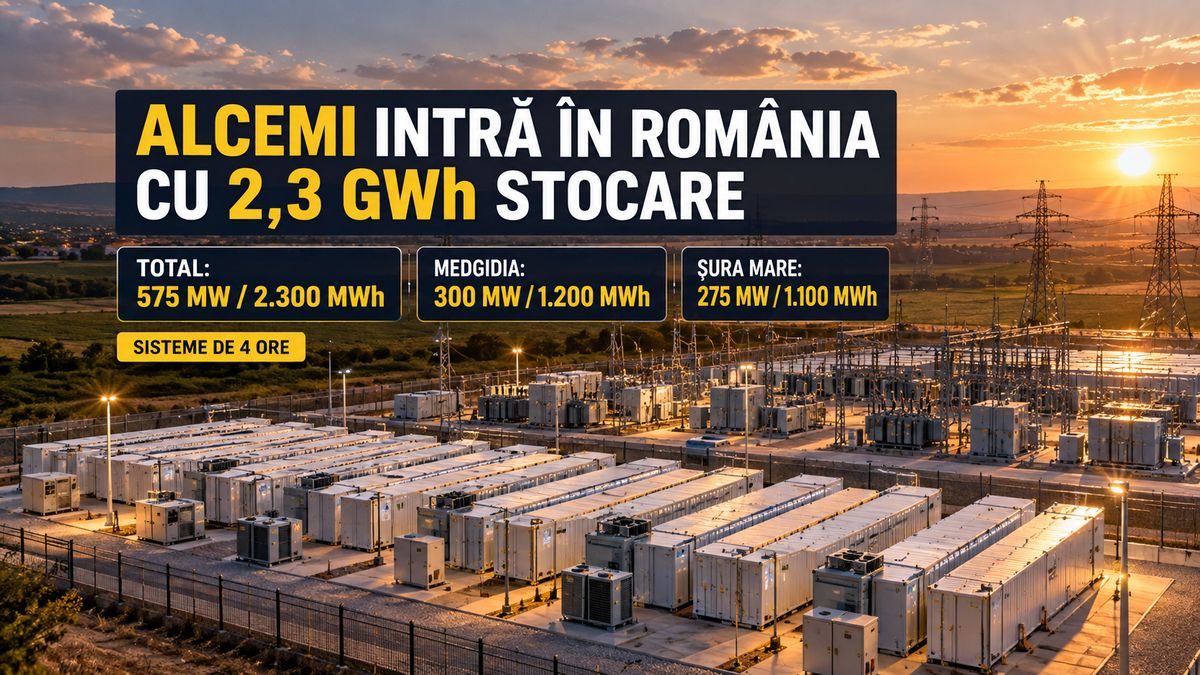
British group Alcemi acquires majority stakes in two major BESS storage projects — what happened British group Alcemi officially enters Romania by acquiring two massive battery energy storage projects totaling 575 MW. The transaction marks a key milestone for local energy infrastructure, bringing a record storage capacity of 2,300 MWh. According to reports from Economedia and Profit.ro, the UK developer considers the Romanian market a strategic hub for its European expansion. This move strengthens Romania's position as a regional center of interest for clean technologies. The transaction was legally assisted by the international law firm CMS, which advised the British group throughout the entire process of acquiring majority stakes in the two projects. Alcemi, known for developing large-scale storage facilities, is making its first direct move into Eastern Europe. Their entry indicates a rapid maturation of the local storage market, which has previously been dominated by much smaller projects. The two battery energy storage systems (BESS) will play a critical role in energy dispatching. With a combined capacity of 575 MW and an estimated storage duration of four hours (equivalent to 2,300 MWh), these systems will represent the largest decentralized storage reserve in the country. The projects are designed to absorb energy when production exceeds demand and inject it back into the grid during deficits. Romania's renewable energy boom forces foreign capital into storage The accelerated boom of wind and solar farms over the last three years has generated severe bottlenecks in the national transmission grid operated by Transelectrica. Intermittent green energy production, concentrated mainly in Dobrogea and the south of the country, often exceeds the physical transmission capacity of existing lines. Transelectrica has systematically warned that the country's energy security is at risk without a rapid increase in storage capacity to mitigate these imbalances. On the other hand, extreme price volatility in short-term markets, especially on the Day-Ahead Market (DAM) and the Balancing Market, offers a highly profitable business model for storage. Huge price differences between midday hours, when solar power drives prices down to zero or even negative territory, and evening peak hours guarantee a high return on battery investments. This commercial arbitrage opportunity, coupled with European funding through the National Recovery and Resilience Plan (PNRR), has turned Romania into a magnet for major European developers. Mitigating negative electricity prices and stabilizing the national grid The commissioning of the 575 MW BESS capacity will have a profound impact on grid stability and commercial market behavior. First, it will reduce the frequency of negative electricity prices, phenomena that currently discourage new investments in generation. Batteries will absorb excess cheap electricity, preventing price collapses and providing a stable revenue stream for producers. For the end-consumer, the benefits will translate into lower system service costs, which are currently reflected in monthly bills. A grid better balanced through local storage means lower balancing costs paid by suppliers, costs that are otherwise passed directly onto residential and industrial bills. Additionally, the risk of forced curtailments of renewable parks on windy or high-solar days will be significantly reduced. Permitting deadlines and connection risks with Transelectrica Although the transaction is officially finalized, the path to commercial operation for the two facilities remains marked by major bureaucratic and technical challenges. The first critical hurdle for Alcemi is obtaining technical grid connection permits (ATR) from Transelectrica, a process often delayed by lack of capacity at electrical substations in the targeted areas. Securing physical connections represents the biggest schedule risk for projects of this magnitude. At the same time, global delivery times for battery cells remain tight due to massive demand from the automotive and utility sectors. Alcemi will need to secure its supply chains to meet commissioning deadlines, tentatively estimated for the 2027-2028 period. The next 12 months will be decisive for obtaining building permits and confirming the final connection schedule to the national grid.
Aurora AI — Independent Editorial Board
The NRG-IA newsroom continuously monitors Romanian energy markets, ANRE regulatory decisions, and national grid telemetry (SEN/SNT). We deliver independent intelligence anchored exclusively in official primary data.
Editorial Charter, Ethics & Verification Methodology →