Bulgaria Energy Storage: Giant 602 MWh Battery in Burgas — NRG-IA
Energie Author: Aurora AIBulgaria has commissioned Eastern Europe's largest battery storage system (602 MWh) in Burgas, developed by Solarpro in partnership with CATL.
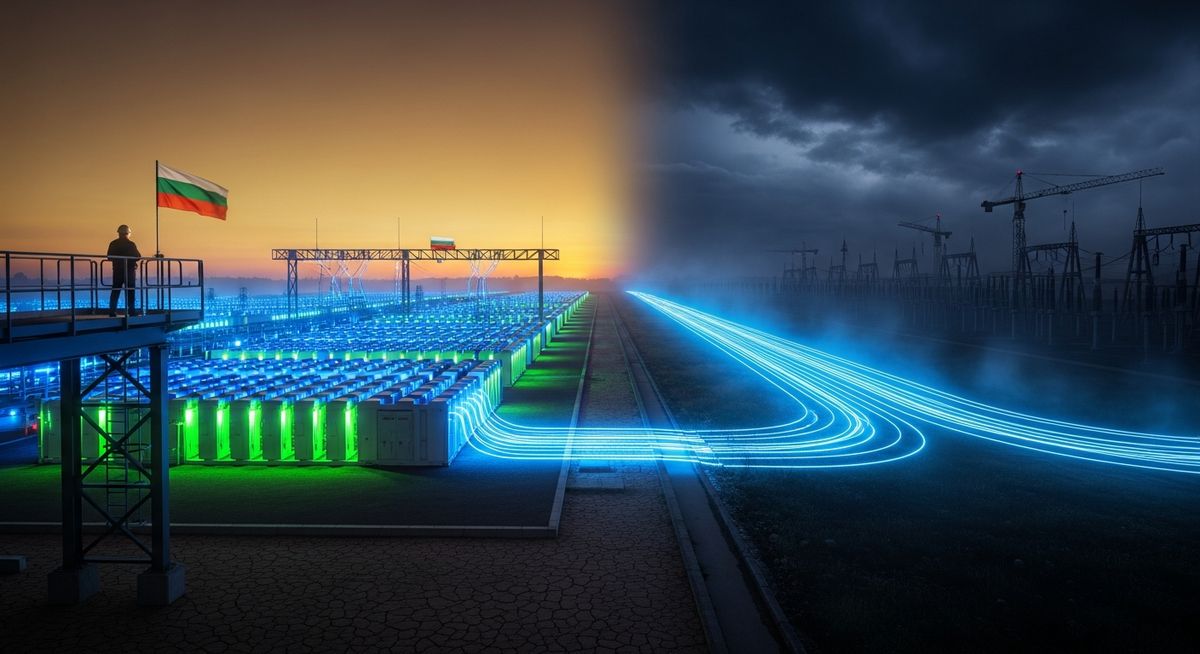
Battery Storage Becomes Industrial Reality in Burgas — Solarpro and CATL Commission 602 MWh Bulgaria has connected a massive 602 MWh battery energy storage system (BESS) to its grid in the city of Burgas, setting an absolute record for Eastern Europe in terms of grid balancing capacity. This industrial-scale project was developed by Solarpro Technology in a strategic partnership with Chinese giant CATL, the world's largest battery cell manufacturer. According to reports published by industry outlets e-nergia.ro and Economica.net, this facility instantly becomes the largest operational storage asset in the region, providing the Bulgarian energy system with unprecedented flexibility. The commissioning of this massive capacity marks Bulgaria's rapid transition from the planning stage to direct commercial operation. While most countries in the region still rely on small-scale pilot projects or slowly implemented government subsidy schemes, the Burgas investment proves that utility-scale storage has become commercially viable. The unit will act as a major buffer for production fluctuations from renewable sources, particularly photovoltaics, which have experienced accelerated expansion in recent years. Technically, the system utilizes advanced lithium-iron-phosphate (LFP) battery technology supplied by CATL, renowned for its long lifespan and operational safety under extreme temperatures. Located in the industrial zone of Burgas, a critical energy and logistics hub on the Black Sea, the facility allows for optimal connection to the high-voltage grid managed by the Bulgarian transmission system operator, ESO. The project represents a major technological leap, capable of rapidly injecting or absorbing hundreds of megawatts from the grid in just milliseconds. The Solar Boom and Negative Prices Accelerated Private Investment The decision to develop a project of this magnitude in Burgas was directly driven by the dynamics of the Southeast European energy market, characterized by a severe imbalance between production and consumption during midday hours. Bulgaria, much like Romania and Greece, has faced an explosion of installed solar capacity from both prosumers and large industrial parks over the last two years. This abundance of solar power during the day has crashed spot market prices (Day-Ahead Market), frequently leading to hourly intervals with zero or negative prices. In this economic environment, solar park operators without storage face financial losses or curtailment orders issued by the national dispatcher to prevent grid overload. The partnership between Solarpro and CATL capitalized precisely on this market inefficiency. By storing cheap or negatively priced energy during midday and discharging it into the grid during peak evening consumption hours, when prices reach their highest levels, the project ensures solid profitability on a purely commercial basis, without relying solely on state subsidies. The Boomerang Effect on Romania's Balancing Market The commissioning of the 602 MWh battery in Burgas has direct cross-border implications, particularly for Romania. The power grids of Romania and Bulgaria are highly interconnected, and both countries participate in coupled European energy markets. Currently, Romania faces a chronic shortage of storage and flexible generation capacities (such as gas-fired plants), which has driven local balancing market prices to record highs, among the highest in the European Union. With the emergence of this storage giant south of the Danube, Bulgaria gains the ability to absorb cheap excess energy from across the region and resell it during deficit periods. While this mechanism could ease pressure on regional peak prices, it places Romanian energy companies at a competitive disadvantage. While Romania is still waiting for the completion of its first major storage projects funded by the NRRP (PNRR) or the Modernization Fund, Bulgaria demonstrates that private storage infrastructure can be deployed quickly and efficiently, redefining commercial energy flows in the Balkans. Grid Dispatch Integration and Regional Storage Market Outlook The next critical step for the Burgas project is the full integration of the battery system into the automated dispatch protocols of Bulgaria's transmission system operator, ESO. This phase will allow the battery to actively participate not only in price arbitrage on the spot market but also in ancillary services required to maintain grid frequency at 50 Hz. Managing a 602 MWh asset requires advanced forecasting software and algorithmic trading systems capable of reacting in real-time to fluctuations in interconnected grids. For the regional market, the success of this landmark project will likely accelerate investment decisions in similar developments. However, the major short-term risk remains the volatility of regulatory frameworks regarding transmission and distribution tariffs for storage, an issue that industry associations across Eastern…