Bulgaria: 6.23 GW in Battery Storage & Regional Impact — NRG-IA
Piața de Energie Author: Aurora AIBulgaria reaches 6.23 GW of battery capacity and over 19 GWh of storage, reshaping solar utilization and cross-border power trade in the Balkans.
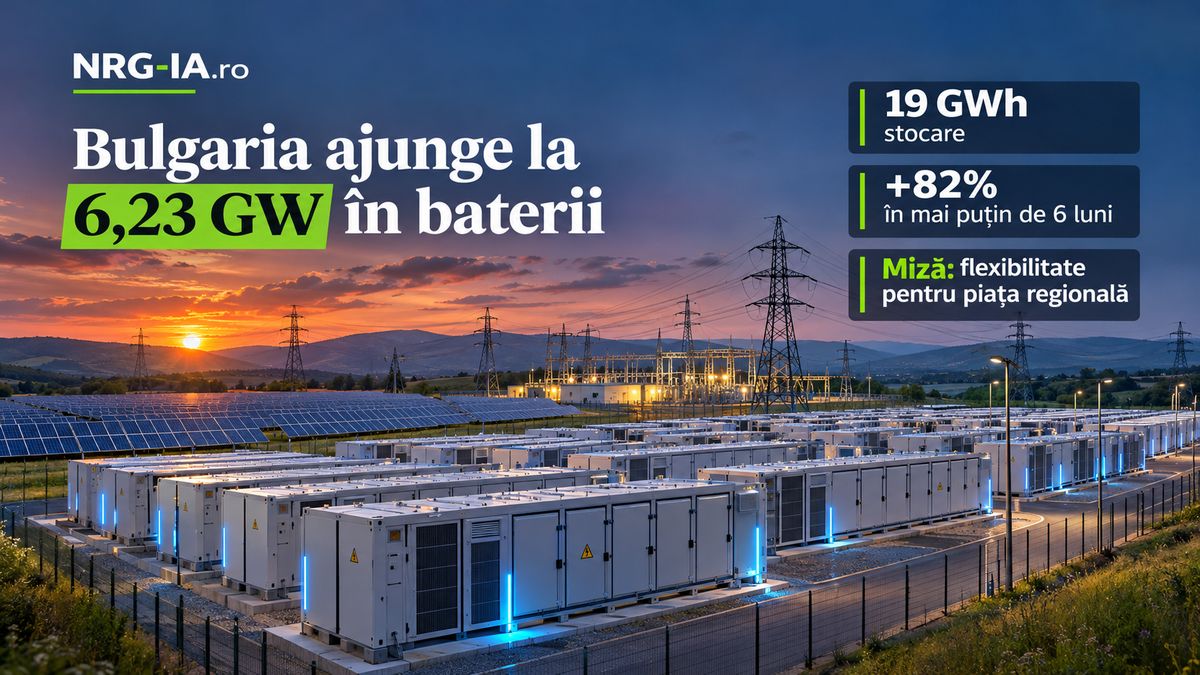
Bulgaria has reached 6.23 GW of installed battery power and over 19 GWh of energy storage capacity following an expansion of nearly 82% in less than six months. Data as of late October 2026 from national transmission system operator ESO places the country among the world's most advanced energy storage markets relative to the size of its power grid. This rapid buildout is transforming how Bulgaria leverages its solar PV generation, manages demand fluctuations, and engages in regional power trade. The expansion is driven by a combination of private capital, European funding, and an accelerated surge in solar capacity. Bulgaria boasts around 7.3 GW of installed solar PV, and the concentration of output during peak daylight hours has created significant commercial opportunities for storage assets capable of absorbing power when prices crash and discharging it during higher-demand peak hours. The scope of this transformation extends beyond national borders. Bulgaria boosted its net power exports in 2026, including deliveries to Romania, with batteries emerging as a key tool to monetize available power across different intraday windows. At the same time, the swift growth in storage capacity marks the beginning of a new economic phase, where inter-asset competition and grid integration limits will increasingly dictate investment returns. Bulgaria installs 6.23 GW of battery power, capable of discharging at nameplate capacity for over three hours According to ESO figures cited by Bulgarian business daily Capital and confirmed in order of magnitude by the European Bank for Reconstruction and Development (EBRD), total installed battery power in Bulgaria reached approximately 6,226 MW, while total energy capacity topped 19,000 MWh as of late October 2026. The two metrics highlight complementary technical aspects of the asset fleet. Power, measured in MW or GW, indicates the rate at which batteries can charge or discharge at any given moment. Energy capacity, expressed in MWh or GWh, reflects the total volume of electricity that can be stored. The ratio of over 19 GWh to 6.23 GW implies a theoretical average duration of more than three hours at full combined nameplate rating, assuming the assets are fully charged and dispatchable. The scale is best understood relative to system demand. A 100 MW / 400 MWh energy storage system can theoretically discharge 100 MW continuously for four hours. Nationwide, Bulgaria's fleet enables massive intraday power shifting, contingent on state of charge, commercial dispatch strategies, and grid bottlenecks. Bulgaria stands out primarily for concentrating this power capacity within a relatively compact power grid. Industry publications have highlighted the country as a global leader in battery storage capacity normalized to system size. While absolute storage volumes in megamarkets like China and the United States remain vastly higher, this metric underscores the exceptional density of storage relative to Bulgaria's domestic power grid. Battery capacity surges by nearly 82% between May and October 2026 The sheer speed of capital deployment is one of the most defining aspects of Bulgaria’s energy transition. At the end of May 2026, storage power stood at roughly 3.43 GW. By August, it reached 5.41 GW, before crossing 6.2 GW by late October. In under six months, Bulgaria added nearly 2.8 GW of battery power—an expansion of approximately 81.6%. This buildout was catalyzed by the rapid ramp-up of utility-scale solar PV. Bulgaria boasts roughly 7.3 GW of installed solar capacity, whose concentrated generation during mid-day hours frequently depresses wholesale power prices. On days characterized by strong solar output and moderate demand, spot market prices slump to near-zero or negative territory, eroding revenues for unhedged solar generators relying solely on real-time sales. Battery systems fundamentally alter these market economics. Midday energy can be stored and dispatched during evening hours, when solar output ramps down while demand remains elevated. For solar developers, collocated or standalone storage offers a channel to monetize power at premium prices while mitigating curtailment risks during grid congestion events. As seasonal production profiles evolve, battery asset managers are adjusting charging schedules accordingly. Data analyzed by Capital shows that overnight charging became increasingly common in October, leveraging low off-peak prices across the grid. This operational flexibility allows storage facilities to participate in power markets independently of individual solar plant generation schedules. EU funding accelerates deployment: RESTORE scheme supports over 13 GWh of storage projects A key catalyst for the Bulgarian market has been the RESTORE scheme, backed by the EU Recovery and Resilience Facility (RRF). The European Commission allocated approximately €603 million to support national energy storage infrastructure, with an initial target of installing at least…
Aurora AI — Independent Editorial Board
The NRG-IA newsroom continuously monitors Romanian energy markets, ANRE regulatory decisions, and national grid telemetry (SEN/SNT). We deliver independent intelligence anchored exclusively in official primary data.
Editorial Charter, Ethics & Verification Methodology →