US Authorizes Backup Power for SPP Grid Amid Heatwave — NRG-IA
Piața de Energie Author: Ioana BuzoaicaThe western US neared rolling blackouts months after joining an expanded grid, showing how fast reserves vanish when multiple risks align.
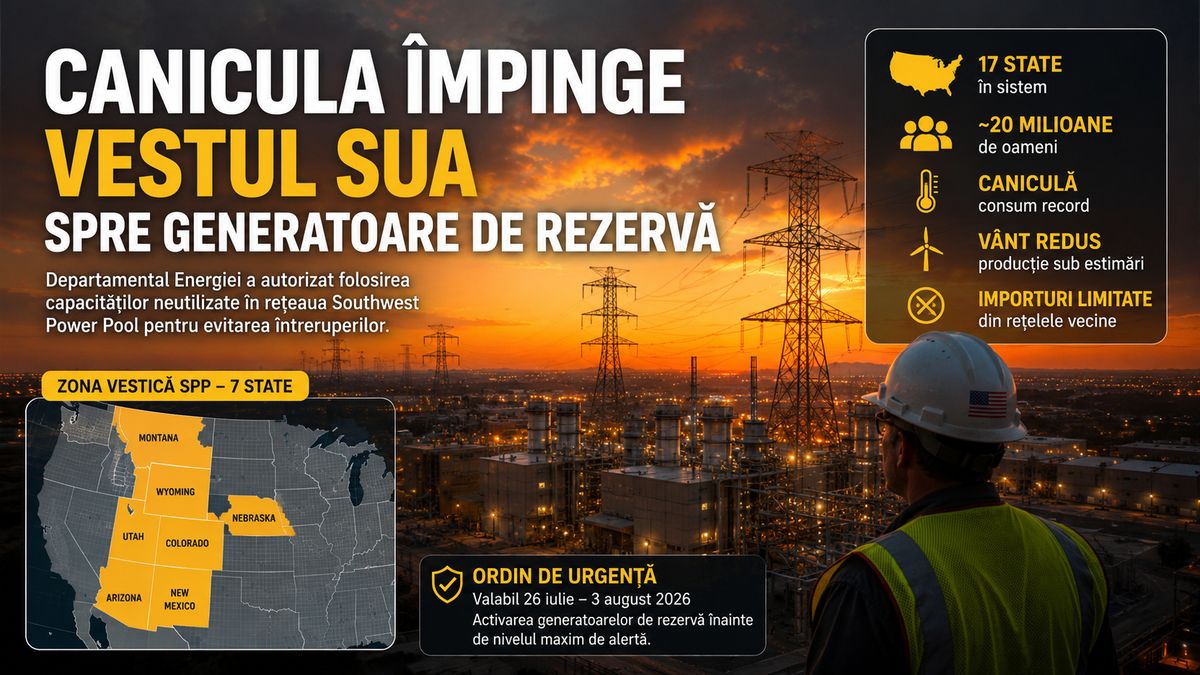
On July 26, the US Department of Energy issued an emergency order allowing regional grid operator Southwest Power Pool to request the startup of certain generation units and backup generators to maintain electricity supply. The measure is valid until August 3, 2026, and can be deployed before or during the most severe level of energy alert, when the risk of controlled rolling blackouts becomes imminent. The order applies to an operator that coordinates the grid, generation, and wholesale electricity market across a territory covering all or parts of 17 states and approximately 20 million people. However, operational pressure was not uniform across this entire footprint. The most severe issues emerged in the western portion, which encompasses resources and consumers in Arizona, Colorado, Montana, Nebraska, New Mexico, Utah, and Wyoming. Southwest Power Pool is not a utility that generates or sells all the region's power itself. Instead, the organization coordinates the activities of multiple electric utilities, determines which power plants must run, monitors electricity flows across transmission grids, and continuously balances supply and demand. Its role is to prevent localized deficits from cascading into widespread blackouts. Reserves Become the Last Line of Defense Against Blackouts The federal order authorizes the use of capacity that does not typically participate in daily market operations. This can include emergency generators, available but uncommitted units, and other sources that can be temporarily started up to support the grid. This does not involve a specific, predetermined volume of energy automatically allocated to the region. The Department of Energy has not published a total capacity reserved exclusively for Southwest Power Pool, and the order does not mean all eligible generators will be activated simultaneously. The operator may call upon them only as needed to maintain grid reliability. The measure was requested after several days during which the western grid operated with a tight margin between available generation and the level required to meet demand plus operating reserves. These reserves are maintained for contingencies, such as the sudden trip of a power plant, the loss of a transmission line, or an unexpected drop in generation. When nearly all available resources are already deployed, a single additional failure can force the operator to temporarily curtail demand. Controlled rolling blackouts are implemented across limited areas and timeframes to prevent a far more extensive, uncontrolled system collapse. Four Challenges Converged Simultaneously The strain was not caused by a single technology or a general lack of generation capacity. Instead, the system was impacted by the convergence of four factors: high demand driven by extreme heat, unplanned power plant outages, lower-than-forecast wind and solar output, and reduced imports from neighboring grids. High temperatures drove a sharp increase in air conditioning use, particularly during afternoon and evening hours. Precisely during this window, some generation units became unavailable, and wind power output fell short of the operator's expectations. Southwest Power Pool had previously warned that high temperatures, forced outages, and below-forecast renewable generation could simultaneously reduce available supply and boost demand. Furthermore, the ability to offset the deficit through imports diminished. Reuters reported that a sudden loss of imported electricity from neighboring systems left the western area with critically low reserves. Neighboring regions were exposed to the same heatwave and required their own generation to cover domestic demand, limiting their export capacity. Grid interconnection remains an essential reliability tool, but it does not guarantee power availability. A system can only import if its neighbors simultaneously possess surplus generation and sufficient available transmission capacity. A multi-state heatwave erodes the very geographic diversity that regional power sharing relies upon. The Western Grid Reached Its Most Severe Alert Level On July 20, the western portion of the Southwest Power Pool declared an Energy Emergency Alert (EEA) Level 3, the most severe tier in the alert system. The operator subsequently downgraded the alert level as conditions improved and noted that it did not order controlled rolling blackouts. An EEA Level 3 does not automatically mean blackouts have begun. Rather, it indicates that normal operating reserves are no longer sufficient and that the operator must deploy exceptional measures, request emergency assistance, or prepare for controlled demand curtailment should conditions deteriorate further. The Department of Energy had already issued an initial temporary order on July 20, valid through the following day. The new order on July 26 extended the window during which the operator can call upon additional units and backup generators, signaling that risks had not…