Heatwave cuts power to 120,000 French homes: RTE incident — NRG-IA
Geopolitică & Energie Author: Ioana BuzoaicaA major outage in Finistère, France, highlights local grid vulnerability during extreme heatwaves, despite adequate national power supply.
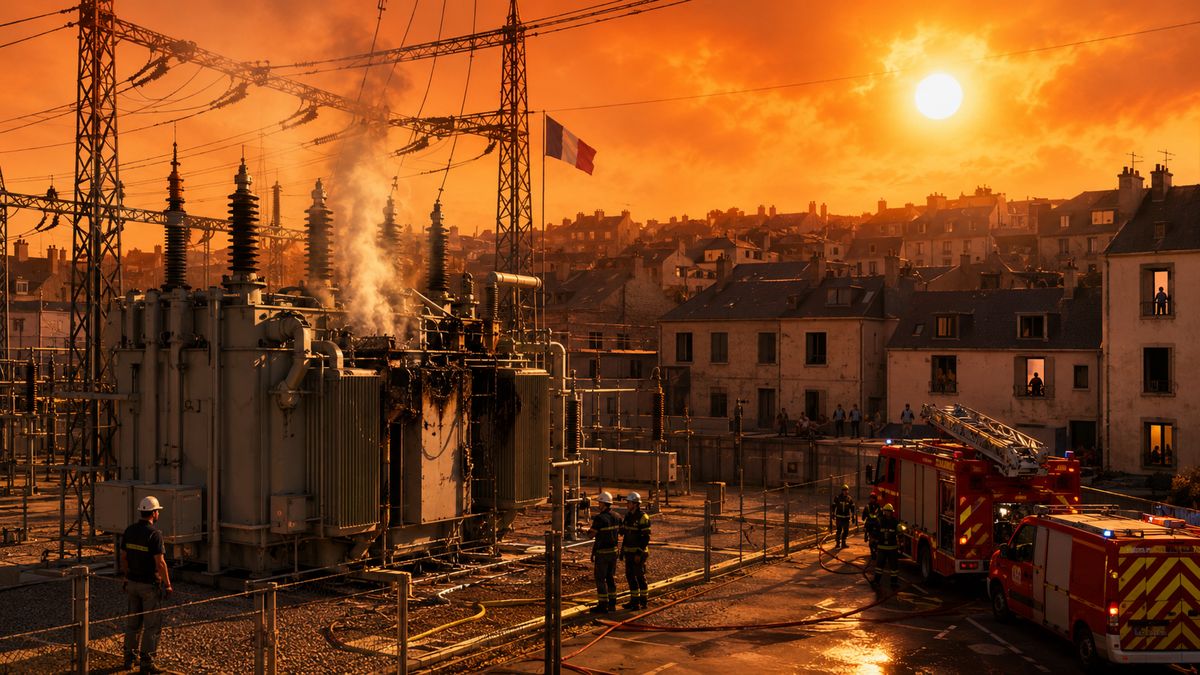
The heatwave that pushed France toward its hottest day on record also delivered a real-world test for its power infrastructure. On the evening of June 23, an accidental incident at a transformer operated by RTE in Ergué-Gabéric, near Quimper, triggered a major blackout in the southern Finistère department. At its peak, up to 120,000 households were affected, with approximately 68,000 still without electricity on the morning of June 24. The figure of 50,000 homes without power, cited in initial reports, only partially describes the unfolding incident. Updated data reveals three distinct phases: up to 120,000 households affected at the peak, around 68,000 without power on Wednesday morning, and approximately 15,000 still disconnected at 7:00 PM. These figures do not contradict each other; rather, they reflect the actual pace of power restoration. The Finistère Prefecture attributed the incident to accidental causes linked to extreme temperatures. The area was under a red heatwave alert, prompting authorities to activate a crisis unit, establish a 150-meter security perimeter around the facility, and preemptively evacuate nine homes. Hospitals, nursing homes, and other sensitive consumers were prioritized for reconnection, including through the deployment of backup generators. A transmission transformer can cut off power to an entire region The incident did not occur on the local low-voltage grid, but rather at a facility owned by RTE, the operator of the French high- and extra-high-voltage transmission grid. RTE manages the infrastructure that transports electricity between major generation centers, interconnections, and consumption hubs before it reaches the distribution networks operated by Enedis. Consequently, a failure at a transmission node transformer can have far more widespread consequences than a local neighborhood distribution outage. Power may be available at the national level, power plants may be running, and the overall supply-demand balance may remain stable. However, if the infrastructure delivering electricity to a specific area is compromised, households, businesses, public services, and local communications can still be left in the dark. In Finistère, the heat dome simultaneously strained two components of the system: physical infrastructure and demand. High temperatures drive up cooling needs, particularly through air conditioning, fans, commercial refrigeration, and industrial facilities. At the same time, grid equipment operates with tighter thermal margins, and maintenance interventions become more challenging precisely when demand peaks. France had sufficient power nationally, but lacked local resilience Just two days before the incident, RTE stated that the heatwave posed no particular threat to national security of electricity supply. This assessment is not automatically contradicted by the Finistère outage, as the two scenarios measure different metrics. Security of supply addresses whether France, on an aggregate level, has sufficient generation, imports, and reserves to cover demand. Local resilience answers a different question: whether the grid in a specific territory can deliver electricity to consumers under extreme temperatures, wildfires, storms, floods, or technical failures. The Finistère outage demonstrates that a country can possess a power system large enough to avoid national deficits while remaining vulnerable at local nodes characterized by high demand concentration and limited redundancy. For the consumer, this distinction is irrelevant during a blackout: power may exist in the system, but it fails to reach the outlet. Heatwave also reduced French nuclear output by 4.1 GW The failure in Finistère was not the only energy impact of the extreme heat. On the same day, France's nuclear generation was curtailed by approximately 4.1 GW—equivalent to about 7% of total midday electricity demand—according to EDF data cited by Reuters. The Golfech 2 reactor was shut down, while the Saint-Alban 2, Bugey 3, and Nogent 2 reactors reduced output because high temperatures restricted access to cooling water. French regulations require EDF to curtail or shut down reactors when river water temperatures reach thresholds that could harm local ecosystems. France, typically one of Europe's largest electricity exporters, saw its net exports drop to around 3 GW on the afternoon of June 24, down from the 10–12 GW recorded the previous week. Consequently, the heatwave affected not only local supply in Finistère but also the volume of cheap electricity available to neighboring markets. Higher demand, lower nuclear, below-average wind The heatwave exerted three simultaneous pressures on the European electricity market. First, consumption rose due to cooling needs. Second, nuclear generation was temporarily restricted by cooling constraints. Third, wind generation fell below normal levels, increasing reliance on gas-fired power plants during peak hours. Under these conditions, spot prices in…
Ioana Buzoaica — Independent Editorial Board
The NRG-IA newsroom continuously monitors Romanian energy markets, ANRE regulatory decisions, and national grid telemetry (SEN/SNT). We deliver independent intelligence anchored exclusively in official primary data.
Editorial Charter, Ethics & Verification Methodology →