Heatwave cuts French nuclear output by up to 9.4 GW — NRG-IA
Piața de Energie Author: Ioana BuzoaicaA heatwave could cut French nuclear output by 9.4 GW on Aug 14. With Romania and Hungary also affected, cooling water is a key issue for Europe.
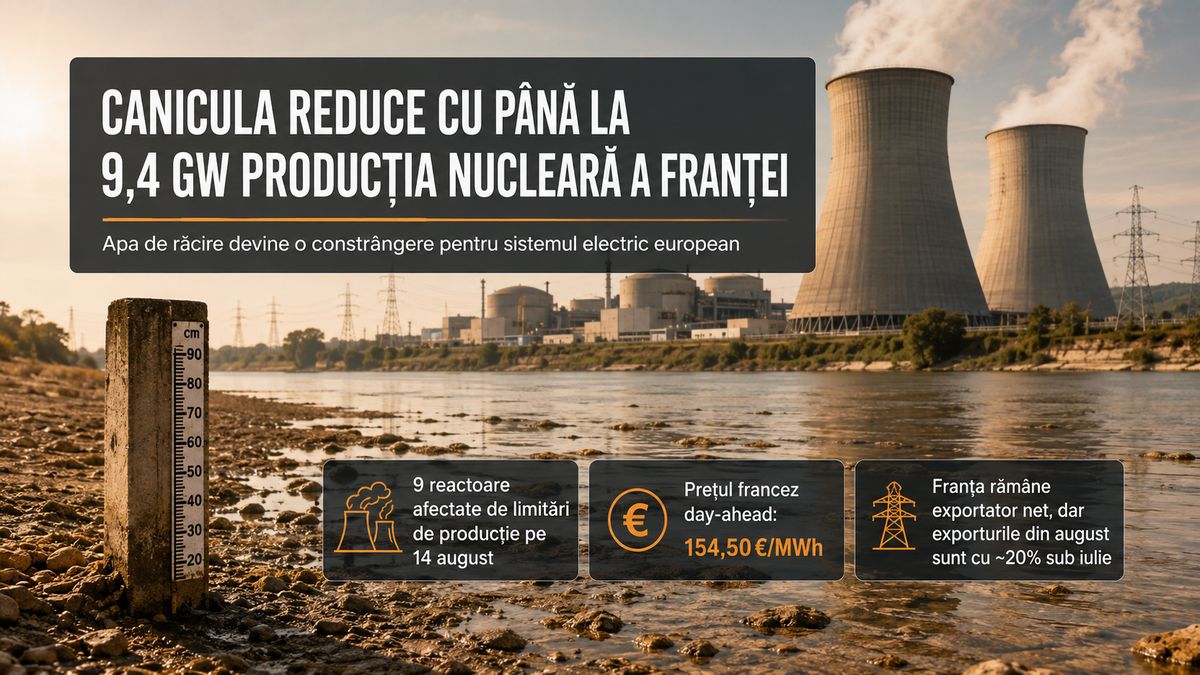
A heatwave could reduce France's nuclear output by up to 9.4 GW at peak times on August 14, according to EDF estimates, in an episode affecting nine reactors and pushing French nuclear fleet availability to its lowest level for August since 2023. In the wholesale market, the French day-ahead contract for Friday delivery rose by 4.4% to €154.50/MWh. The 9.4 GW represents the estimated output limitations associated with heatwave conditions, not France's entire unavailable nuclear capacity. When scheduled maintenance, technical issues, nuclear fuel conservation, and other outages are factored in, LSEG estimates that approximately 27.7 GW of nuclear capacity will be offline on Friday. The distinction is important. France is not facing an electricity shortage and remains a net exporter. The issue is the rapid reduction of a massive generation source precisely at a time when wind power is weak in Western Europe, high temperatures are driving up air conditioning demand, and gas and coal-fired plants are becoming more critical for market balancing. However, the phenomenon has far broader implications than single-day power prices. This summer, France, Romania, and Hungary are facing the same physical constraint, manifested in different ways: nuclear power plants require vast amounts of water for cooling, and the combination of high temperatures and very low river flows can reduce available capacity exactly when the power grid needs stable baseload generation. Nine French Reactors Under Heatwave Pressure The estimated limitations for August 14 are higher than those forecast just a few days earlier. On August 11, the market anticipated mid-week cuts of around 7.3 GW to French nuclear output, equivalent to about 12% of the fleet's capacity. For Friday, EDF's estimate rose to 9.4 GW, or approximately 15%. The heatwave's effects compound other outages. Some units are offline for maintenance or technical issues, while two reactors at Gravelines remain affected by a separate incident caused by jellyfish clogging the water intake systems. Nevertheless, France continues to export significant volumes of electricity. Average net scheduled exports for August stand at around 9.5 GW, but this is about 20% lower than in July. For neighboring markets, the difference matters: less French nuclear power available for export means a larger share of demand must be met by other sources. The situation becomes tighter when nuclear and wind generation weaken simultaneously. This week, German wind output during a critical interval was estimated at just 4.7 GW, roughly 60% below the seasonal average. This has pushed Germany and the UK toward greater reliance on thermal power plants, including gas and coal. For the power market, this combination is enough to quickly shift the marginal price-setting technology. French nuclear can generate massive volumes, and its reduced availability makes room for plants with higher operating costs. The day-ahead price of €154.50/MWh reflects this tightening balance for August 14 delivery, rather than the final price paid by French consumers. Water Becomes the Physical Constraint for Reactors on Hot Days The issue is not the nuclear reaction itself, but the dissipation of the heat generated by the plant. In open-loop cooled plants, the French Nuclear Safety Authority, ASN, indicates that approximately 40–60 cubic meters of water per second may be required for each reactor. Water is drawn from a river or the sea, passes through the cooling systems, and is returned to the environment at a higher temperature. For plants equipped with cooling towers, the required river withdrawal is much lower, in the range of about 2 cubic meters per second per reactor, though some water is lost through evaporation. During heatwaves, these two constraints can converge. River water is already warmer, and drought can reduce its flow. Consequently, the plant has less capacity to discharge heat without exceeding limits established to protect the aquatic ecosystem and manage water resources. If temperature or flow limits risk being exceeded, EDF must curtail output, and in certain situations, the reactor may have to be shut down. However, the causes vary by site. At Golfech, the temperature of the Garonne River led to the shutdown of one unit. At Saint-Alban, a reactor that initially tripped automatically was subsequently kept offline due to the temperature of the Rhône. At Chooz, the constraint is primarily linked to the very low flow of the Meuse River and Franco-Belgian water management obligations. Consequently, the challenge facing French nuclear power this summer is driven by a combination of high river temperatures, low flows, thermal discharge limits, and water resource management obligations. Nine Gigawatts Lost for a Few Hours Can Shift the Entire Market Price On an annual scale, French nuclear generation losses caused by high temperatures and hydrological conditions have historically been low. EDF estimates an average of…
Ioana Buzoaica — Independent Editorial Board
The NRG-IA newsroom continuously monitors Romanian energy markets, ANRE regulatory decisions, and national grid telemetry (SEN/SNT). We deliver independent intelligence anchored exclusively in official primary data.
Editorial Charter, Ethics & Verification Methodology →