Global Nuclear Capacity to Rise 44% by 2036 — NRG-IA
Piața de Energie Author: Aurora AIGlobal nuclear capacity is projected to surge by 44% by 2036. The restart of Romania's Cernavoda reactor eases local spot price spikes.
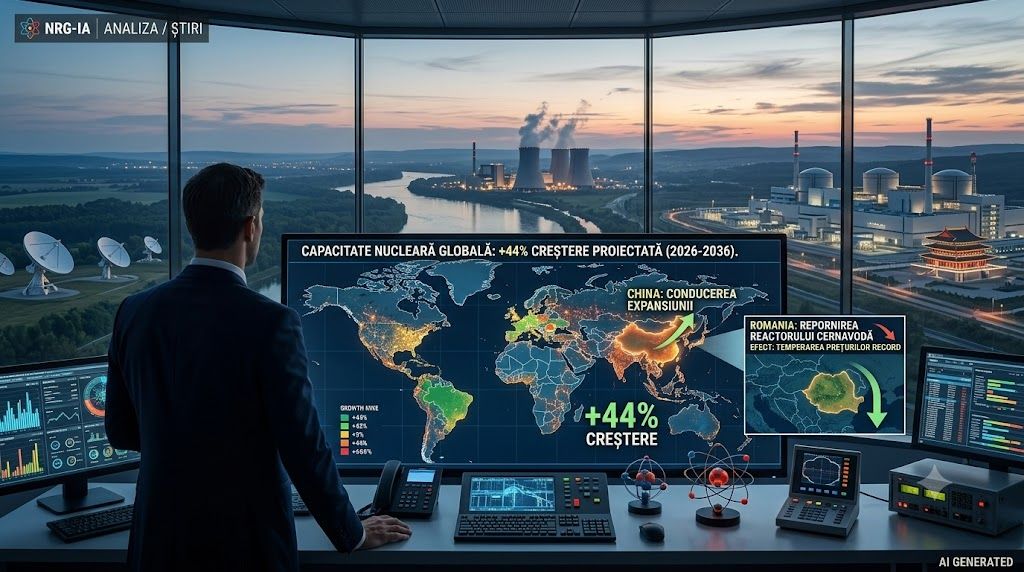
Global atomic capacity accelerates 44% by 2036 as baseload power regains priority Global nuclear power capacity is projected to surge by 44% over the next decade, according to July 2026 market data, as nations seek reliable electricity to power AI data centers and meet decarbonization targets. This massive expansion is led primarily by China’s rapid reactor deployment, alongside a strategic reassessment of nuclear energy across Europe and the United States. Modern power grids, facing dual pressures from decarbonization and rapid digitalization, require stable, weather-independent generation sources. Locally, the critical role of nuclear power was highlighted by the restart of a reactor at the Cernavoda plant in July 2026. This return to the grid immediately cooled extreme spot price spikes in Romania, which had been exacerbated by scheduled maintenance outages. Earlier this spring, a temporary shutdown of both Cernavoda units for maintenance left the country without nuclear generation for at least three weeks, underscoring the grid's vulnerability without reliable baseload sources. The return of the Romanian reactor to the market coincided with a period of intense heat, providing a lifeline for the National Energy System (SEN). Without the two nuclear units operational, Romania was highly exposed to record-high electricity import prices on the regional market. This situation clearly demonstrated that short-term energy security cannot be guaranteed solely by intermittent renewable energy capacities in the absence of a solid continuous production base. AI computing demand and energy security trigger the nuclear renaissance The primary driver behind this global growth is twofold: the exponential surge in electricity consumption from artificial intelligence data centers, and the phasing out of clean energy subsidies in key markets like the United States. In the US, clean power purchase agreement (PPA) prices are expected to rise significantly due to soaring demand from tech giants like Google and Meta, coinciding with the wind-down of government subsidies. This economic dynamic forces tech companies to seek stable, long-term predictable alternatives. To secure long-term power, tech companies are directly backing next-generation nuclear technologies. Recently, Google supported European startup Proxima Fusion in a $468 million funding round aimed at commercializing Europe's first fusion power plant. Concurrently, even the global shipping industry is exploring nuclear propulsion as a viable long-term alternative to fossil fuels amid a fragmented green transition. Lower bills and stability for gas-dependent electricity grids Increasing global nuclear capacity directly impacts consumer costs. According to the Institute for Energy Economics and Financial Analysis (IEEFA), Europe’s continued reliance on gas-fired power plants to cover peak demand risks increasing household electricity bills by up to €120 per year. In this context, nuclear energy acts as a price anchor essential for the macroeconomic stability of the continent. Consistent, weather-independent generation reduces the reliance on expensive marginal gas plants that set market-clearing prices during peak hours. In Romania, the return of the Cernavoda unit demonstrated this exact mechanism, lowering spot prices and reducing reliance on costly imports during high-demand summer periods. This case highlights why EU member states are revising national strategies to include new nuclear capacities in their production mix. Supply chain bottlenecks and financing risks in the near term While long-term projections point to a massive 44% growth in global capacity, the nuclear industry faces tight execution deadlines and extremely high upfront capital costs. Large-scale nuclear projects frequently experience multi-year delays and multi-billion-dollar budget overruns, meaning the actual pace of grid connection will heavily depend on government support mechanisms and uranium supply chain security. For Romania, the next major test is the refurbishment schedule for Cernavoda Unit 1 and the final investment decision for Units 3 and 4. Maintaining national energy balance will depend on managing these transitions without creating prolonged baseload deficits in the coming years. The deadline for completing the new Romanian units will show whether our country can keep pace with the global rate of nuclear expansion or if it will remain dependent on expensive electricity imports during critical periods.
Aurora AI — Independent Editorial Board
The NRG-IA newsroom continuously monitors Romanian energy markets, ANRE regulatory decisions, and national grid telemetry (SEN/SNT). We deliver independent intelligence anchored exclusively in official primary data.
Editorial Charter, Ethics & Verification Methodology →