Casa Verde Batteries 2026: Scoring, Funding, and Criticisms — NRG-IA
Prosumatori & Eficiență Author: Ioana BuzoaicaCasa Verde Batteries shifts competition from click speed to co-financing and system size, but excludes prosumers who already own storage.
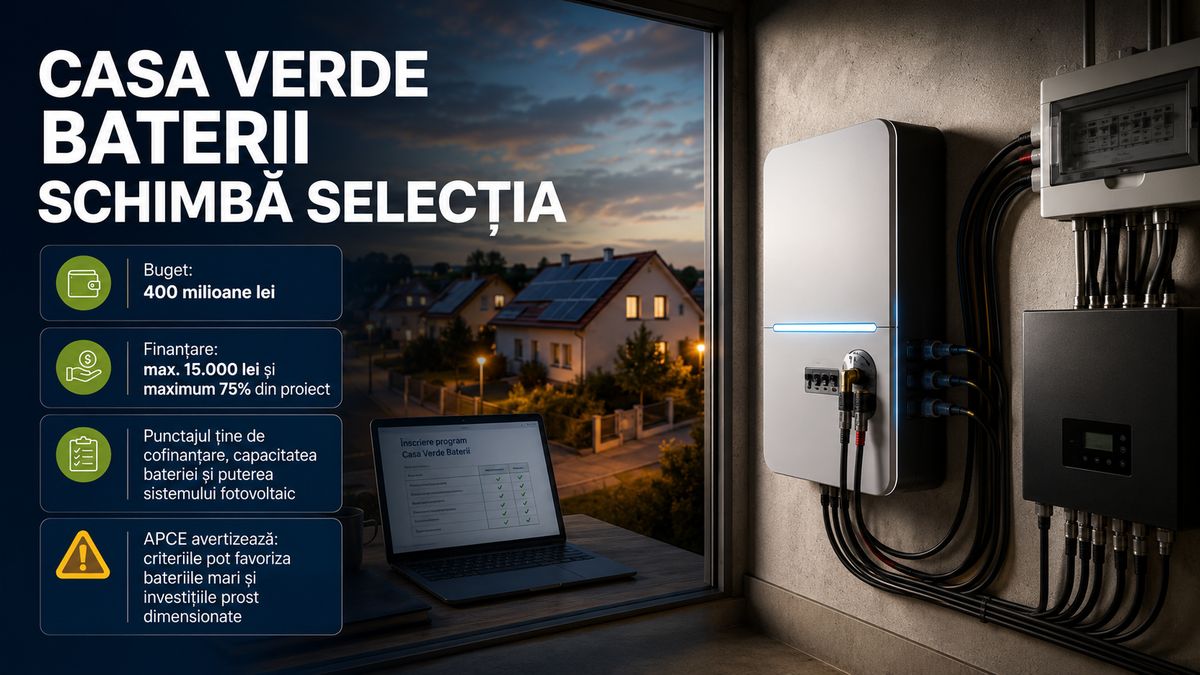
On August 18, the Ministry of the Environment launched a public consultation on the draft guidelines for the new prosumer battery program, which has a budget of RON 400 million. The proposed funding reaches a maximum of RON 15,000 (VAT included) per project, capped at 75% of eligible expenses and a standard cost of RON 1,250 per kWh of storage capacity. The battery must have a capacity of at least 12 kWh, with the beneficiary covering at least 25% of the investment. However, the most significant change lies in the selection process. Projects will no longer be funded solely based on how quickly applicants manage to register on the platform. The Environmental Fund Administration (AFM) proposes a scoring system of up to 100 points, based on the beneficiary's own financial contribution, battery capacity, and the capacity of the photovoltaic system. This system attempts to replace the old registration race with a project-based competition, but the chosen formula shifts the advantage toward other factors: higher co-financing and larger installations. Registration speed demoted to the final tie-breaker The co-financing contribution can yield up to 40 points, the storage system capacity another 40 points, and the PV capacity up to 20 points. Once the application window closes, projects will be ranked in descending order of their score and approved within the limits of the available budget. Speed does not disappear entirely. If two projects achieve the same score, the tie-breaker is determined first by the value of the co-financing contribution, then by battery capacity, and finally by the capacity of the PV installation. The date and time of registration only come into play at the very end of this sequence. Consequently, "first-come, first-served" ceases to be the primary rule, though the submission timestamp remains the ultimate tie-breaker. Diana Buzoianu explained on August 19 that the Ministry of the Environment would have preferred a higher co-financing contribution to carry decisive weight, whereas the AFM also proposed criteria regarding storage system capacity and the capacity of the existing installation. The interim Minister of the Environment acknowledged that some of the feedback received after the draft's publication is valid and stated that the guidelines will be improved following the consultation. The new scoring system may reward size rather than optimal sizing The Romanian Association of Prosumers and Energy Communities (APCE) challenges this very architecture. APCE warns that scoring battery capacity and PV power separately, without requiring a technical correlation between the two, could incentivize the installation of batteries larger than the household's actual energy needs. This issue is particularly relevant given that the Ministry explicitly states that funded systems must be sized in relation to the prosumer's actual production and consumption needs. The declared objective is to maximize the efficient use of generated energy and reduce grid pressure. The scoring formula must therefore reconcile two objectives that are not automatically aligned: maximizing the storage capacity installed using public funds and sizing each system according to the household's actual profile. APCE estimates that only about 3% of residential prosumers would be able to obtain the maximum score for PV capacity, as the grid awards progressive points up to 20 kW, which exceeds the size of many residential installations. This figure is the association's estimate, not an official ANRE statistic on the current distribution of prosumers by capacity brackets. The result could be a profound shift in the competition for funding. Instead of the advantage being decided by a few seconds on the platform, the current draft links it to the applicant's financial capacity and the size of their installation. For a program with demand potentially far exceeding available resources, how these three criteria are weighted will determine who actually secures the funding. Prosumers who have already invested in batteries are excluded One of the most controversial provisions stipulates that no storage system must already exist at the implementation site. Under the current draft, a prosumer who previously purchased a battery using their own funds cannot apply for funding to expand capacity. APCE argues that this rule penalizes those who have already invested in storage and demands that they be allowed to receive support for additional capacity. The size of this category is already significant. According to ANRE data as of June 30, 2026, Romania had 359,378 prosumers connected to the electricity grids, of which 324,535 were individuals. On the same date, 127,084 prosumers had storage batteries, of which 123,231 were individuals. Relative to the number of individual prosumers, storage was already present in nearly 38% of cases. The difference leaves approximately 201,000 individual prosumers without batteries, before applying other…
Ioana Buzoaica — Independent Editorial Board
The NRG-IA newsroom continuously monitors Romanian energy markets, ANRE regulatory decisions, and national grid telemetry (SEN/SNT). We deliver independent intelligence anchored exclusively in official primary data.
Editorial Charter, Ethics & Verification Methodology →