Casa Verde Batteries: RON 15,000 Grant for Prosumers — NRG-IA
Ghid Consumator Author: Auorora AIRomanian prosumers can apply Nov 20–25, 2026 for storage grants up to RON 15,000. Selection is score-based, with last-minute rule updates proposed.
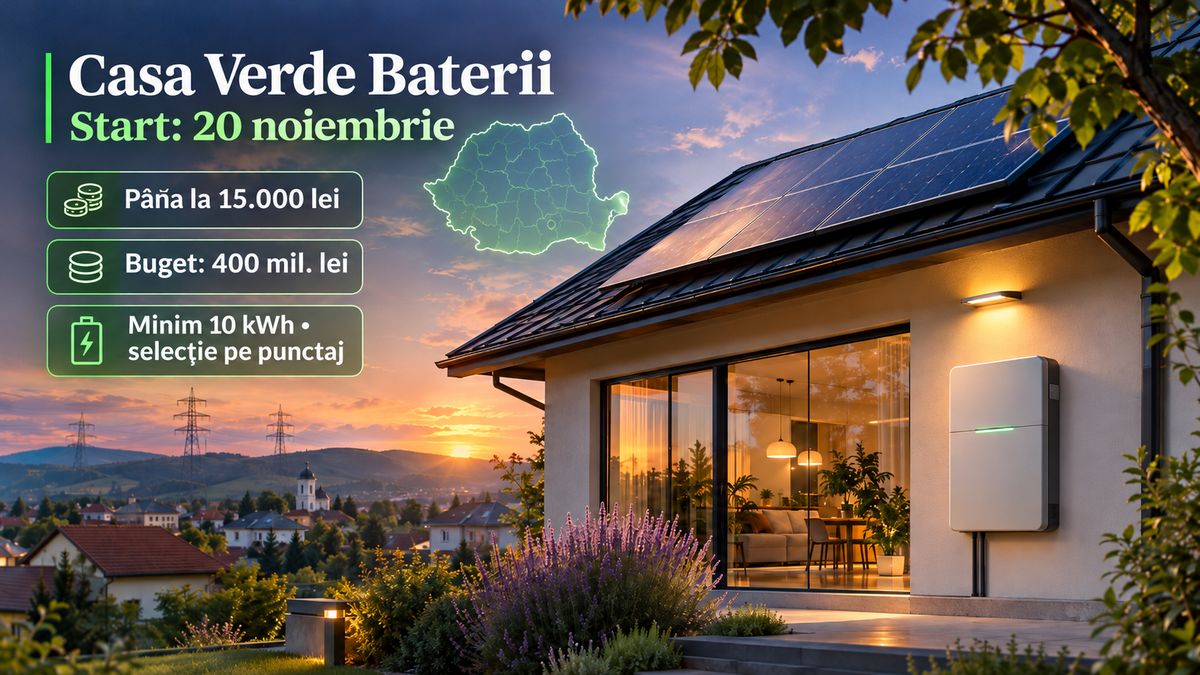
Romania’s Environment Fund Administration (AFM) will open applications for the "Green House Batteries" scheme on November 20, 2026, at 10:00 AM. Under the program, residential prosumers with existing solar PV installations can secure grants of up to RON 15,000 to install energy storage systems. Backed by a total budget of RON 400 million, the application window closes on November 25 at 11:59 PM. The subsidy covers up to 75% of eligible project costs for new storage systems with a minimum capacity of 10 kWh. This marks a strategic shift from previous editions of the Green House Photovoltaics scheme, redirecting public support toward optimizing self-consumption by enabling prosumers to store excess solar generation for later use. Beneficiary selection is based on a scoring grid within the available budget, rather than strictly on a first-come, first-served basis. Two weeks ahead of the application window, the Ministry of Environment published proposed amendments to the tie-breaking rules, which could influence applicants' decisions regarding battery capacity and co-financing levels. Applications Open November 20–25: Installers Register First The timetable announced by AFM on November 6 establishes a two-stage process. The first phase targets installation companies seeking accreditation, who must submit their validation files between November 16 (10:00 AM) and November 20 (11:59 PM). The second phase is dedicated to individual prosumers, who can apply between November 20 (10:00 AM) and November 25 (11:59 PM). Applicants submit their documentation online via AFM’s digital platform. The funding application form must be downloaded, completed, and reuploaded unsigned. Required documents include an identity card, tax clearance certificates from the National Agency for Fiscal Administration (ANAF) and local municipal authorities, as well as an additional tax clearance certificate if the project is located in a different municipality than the applicant's residence. To prove prosumer status, applicants must provide their prosumer agreement, grid connection certificate for the consumption point, and an electricity bill issued in the applicant's name no more than six months prior to registration. Tax certificates must be valid on the submission date. Electronically issued documents must be uploaded in their original digital format as specified by guidelines. Funding is open to individuals holding active prosumer status, regardless of whether their original PV system was privately funded or subsidized through a previous state initiative. Applicants must have no outstanding tax liabilities and meet on-site energy use criteria. Having a pre-existing battery does not automatically disqualify an applicant, but double funding for the same expenses is strictly prohibited. Up to RON 15,000 for 10+ kWh Batteries: Co-financing Requirements The official guidelines, approved under Ministry of Environment Order No. 1,904/2026 and published in the Official Gazette on September 14, establish three financial thresholds: the AFM grant cannot exceed 75% of project costs, maximum funding is capped at RON 15,000 (VAT included), and eligible unit costs are standardized at RON 1,500 per kWh of installed storage capacity. For instance, for a 10 kWh battery project with eligible costs of RON 15,000, AFM's subsidy reaches RON 11,250, leaving a co-financing requirement of RON 3,750 for the beneficiary. For a project with eligible costs of RON 20,000, funding hits the maximum cap of RON 15,000, requiring a RON 5,000 owner co-contribution. For higher-value installations, the AFM grant remains capped at the program maximum. Subsidized batteries must be brand new, backed by a minimum five-year warranty, and rated for at least 5,000 charge-discharge cycles. Integrated monitoring and protection features via a Battery Management System (BMS) are mandatory. The installation must enable automated battery charging from surplus solar PV power. A significant additional cost may arise for existing installations requiring a hybrid inverter to integrate the battery. While guidelines allow retrofit installation prior to commissioning the storage system, purchasing, mounting, and commissioning a hybrid inverter are non-eligible expenses borne entirely by the applicant. Technical compatibility must therefore be verified prior to finalizing the project budget and system configuration. Merit-Based Allocation: Scoring Replaces First-Come, First-Served The evaluation methodology represents a major shift in program design. Following the application deadline, AFM’s software calculates each project’s score, ranking applications in descending order until the budget is fully allocated. Submission timestamp serves only as a tie-breaker in cases of equal scores. Under the guidelines in force as of November 7, 2026, the maximum score of 100 points is divided between two criteria. Applicant co-financing can award up to 50 points based on the ratio between the beneficiary's…
Auorora AI — Independent Editorial Board
The NRG-IA newsroom continuously monitors Romanian energy markets, ANRE regulatory decisions, and national grid telemetry (SEN/SNT). We deliver independent intelligence anchored exclusively in official primary data.
Editorial Charter, Ethics & Verification Methodology →