Casa Verde Batteries: Rules Under Debate Ahead of Launch — NRG-IA
Ghid Consumator Author: Ioana BuzoaicaThe August 26 debate shapes how Romania spends 400m RON on prosumer storage. While co-financing remains key, other rules are being reconsidered.
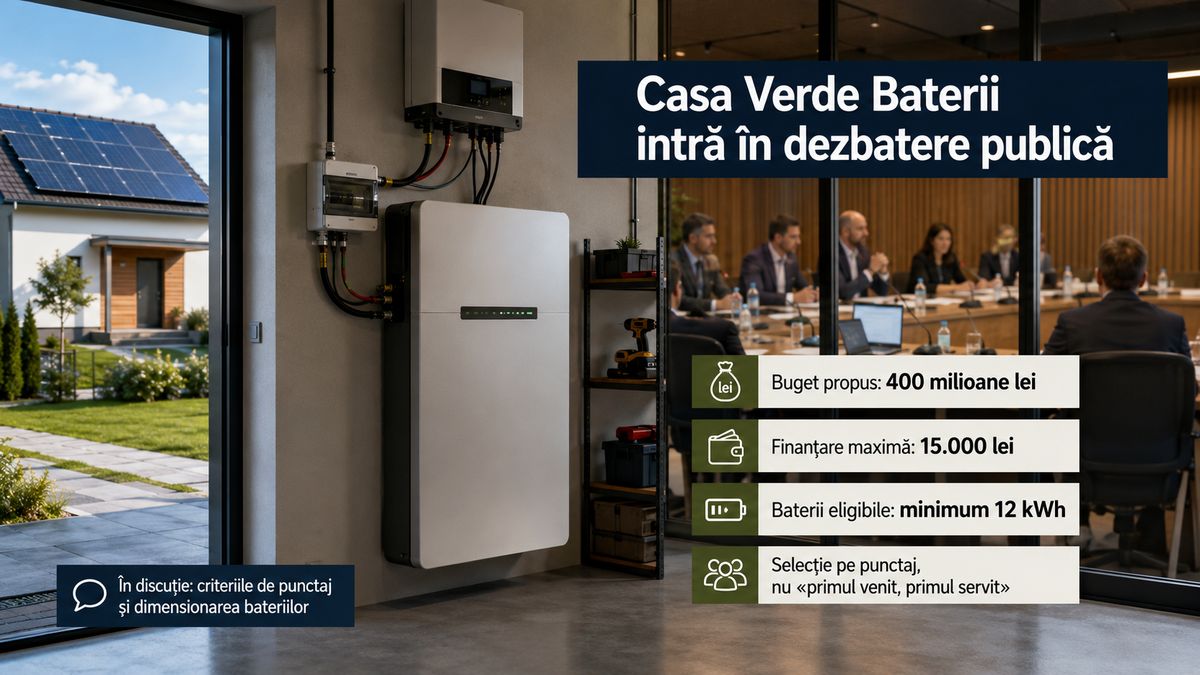
On Wednesday, August 26, the Ministry of the Environment and the Administration of the Environmental Fund (AFM) launched a public consultation on the rules of a program set to allocate 400 million RON exclusively for prosumer batteries . This marks a major shift from the traditional 'Casa Verde' (Green House) editions: the state is no longer funding new solar panel installations, but is instead trying to address the fallout of the rapid PV expansion—massive daytime generation coupled with a lack of sufficient capacity to store it for evening hours. Under the draft guidelines, a beneficiary can receive up to 15,000 RON, VAT included , with the AFM funding capped at 75% of eligible expenses and a cost standard of 1,250 RON per kWh of storage capacity . The co-financing requirement is at least 25%, and the battery must have a capacity of at least 12 kWh. The program is open to individuals who already hold prosumer status, regardless of whether their panels were installed through a previous Casa Verde scheme or using their own funds. However, the main point of contention is not the 15,000 RON limit. The real conflict lies in how the funds will be allocated once demand outstrips the budget . Casa Verde abandons the 'fastest click' race The Ministry wants to break away from the mechanism that dominated previous AFM editions: 'first-come, first-served'. Instead of a race where access to funding was decided in seconds by registration speed, projects will now be ranked based on a scoring system. The current draft distributes a maximum of 100 points across three criteria: the beneficiary's co-financing contribution can yield up to 40 points, battery capacity another 40 points, and the capacity of the existing PV system up to 20 points. The Minister of Environment, Diana Buzoianu, has already announced that one of these criteria is here to stay: co-financing . The Ministry's logic is that a beneficiary who covers a larger share of the investment draws less public funding, allowing more projects to be financed from the same 400 million RON budget. In contrast, the criterion related to the capacity of the PV system is already being questioned. Buzoianu stated that she does not consider it essential and is open to removing it if the arguments raised during the consultation justify this change. This represents one of the most significant potential changes to the final guidelines. The scoring system risks turning the battery program into a capacity race The Ministry's intention is for batteries to be sized in relation to PV generation and household consumption. However, the draft's scoring formula could create a different incentive: the larger the storage capacity, the more points the applicant receives. The Association of Prosumers and Energy Communities (APCE) warns that such a mechanism could favor oversized batteries, installed to maximize scores rather than to efficiently use the energy generated by the home. The organization is calling for a clearer link between PV system capacity, available generation, household consumption, and the capacity of the funded battery. This criticism is also backed by market experts. For some households, a 12 kWh battery may be appropriate; for others, a smaller capacity could more efficiently cover consumption and PV surplus. A single threshold thus risks funding storage capacity that will be underutilized in certain homes. This is one of the most critical decisions for the final draft: whether the program will reward as many battery kWh as possible or the storage kWh that are actually useful for both the grid and the household . The 12 kWh threshold has become a key topic of the consultation The draft sets a minimum eligible capacity of 12 kWh . For households with large PV systems and high consumption, this level may be justified. For prosumers with smaller installations, this condition could unnecessarily inflate project costs and the required co-financing. Installers consulted ahead of the debate called for a re-evaluation of this threshold and sizing that aligns more closely with actual consumption profiles. Another criticism is that the current formula could disadvantage households with small and medium PV installations, pushing funding toward projects with capacities exceeding technical requirements. In the current draft, the size of the PV installation yields up to 20 points, progressively up to 20 kW. APCE argues that this criterion favors a small category of prosumers with large systems, estimating that only about 3% of residential prosumers could achieve the maximum score on this component. This explains, in part, the Ministry's willingness to reconsider the criterion. Those who have already purchased batteries may be left out of the program Another dispute concerns prosumers who have already invested their own funds in a storage system. The current draft excludes them if a battery is already installed at the implementation site. APCE believes this rule penalizes the very…
Ioana Buzoaica — Independent Editorial Board
The NRG-IA newsroom continuously monitors Romanian energy markets, ANRE regulatory decisions, and national grid telemetry (SEN/SNT). We deliver independent intelligence anchored exclusively in official primary data.
Editorial Charter, Ethics & Verification Methodology →