CCGT Power Ișalnița: Study for 950 MW/950 MWh storage — NRG-IA
Energie Regenerabilă Author: Ioana BuzoaicaThe CE Oltenia-Alro joint venture has received bids for a feasibility study on a 950 MW battery storage system across three major energy hubs.
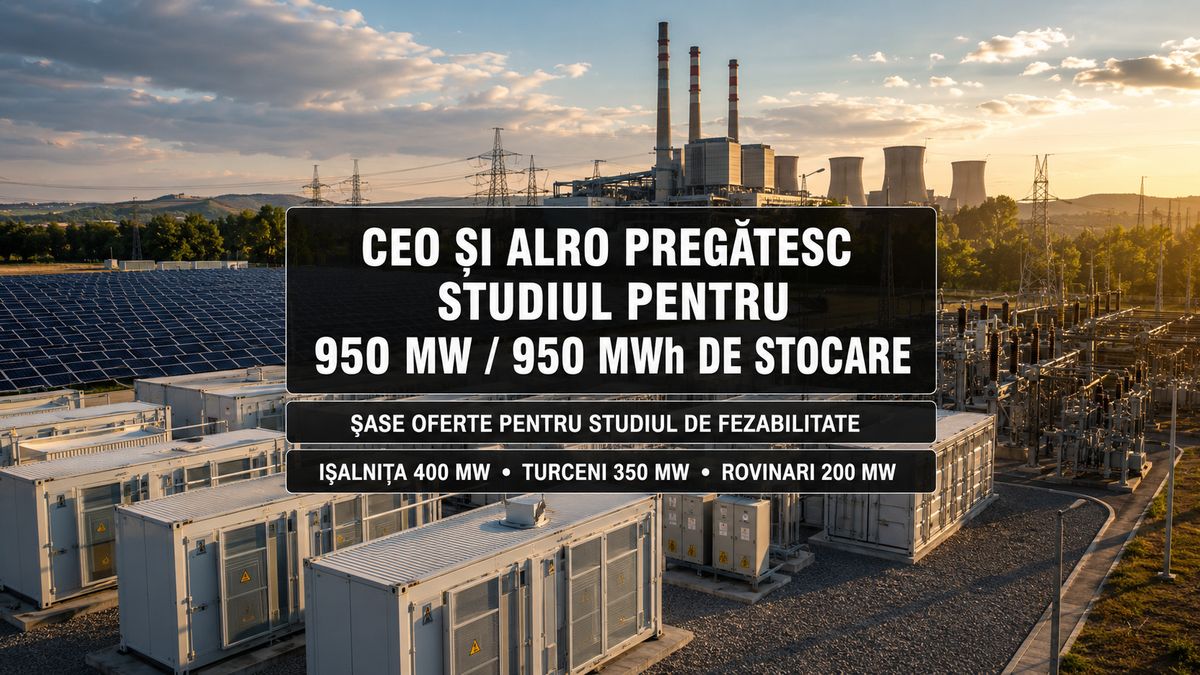
CCGT Power Ișalnița, a joint venture owned 59.9% by Complexul Energetic Oltenia (CE Oltenia) and 40.1% by Alro, has received six bids for a feasibility study and technical documentation for a storage system with approximately 950 MW of installed capacity and 950 MWh of storage capacity . The proposed configuration is split across the energy hubs of Ișalnița, Turceni, and Rovinari. If the project progresses to the investment stage, it could represent one of the largest leaps in storage capacity ever planned in Romania. Its scale is comparable to the entire current Romanian market. At the end of July, the latest data from Transelectrica showed Romania had 989.3 MW of installed storage capacity and 1,974.7 MWh of energy capacity . The 950 MW under study by CCGT Power Ișalnița would therefore represent nearly the total capacity of all installations reported nationwide at that time. The procedure does not yet constitute a final investment decision to build the batteries. At this stage, CCGT Power Ișalnița is contracting the study to determine the technical solution, costs, integration into existing infrastructure, and final investment parameters. The procurement for feasibility services has an estimated value of RON 1.495 million , was published on July 9, and the deadline for submitting bids was July 31. Ișalnița would host the largest component of the system The current documentation tentatively distributes the 950 MW between Ișalnița – 400 MW, Turceni – 350 MW, and Rovinari – 200 MW . These parameters are to be validated and optimized through the feasibility study, meaning both the allocation between sites and the technical configuration could be adjusted before any final investment decision. The total capacity of 950 MW is paired with approximately 950 MWh of energy capacity, corresponding to a nominal storage duration of about one hour at maximum output . The distinction between these two metrics is crucial: megawatts indicate the rate at which the battery can absorb or discharge power at any given moment, while megawatt-hours represent the total energy it can store. Such a configuration would favor applications where speed and power are more critical than long-duration energy shifting. The documentation requires analyzing integration into existing energy infrastructure, including grid connections, substations, protection systems, and technical spaces, alongside geotechnical, environmental, urban planning, and fire safety conditions. The three sites are simultaneously energy hubs built around conventional generation and areas where new renewable capacities are being developed. This could allow the batteries to quickly absorb surplus power, shift it to periods of higher demand, and participate in ancillary services essential for grid stability. Lignite hubs take on a new energy role The transformation is already visible in the Oltenia region. CE Oltenia and OMV Petrom are developing four solar photovoltaic parks at Ișalnița, Tismana, and Rovinari, with a total installed capacity of approximately 550 MW , and the first panel deliveries for these projects began in 2026. Adding hundreds of megawatts of battery storage to these same platforms would redefine the role of infrastructure originally built around lignite. Substations, grid connections, and industrial land can support a mix where renewable generation is paired with rapid energy absorption and discharge capabilities. For the Romanian power system, this function is becoming increasingly vital as solar generation surges during midday hours, widening the gap between periods of abundant energy and peak demand. A battery with a one-hour duration does not shift solar generation from one day to the next, but it can move significant volumes between adjacent hours and respond rapidly to system fluctuations. The company was originally established for an 850 MW gas plant This shift in direction is particularly notable given that CCGT Power Ișalnița was not founded with storage in mind. The company was established in 2023 by CE Oltenia and Alro to develop and operate an approximately 850 MW combined cycle gas turbine (CCGT) power plant at Ișalnița. The official shareholding structure is 59.9% CE Oltenia and 40.1% Alro. However, the gas plant project has faced delays and two unsuccessful procurement procedures. The first tender was canceled, and the subsequently relaunched procedure, at a significantly higher estimated cost, was canceled again in January 2026. In this context, the company pivoted toward storage in the spring, leading to the summer launch of the procurement for the 950 MW study. However, batteries and gas plants are not equivalent energy assets. An 850 MW CCGT can generate power continuously as long as fuel is available and it remains technically operational. The proposed storage system can deliver around 950 MW, but its 950 MWh configuration limits it to maintaining this output for about one hour. The battery can take over some of the flexibility…
Ioana Buzoaica — Independent Editorial Board
The NRG-IA newsroom continuously monitors Romanian energy markets, ANRE regulatory decisions, and national grid telemetry (SEN/SNT). We deliver independent intelligence anchored exclusively in official primary data.
Editorial Charter, Ethics & Verification Methodology →