Cheapest Energy Is Unused: Home Bill Reduction Guide — NRG-IA
Ghid Consumator Author: Aurora AIReduce home bills by targeting actual energy losses first. Learn what to do before installing solar panels or heat pumps based on your budget.
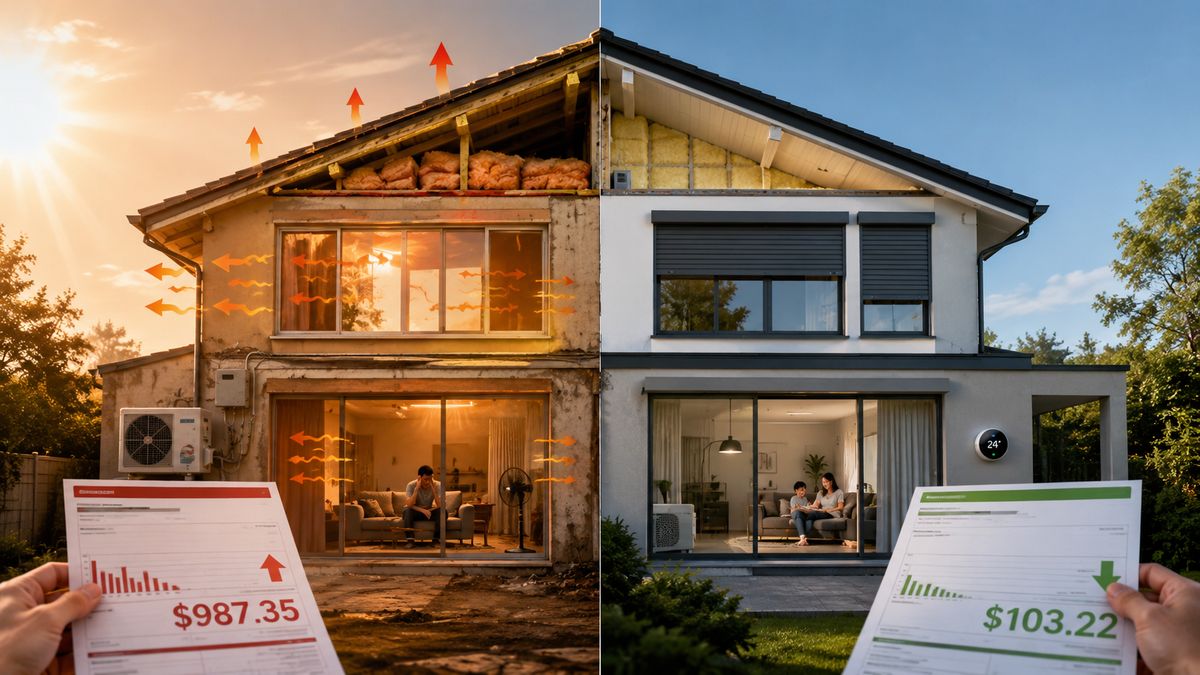
An efficient home does not start with energy generated on the roof. It begins with the energy the home stops losing in winter and stops consuming in summer to compensate for overheating. The principle is simple: every kWh that no longer needs to be used for heating, cooling, or hot water reduces the bill without requiring additional panels, larger batteries, or an oversized heating source. In European energy policy, this principle is called "energy efficiency first": before making major investments in new production capacity or infrastructure, cost-effective demand reduction must be analyzed. For a homeowner, the right question is not "which technology do I buy first?", but "where is my home losing the most comfort and energy?". The answer varies from one home to another. A house that overheats through west-facing windows has a different priority than an apartment with drafty window frames or a house with an uninsulated attic and a boiler set to an excessively high flow temperature. Start with the diagnosis, not the product There is no universal investment sequence that is cost-effective for every home. A recently built house with a good thermal envelope can benefit significantly from heating automation, exterior shading, and photovoltaics. An old, uninsulated house can still consume a lot of energy even if it has solar panels, because it loses heat through the roof, walls, windows, and drafty areas. The first useful step is to inventory the symptoms: in winter, you feel cold drafts near windows, doors, or electrical outlets on exterior walls; the ceiling of the top floor is cold, and the attic is uninsulated; the air conditioning runs for hours in the afternoon, especially in rooms with large west-facing windows; some rooms are too hot, while others are too cold; the boiler or heat pump cycles frequently, but the indoor temperature remains unstable; bills are rising, even though comfort is not improving. A comprehensive energy audit provides the best foundation for extensive work. For small investments, an HVAC specialist, a thermographer, or an experienced builder can quickly identify obvious issues. Decisions should not be made solely based on a product catalog or the promise of a generic percentage of savings. Exterior shading stops heat before it enters the home For homes that overheat in the summer, exterior shading is one of the most effective interventions. Roller shutters, textile screens, awnings, pergolas, shutters, or well-positioned vegetation reduce solar radiation before it passes through the glass and turns into indoor heat. The difference between exterior shading and interior curtains is significant. Interior curtains, roller blinds, or venetian blinds can reduce glare and some radiation, but the heat has already largely passed through the glass. Exterior shading blocks solar energy before the glass even heats up. The US Department of Energy estimates that an awning can reduce summer solar heat gain by up to 65% on south-facing windows and up to 77% on west-facing windows. The actual effect depends on window size, orientation, existing shading, glass type, and climate. West and southwest-facing windows are typically the most problematic on very hot days. The afternoon sun enters at a low angle and hits large windows directly, precisely when outdoor temperatures are already high. In these cases, a retractable shading system, used in summer and retracted in winter, is generally more flexible than a fixed solution that permanently reduces useful solar gain during the cold season. The roof and drafts: invisible but permanent savings In many homes, energy losses are not spectacular. There is no visible equipment that can instantly resolve them. They occur through uninsulated attics, unsealed access hatches, gaps around pipes, misaligned window frames, doors that do not seal tightly, and imperfect joints between building elements. Sealing drafts is one of the interventions that can have a rapid effect on comfort. A worn weatherstrip, a balcony door that does not close tightly, or an unsealed attic hatch can let in cold air in winter and hot air in summer. Solutions are relatively affordable but must be applied without blocking necessary ventilation. A tighter home requires controlled ventilation and humidity management, not the complete elimination of all air exchange. Insulating the attic or the attic floor is often one of the most cost-effective measures for single-family homes. If the space above the top floor is cold and uninsulated, heat rises to the ceiling, and in winter, the heating system has to work harder to maintain the same temperature. The European Commission estimates that roughly 75% of buildings in the European Union have poor energy performance, and energy renovation remains slow relative to what is needed. For the homeowner, the practical takeaway is simpler: before sizing a heat pump or a photovoltaic system, it is worth reducing the home's energy demand. Windows should be…
Aurora AI — Independent Editorial Board
The NRG-IA newsroom continuously monitors Romanian energy markets, ANRE regulatory decisions, and national grid telemetry (SEN/SNT). We deliver independent intelligence anchored exclusively in official primary data.
Editorial Charter, Ethics & Verification Methodology →