2026 Oil Crisis: Hormuz, Petroline & Fuel Supply — NRG-IA
Geopolitică & Energie Author: Ioana BuzoaicaThe crisis starting Feb 28, 2026, is the largest supply shock in oil history. Seven months in, pressure has shifted from crude to refined products.
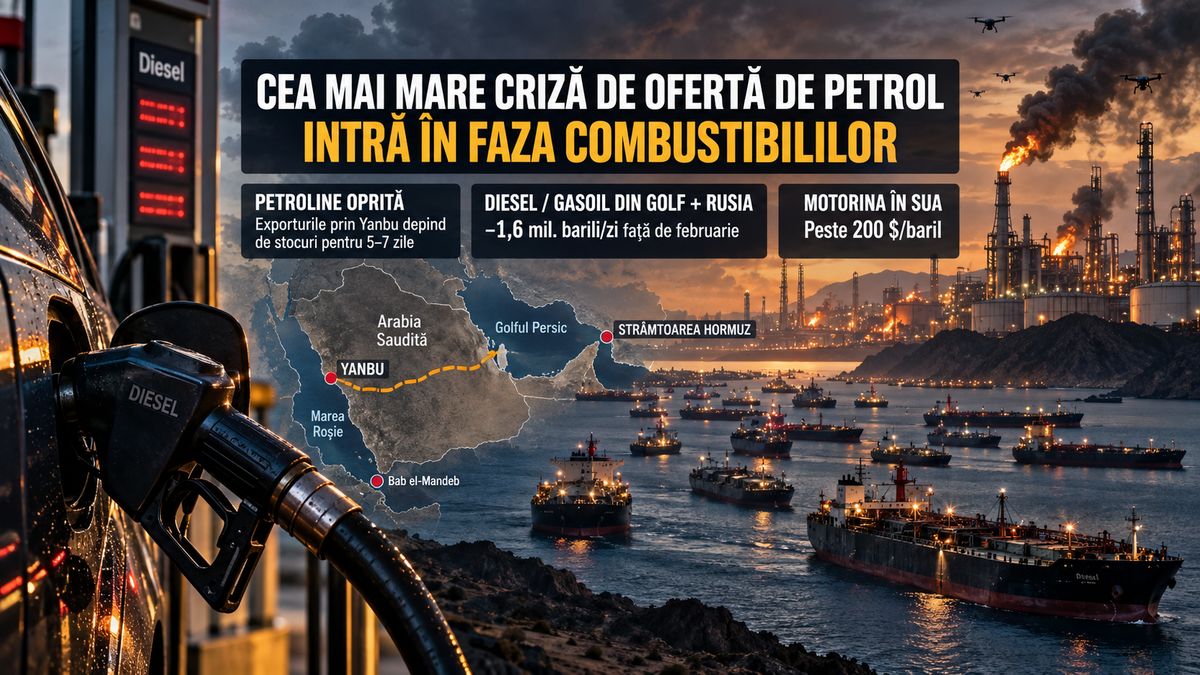
The International Energy Agency describes the shock that began in the Middle East on February 28 as the largest supply disruption in the history of the global oil market. In the most severe phases of the crisis, Gulf production was more than 10 million barrels per day below pre-war levels, and by June 22, cumulative production losses from the region had already exceeded 1.3 billion barrels. In August, over 10 million barrels per day of Gulf production remained offline. But the supply record alone no longer defines the crisis. In September, the market's central issue shifted to what happens after oil extraction: transporting it to refineries and converting it into diesel, jet fuel, gasoline, and marine fuel. In 1973, the primary question was who had the oil. In 2026, the question simultaneously becomes who still has the oil and who can still refine it into diesel, jet fuel, and gasoline. The largest supply loss did not produce the largest price spike A comparison with the major oil crises of the last five decades highlights the scale of the shock. The 1973–1974 Arab embargo removed approximately 4.3 million barrels per day from the market. The 1978–1979 Iranian Revolution produced a peak loss of about 5.6 million barrels per day, the Iran–Iraq War around 4.1 million, and the 1990 invasion of Kuwait roughly 4.3 million. In 2026, the loss exceeded 10 million barrels per day and, in its most severe phases, approached 14 million. In terms of absolute volume of lost supply, the current crisis thus surpasses all major precedents in the modern market. However, prices did not replicate the 1973 shock, when oil prices nearly quadrupled. Today, the world has strategic reserves, significant non-Gulf production, and an economy less dependent on every barrel of oil consumed. IEA member states released 400 million barrels from emergency stocks, the largest coordinated intervention in the agency's history. Part of the adjustment, however, came through a much harsher mechanism: demand destruction. For 2026, the IEA estimates a decline in global oil consumption of approximately 2.5 million barrels per day. The market failed to fully replace the lost supply; instead, it began consuming less. Diesel looks worse than crude oil The IEA report from September 11 captures the second phase of the crisis most clearly. Global refineries processed approximately 81.4 million barrels per day in August, 4.2 million less than in the same period of 2025. For the full year, the agency estimates a decline in global refined volumes of about 2.6 million barrels per day. The Gulf lost not only crude production but also a massive share of its refined product exports. In August, the region's exports of petroleum products and LPG were approximately 3.7 million barrels per day—nearly 60%—below February levels. For diesel and gasoil, the deterioration is even more pronounced. Net exports from the Gulf had fallen to around 390,000 barrels per day, just over a quarter of pre-war levels. In the United States, the price of diesel per barrel exceeded $200, roughly 94% above pre-war levels. At the pump, the national average surpassed $6 per gallon, even though the US is the world's largest oil producer. The explanation is simple: crude oil and diesel are not the same product. Additional oil production does not automatically resolve a lack of refining capacity, and distillates are traded on a global market. The Russia–Ukraine war has become the second shock to fuels Ukrainian attacks on Russian refineries produce a different effect than the Gulf blockade. Hormuz affects access to oil and petroleum products from one of the world's largest exporting regions. Striking Russian refineries reduces the capacity to process crude into finished fuels. Sometimes, shutting down a refinery can even free up more Russian crude for export. However, the market loses the very products that have become the hardest to replace: diesel, gasoline, jet fuel, and fuel oil. The IEA estimates that net exports of diesel and gasoil from the Gulf and Russia in August were approximately 1.6 million barrels per day below February levels. Before the crisis, the two regions together supplied nearly 45% of global seaborne trade in these products. Russia was forced to limit exports to protect its domestic market. By late August, Russian gasoline production had fallen to approximately 80,000 tonnes per day, sufficient for about 70% of estimated domestic demand. Moscow extended restrictions on producers' diesel exports until September 30, while gasoline exports are restricted until January 31, 2027. On September 13, US President Donald Trump publicly called on Volodymyr Zelenskyy to halt attacks on Russian diesel-related infrastructure. The statement attributes a dominant share of the problem to Kyiv. However, IEA data describes a broader crisis: two of the regions that together supplied nearly half of the world's seaborne diesel trade are being affected simultaneously. Petroline has put the…