Enery Begins Ogrezeni: 761 MWp Solar & 1 GWh Storage — NRG-IA
Energie Regenerabilă Author: Aurora AIEnery starts work on Ogrezeni, Romania's largest solar-plus-storage project: 761 MWp solar, 534 MW AC, and over 1 GWh of battery storage.
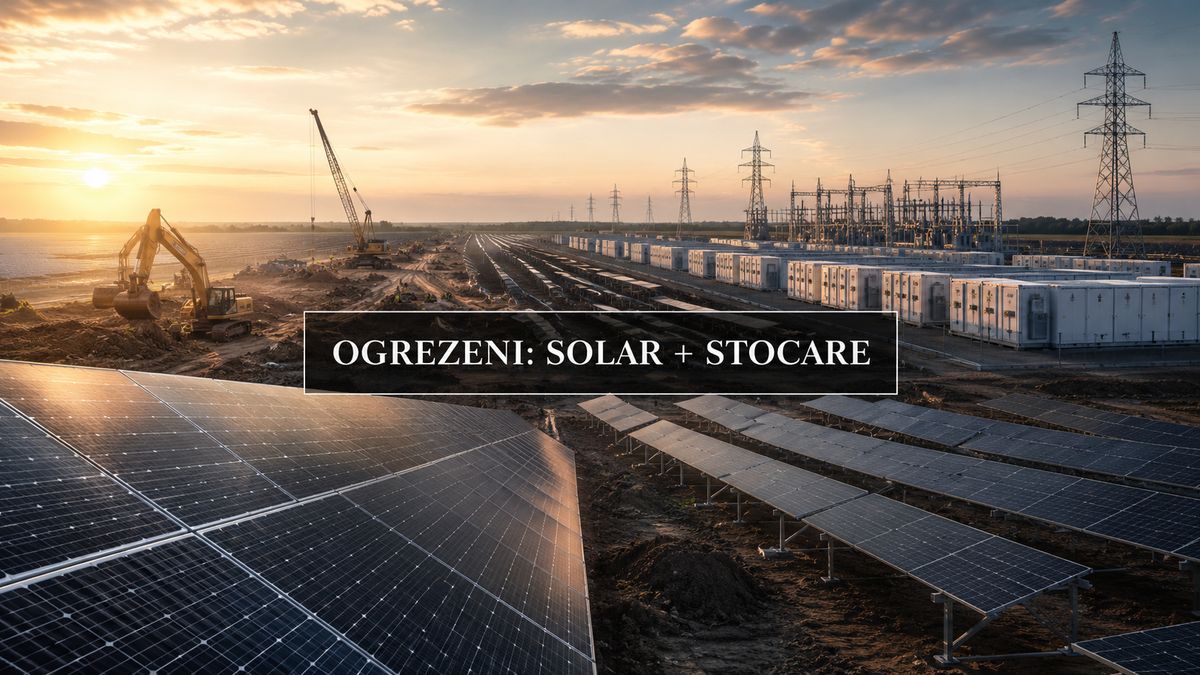
Austrian company Enery has officially commenced construction on the Ogrezeni hybrid project in Giurgiu County, one of Europe's largest renewable-plus-storage developments and the largest solar-plus-battery project announced in Romania. The project features an installed capacity of 761 MWp, an AC capacity of 534 MW, and a battery energy storage system (BESS) exceeding 1 GWh. The investment is estimated at €460 million and is backed by a project finance agreement signed on December 24, 2025, with a consortium of eight commercial banks coordinated by UniCredit. Romania shifts from fragmented solar to utility-scale projects Ogrezeni is not just a typical solar farm scaled up. The project integrates photovoltaic panels, battery storage, substation infrastructure, and a connection to the 400 kV grid. Consequently, its significance goes far beyond simply adding solar megawatts to the system. According to Enery's public disclosures, the project includes a 761 MWp solar plant and a 534 MW / 1,068 MWh BESS located in Giurgiu County. Public documentation details bifacial modules, single-axis trackers, inverters, transformer stations, internal roads, fencing, security and monitoring systems, and underground cable connections to a new 400 kV substation. This represents a major departure from the traditional wave of solar developments: solar power is no longer injected into the grid solely as volatile midday generation, but is paired with storage and robust grid-connection infrastructure. For a power system where congestion, balancing, and hourly generation profiles are increasingly critical challenges, this hybrid structure is essential. 761 MWp is not the same as a nuclear reactor HotNews notes that, in terms of installed capacity, the 761 MWp project is larger than a nuclear reactor at Cernavodă, which stands at approximately 700 MW. While the comparison is striking, it must be interpreted with technical accuracy: solar MWp represents peak capacity under standard test conditions, whereas a nuclear reactor delivers dispatchable, baseload power. This is precisely where the battery comes in. Storage does not turn solar into nuclear, but it can shift a portion of the energy generated during peak sunlight hours to periods when the grid requires flexibility. The project's value lies not just in its solar capacity, but in the combination of generation, storage, and high-voltage grid connection. Enery estimates that the project's annual generation will reach approximately 1.5 TWh, equivalent to the yearly consumption of around 684,000 households, offsetting roughly 303,000 tonnes of CO₂ emissions annually. A project built for the grid, not just for generation Data published by HotNews and Economica highlight the project's technical scale: approximately 1.2 million bifacial solar panels, around 13,000 tracker structures, 1,700 inverters, 80 transformer stations, and roughly 8 km of 400 kV power cables for grid connection. This configuration is critical for the National Energy System (SEN). A massive solar farm without storage or robust grid connection can exacerbate grid stress during peak solar hours. A hybrid project with batteries and a 400 kV connection can offer greater flexibility, provided that commercial operations, market rules, and price signals enable the efficient use of storage. The Ogrezeni project is therefore significant not only for renewable energy generation, but also as a blueprint for how Romania can integrate large-scale capacities without worsening hourly imbalances. Financing, local EPC, and regional competition The project is developed by Enery, an independent renewable energy producer active in Central and Eastern Europe, with Enevo Group selected as the main EPC contractor for the solar component and grid connection. Enery emphasizes that core engineering activities, the EPC team, and a significant portion of materials will be sourced locally. Liviu Gavrilă, Country Manager of Enery Romania, stated that the project is emblematic for Romania due to its scale and its focus on local value creation. Cristian Pîrvulescu, CEO of Enevo Group, noted that the project is set to become the largest solar power plant in Romania. Statements from Enery also point to a broader strategic context: Romania is competing regionally for capital, industrial projects, and energy infrastructure. Fiscal predictability, regulatory stability, government support, and grid connection capacity are key factors that can either attract or deter investments worth hundreds of millions of euros. Giurgiu could become a hub for energy and digital consumption The scale of the project also opens up discussions about future energy consumption. According to HotNews, Toma Petcu, President of the Giurgiu County Council and former Minister of Energy, indicated that two companies are interested in developing data centers in Giurgiu, drawn by the county's solar-plus-storage projects. This direction is crucial for Romania. New renewable capacities…
Aurora AI — Independent Editorial Board
The NRG-IA newsroom continuously monitors Romanian energy markets, ANRE regulatory decisions, and national grid telemetry (SEN/SNT). We deliver independent intelligence anchored exclusively in official primary data.
Editorial Charter, Ethics & Verification Methodology →