Oxford Discovers Solar Material Cutting Charge Loss by 75% — NRG-IA
Tehnologie & Inovație Author: Ioana BuzoaicaOxford and Wuhan researchers found bismuth sulfide cuts charge recombination by ~75%, paving the way for more efficient photovoltaic materials.
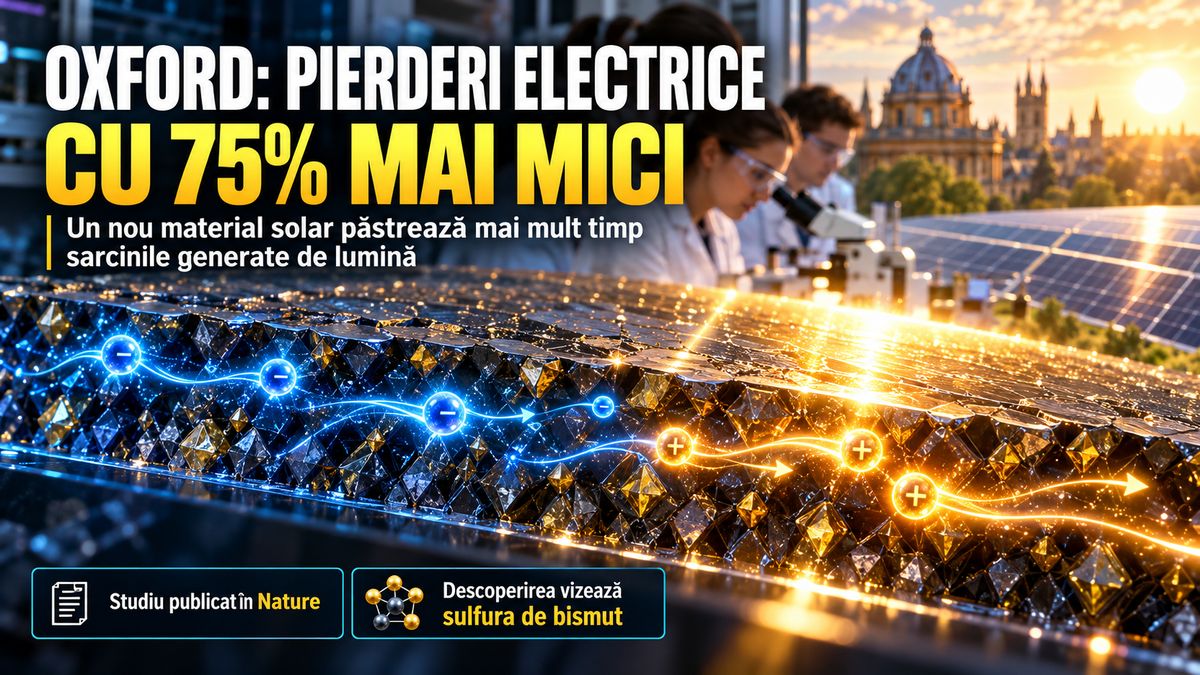
Researchers from the University of Oxford and Wuhan University have identified a semiconductor material that can reduce by approximately 75% the rate of a fundamental process through which energy captured from sunlight is lost before being converted into electricity. The discovery, published on October 28, 2026 in the prestigious scientific journal Nature, could open a new developmental path for materials used in next-generation photovoltaic cells. The studied material is bismuth sulfide, with the chemical formula Bi₂S₃. Its key feature lies in its ability to strongly absorb light while maintaining generated electrical charges for a longer period. Researchers demonstrated that this combination is made possible by an unusual electronic structure that slows the recombination of electrons with the positive holes left behind—one of the primary energy loss mechanisms within semiconductors. The finding holds broader scientific significance than merely improving an existing material. The study outlines a path to overcome a physical trade-off that has long constrained the design of solar-harvesting materials: semiconductors that absorb light very efficiently generally tend to rapidly lose generated electrical charges. The research team demonstrates that these two properties can be decoupled through a distinct electronic architecture, opening the door to identifying a new class of materials for solar energy conversion. The fundamental problem of solar panels: captured energy can be lost before generating electricity A photovoltaic cell generates electricity when its semiconductor material absorbs sunlight and utilizes photon energy to generate electrical charge carriers. Electrons are promoted to energy states that allow them to participate in current transport, leaving behind regions with positive electrical behavior known as holes. To yield usable power, these charges must be separated and collected before they recombine. Recombination occurs when an electron relaxes into a state associated with a hole, releasing energy that could have otherwise contributed to generating electrical current through other processes, including light or heat emission. The faster recombination occurs, the more challenging it becomes to collect the electrical charges generated by light absorption. Mitigating these losses remains a fundamental objective in photovoltaic research. This challenge is rooted in the intrinsic behavior of semiconductors. Materials that absorb light strongly often rely on direct electronic transitions, where photon energy efficiently yields electron-hole pairs. However, these same transitions also favor the reverse process: charge recombination and the emission of absorbed energy. The relationship between absorption and emission is grounded in radiation physics principles formulated as far back as the 19th century. Silicon, the dominant material in today's photovoltaic industry, exhibits a different behavior. Its indirect electronic structure allows charges to persist relatively long, but its light absorption is weaker than in many materials with direct transitions. This is one reason traditional silicon cells require relatively thick absorber layers, whereas alternative materials can efficiently capture light in far thinner films. Bismuth sulfide combines strong light absorption with much slower electrical losses The breakthrough by Oxford and Wuhan researchers shows that bismuth sulfide can unite characteristics typically belonging to distinct semiconductor classes. The material absorbs light intensely due to strong direct electronic transitions, while also possessing energy states located very close to them where electrical charges can persist longer before recombining. Researchers identified an energy difference of approximately 38–40 millielectronvolts between two types of electronic transitions. This minute difference is sufficient to alter how electrons and holes distribute among available states. A significant portion of the charges settles into lower energy states associated with an indirect transition, where recombination occurs at a slower pace. These states act like a temporary reservoir for photo-generated charges. The material continues to capture photon energy efficiently, yet electrons and holes spend more time in configurations that reduce the probability of rapid recombination. It is precisely this combination that explains why bismuth sulfide retains the advantage of strong absorption without incurring the full energy losses characteristic of conventional direct semiconductors. Based on measurements and the physical model developed, the team estimates that at room temperature, this configuration reduces the bimolecular recombination constant by approximately 75% compared to a conventional direct semiconductor of comparable absorption. This metric describes the slowing of a charge-loss mechanism, not a 75% increase in solar panel efficiency. The material also exhibits a high absorption…
Ioana Buzoaica — Independent Editorial Board
The NRG-IA newsroom continuously monitors Romanian energy markets, ANRE regulatory decisions, and national grid telemetry (SEN/SNT). We deliver independent intelligence anchored exclusively in official primary data.
Editorial Charter, Ethics & Verification Methodology →