Nature Energy: Heat-Driven Solid-State Cooling Breakthrough — NRG-IA
Tehnologie & Inovație Author: Ioana BuzoaicaKIT researchers demonstrated the first heat-driven elastocaloric cooling system, turning waste heat into refrigeration without electric motors or HFCs.
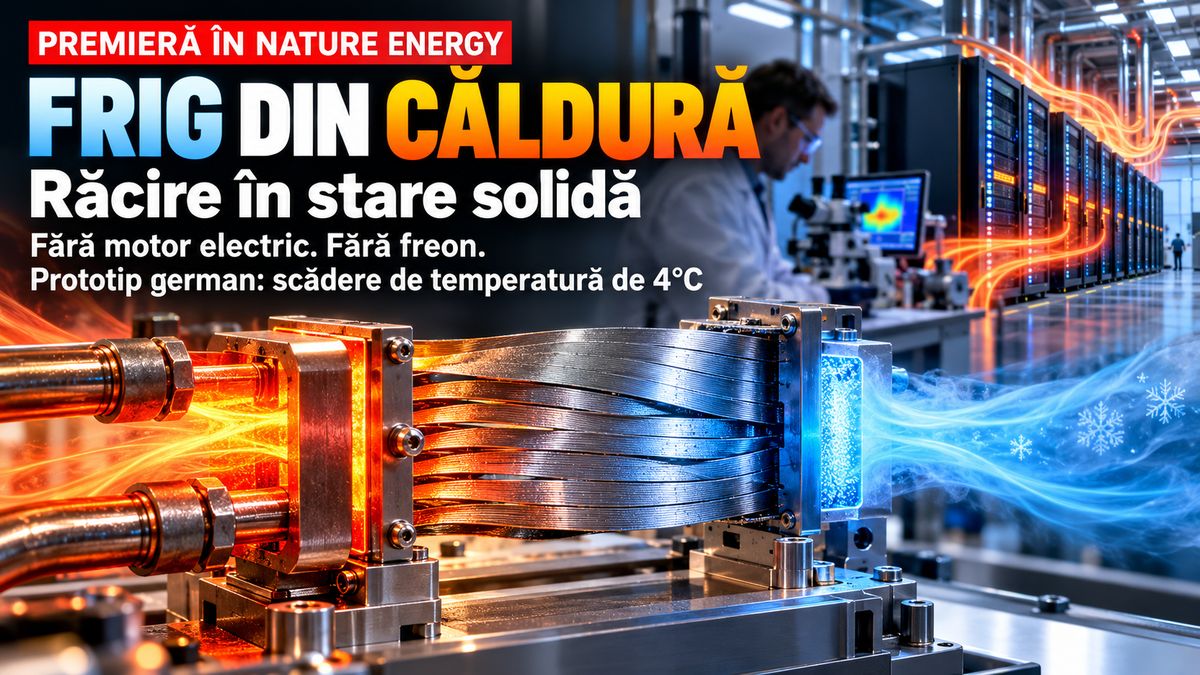
A team of engineers at the Karlsruhe Institute of Technology in Germany, led by researcher Yi-Ting Hsiau, has experimentally demonstrated the world's first solid-state cooling system where the mechanical force required to generate cold is produced directly from heat, without any electric motor. The findings, published in the scientific journal Nature Energy in October 2026, validate a functional prototype based on an ultrathin nickel-titanium shape-memory metal film that achieved a temperature difference of 4°C, operating without mechanical compressors, chemical refrigerants, or fluorinated gases. The achievement resolves one of the biggest paradoxes facing alternative HVAC and industrial cooling technologies. Although solid materials that cool down when mechanically stretched have been recognized for years as a clean alternative to refrigerant-based systems, all existing setups required heavy electric motors or actuators to pull on the metal, consuming substantial electricity. By replacing the electric motor with direct thermal driving, the German researchers demonstrated that the waste heat released into the atmosphere by servers, industrial plants, or electronic equipment can itself become the energy source that drives cooling. How a Nickel-Titanium Film Generates Cold When Stretched by Another Heated Film The physical mechanism behind the demonstration in Karlsruhe is known as the elastocaloric effect and occurs in shape-memory metal alloys, particularly nickel-titanium compounds. When a thin foil of such an alloy is subjected to tensile force and stretched, its internal crystalline structure rapidly reorganizes, releasing heat to the outside. Once the tensile force is released, the metal returns to its original shape, reverses its crystalline phase transition, and abruptly absorbs heat from its surroundings, lowering the temperature below ambient just like a conventional chemical refrigerant, but in an entirely solid state. The key innovation introduced by the team led by Yi-Ting Hsiau lies in the clever coupling of two shape-memory metal films within a single self-regulating assembly. Instead of relying on a piston or an electric motor to stretch the cooling foil, the engineers used a primary metal film as a thermal muscle. When this first film makes contact with a heat source, the alloy changes shape and exerts a powerful mechanical force, pulling directly on the second film, which serves as the cooling element. During laboratory testing, this complete thermomechanical cycle successfully generated a measurable temperature span of 4°C using thermal energy exclusively as its driving fuel. Opting for ultrathin metal films instead of bulky alloy bars was critical to the experiment's success, as the high surface-area-to-volume ratio of thin foils allows for rapid heat transfer and enables high-frequency stretching and relaxation cycles. Eliminating Electric Compressors and High-GWP Refrigerants The energy and climate stakes of this technology directly address the core architecture of artificial refrigeration, which has remained largely unchanged for over a century. Nearly all modern refrigerators, air conditioners, heat pumps, and data center cooling systems rely on vapor-compression mechanics. This process carries two major vulnerabilities: compressors consume a massive fraction of global peak electricity demand, and the working fluids used, such as hydrofluorocarbons (HFCs), exhibit global warming potentials thousands of times higher than carbon dioxide when leaked into the atmosphere. A heat-driven solid-state system tackles both issues simultaneously. On one hand, the working medium is a simple nickel-titanium metal ribbon—a solid, non-toxic, non-flammable material with zero volatile emissions that cannot evaporate or degrade due to pressure leaks. On the other hand, eliminating the electric motor and mechanical compressor removes grid electricity consumption required to sustain the cooling cycle, turning what was an energy expense into a passive waste-heat recovery process. From Cooling AI Data Centers to Industrial Waste Heat Recovery The most immediate and economically impactful application for the prototype demonstrated in Germany lies in data centers and high-power electronic systems. Servers dedicated to training artificial intelligence models, power converters, and industrial batteries continuously dissipate immense amounts of low- to mid-temperature waste heat. Facility operators spend up to 40% of a traditional data center’s energy budget solely powering the electrical systems that reject this heat. An elastocaloric device placed near the thermal source can directly harvest this waste heat to actuate the metal film and cool critical electronic components in a self-sustaining, closed-loop process. For industrial facilities and energy grids across Europe and Romania, where peak electricity prices exert constant pressure on competitiveness, capturing low-temperature waste heat represents one of…
Ioana Buzoaica — Independent Editorial Board
The NRG-IA newsroom continuously monitors Romanian energy markets, ANRE regulatory decisions, and national grid telemetry (SEN/SNT). We deliver independent intelligence anchored exclusively in official primary data.
Editorial Charter, Ethics & Verification Methodology →