Cernavodă Offline: Low Danube Flow, 2027 Bill Estimates — NRG-IA
Piața de Energie Author: Ioana BuzoaicaWith the Danube flow at Baziaș at just 1,300 m³/s on August 22, a Cernavodă restart by month-end is unlikely, keeping pressure on power prices.
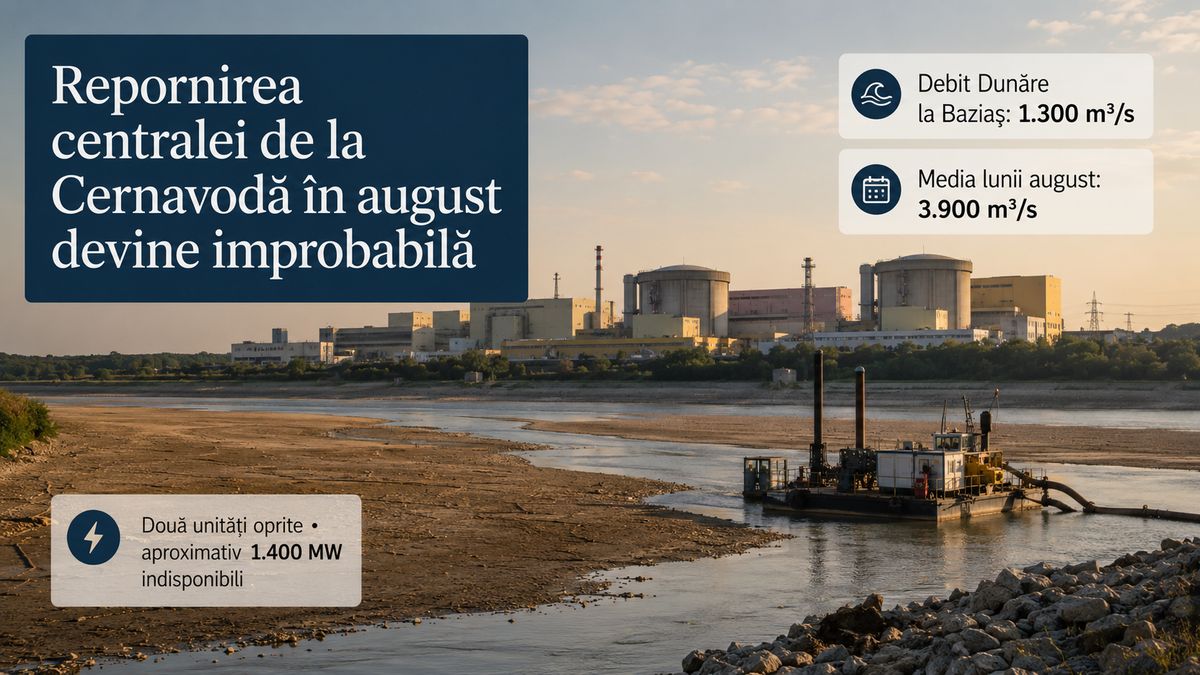
The Cernavodă nuclear power plant is heading toward the end of August with both units offline and no firm reconnection deadline. On August 22, the Danube's flow rate at the entry point into Romania, in the Baziaș section, was only 1,300 m³/s, compared to the multi-annual average of 3,900 m³/s for August. The hydrological forecast indicates an increase to approximately 1,550 m³/s by the end of the analyzed period, but the level remains far below the seasonal norm. This situation has also shifted expectations regarding the restart of the reactors. While tentative dates of August 23 for Unit 1 and August 30 for Unit 2 were considered earlier in the month, two state secretaries from the Ministry of Energy have indicated in recent days that a return by August 31 is now unlikely. Nuclearelectrica has not announced a new firm deadline, as reconnection depends on the actual water levels at Cernavodă, facility parameters, and maintaining nuclear safety margins. For the power system, the consequence is the continued absence of approximately 1,400 MW of nuclear generation, which is normally available continuously, including during evening hours when solar generation drops off. Romania can cover consumption through other sources and imports, but the prolonged outage alters the mix of resources used and could increase energy costs during peak demand periods. Authorities Shift to Direct Flow Interventions The drop in the Danube's water levels has prompted a shift from merely monitoring the hydrological situation to executing physical interventions aimed at improving water supply to the Cernavodă area. The National Committee for Emergency Situations has approved the continuation of dredging works and the construction of a spur dike on the Old Danube—a hydrotechnical structure designed to guide the current and redirect water to the area critical for the plant's supply. High-capacity pumps have also been deployed, and the Ministry of Defense is participating in topo-bathymetric and geodetic measurements, as well as underwater operations. In parallel, Hidroelectrica has begun supplementing the flow by releasing additional water from reservoirs on the Olt River, equivalent to an average flow of 50 m³/s for five days. These measures aim to increase the volume of water available in the Cernavodă area, but their impact cannot be automatically translated into a restart date. The flow measured at Baziaș takes time to propagate along the Romanian sector of the Danube, and local conditions at the plant's intake are influenced by flow distribution, hydrotechnical works, and riverbed geometry. Danube Forecast Indicates Improvement, But From an Extremely Low Baseline On August 22, the 1,300 m³/s measured at Baziaș represented about one-third of the multi-annual average for August. The forecast indicates a stagnation of the flow in the coming days, followed by an increase to approximately 1,550 m³/s. While this increase is favorable, even the forecasted value would represent less than half of the multi-annual monthly average. For the Cernavodă NPP, however, the flow rate at the Danube's entry into Romania is not the sole deciding factor for a restart. Nuclearelectrica specifies that returning the units to the grid will only occur when local parameters allow for operation under strict nuclear safety conditions. Unit 1 underwent a controlled shutdown at the end of July after the Danube's level reached very low values. Unit 2 was temporarily able to continue generation following a local improvement in conditions, but was shut down in a controlled manner on August 13 as water levels continued to drop. Both reactors are in a safe shutdown state. The current issue is the availability of electricity generation, not the nuclear safety of the facility. Romania Temporarily Loses One of Its Most Stable Generation Sources The two units at Cernavodă together produce approximately 10.6 net TWh in a normal operating year, typically accounting for about 18–20% of Romania's electricity generation. What sets this apart from many other technologies is the generation profile. The reactors supply power almost constantly, independent of wind, solar radiation, or intraday variations. The simultaneous absence of both units is therefore more difficult to replace during high-consumption hours, particularly in the evening. State Secretary Cristian Bușoi pointed out that during periods without Cernavodă's output, Romania is forced to purchase more expensive power during certain intervals, citing evening peak values of around €200–208/MWh. These levels describe specific hours on the wholesale market and do not represent the average price of energy or the final price on consumer bills. However, the prolonged shutdown could also impact future contracting. Suppliers and producers must price in risks related to resource availability, import requirements, and balancing costs. The longer the unavailability of a large, baseload source persists, the more relevant these…
Ioana Buzoaica — Independent Editorial Board
The NRG-IA newsroom continuously monitors Romanian energy markets, ANRE regulatory decisions, and national grid telemetry (SEN/SNT). We deliver independent intelligence anchored exclusively in official primary data.
Editorial Charter, Ethics & Verification Methodology →