Cernavodă: Danube Rises 4 cm, Securing Unit 2 Operation — NRG-IA
Piața de Energie Author: Ioana BuzoaicaCernavodă's outlook improves as the Danube rises 4 cm against a forecast drop, securing at least nine more days of operation for the 700 MW Unit 2.
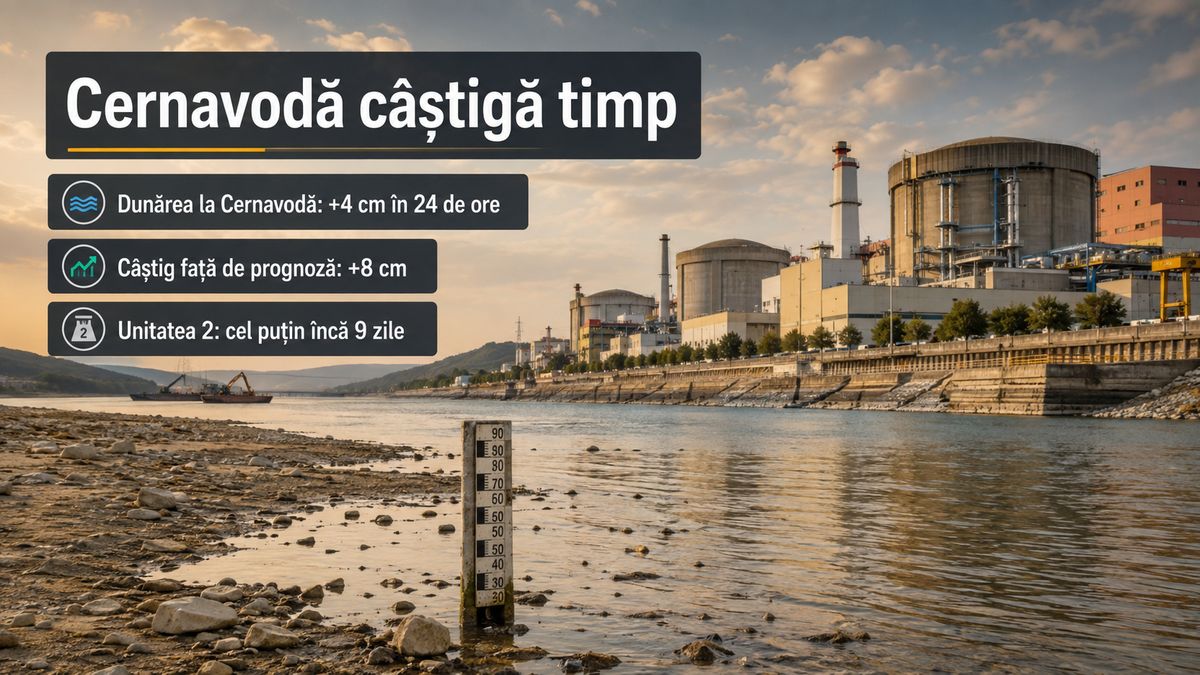
Cernavodă has gained a critical time buffer following interventions carried out in recent days on the Bala Branch and a more favorable Danube water level trend than forecasted. On the morning of August 9, the water level was 4 cm higher than 24 hours prior, despite forecasts predicting a 4 cm drop. The difference between these two trends represents a net gain of 8 cm compared to the estimated hydrological scenario. Radu Miruță announced that, based on the current forecast, this margin allows Unit 2 of the Cernavodă NPP to operate for at least another nine days . This unit currently provides almost all of Romania's nuclear output, after Unit 1 underwent a controlled shutdown on July 28 due to the extremely low level of the Danube. However, the 8 cm does not represent a physical 8 cm rise in the river in a single day. The actual measurement is +4 cm . The other 4 cm comes from the difference compared to the forecasted decline. This distinction is important because it accurately describes the outcome: the situation improved by 8 cm compared to the anticipated trajectory, while the measured level actually rose by 4 cm. Four barges and works on the Bala Branch redistribute part of the flow The increase follows a series of interventions carried out to retain more water along the Old Danube route, which is critical for supplying the Cernavodă area. On Saturday, August 8, authorities completed the controlled sinking of the last two of four barges positioned in the Bala Branch area. Two of them were placed approximately 500 meters from the entrance of the branch, and another two further upstream, in a configuration that forms two artificial sills. The role of these temporary structures is hydraulic: they reduce the volume of water drawn into the Bala Branch and help maintain a higher flow rate on the Old Danube. The intervention does not generate additional water or dam the main Danube; instead, it alters the local distribution of an already severely depleted flow. The barge operation was carried out in addition to dredging works and the intervention performed on August 3 near the Pârjoaia rock. Together, these measures aim to gain extra centimeters in downstream water levels at a time when every variation is critical for the operation of the nuclear power plant. Prior to completing the operation, specialists estimated that the four-barge system could raise the water level on the Old Danube by approximately 6–7 cm immediately after the fork with the Bala Branch, and could yield a 2–4 cm effect at Cernavodă. The 4 cm increase reported on Sunday falls within this range, but cannot be entirely attributed to the newly submerged barges. The propagation of the hydraulic effect over the approximately 60 km distance to Cernavodă takes time, and the measured level is the combined result of the interventions and the river's natural behavior. Unit 2 keeps approximately 700 MW of nuclear capacity in the grid The current situation is all the more critical for the National Energy System (SEN) as Romania is already operating with only one of the two units at Cernavodă. Nuclearelectrica announced on July 27 that Unit 1 would undergo a controlled shutdown and be disconnected from the grid on the morning of July 28, due to the unprecedentedly low level of the Danube amid severe drought. The measure was implemented in accordance with the plant's procedures for such hydrological conditions. Unit 1 has a nominal installed capacity of approximately 706.5 MW, and Unit 2 has approximately 704.8 MW. Under normal conditions, the two units together provide over 1,400 MW of stable nuclear capacity to the Romanian grid. Keeping Unit 2 online therefore preserves about half of Cernavodă's normal nuclear capacity at a time when hydropower is also constrained by drought, and wind and solar generation fluctuate heavily depending on weather conditions and the time of day. For the national grid, the difference between having one nuclear unit available and having both shut down is approximately 700 MW of baseload power that does not need to be replaced hourly by other power plants, storage, or imports. The nine days must bridge the gap until a potential recovery in flow The time gained becomes even more significant when viewed against the Danube's forecast. The river's flow rate at the entry point into Romania, at the Baziaș section, is currently extremely low. On August 8, the flow rate was approximately 1,400 m³/s , compared to a multi-annual average of about 3,900 m³/s for August . The river was thus carrying just over a third of its typical flow for this time of year. Forecasts indicated that the flow rate would remain around 1,400 m³/s until August 12, followed by a slow increase to approximately 1,450 m³/s on August 13 and 1,500 m³/s around August 15. The expected increase is linked to the downstream propagation of higher flows resulting from precipitation in the upper Danube basin. Even if the forecast is confirmed, these values remain well…
Ioana Buzoaica — Independent Editorial Board
The NRG-IA newsroom continuously monitors Romanian energy markets, ANRE regulatory decisions, and national grid telemetry (SEN/SNT). We deliver independent intelligence anchored exclusively in official primary data.
Editorial Charter, Ethics & Verification Methodology →