Cernavodă Unit 1 Offline Again; Tech Director Replaced — NRG-IA
Piața de Energie Author: Ioana BuzoaicaJust three days after reconnecting, Cernavodă Unit 1 tripped again, leaving Romania with zero nuclear generation on Nov 9 amidst high power prices.
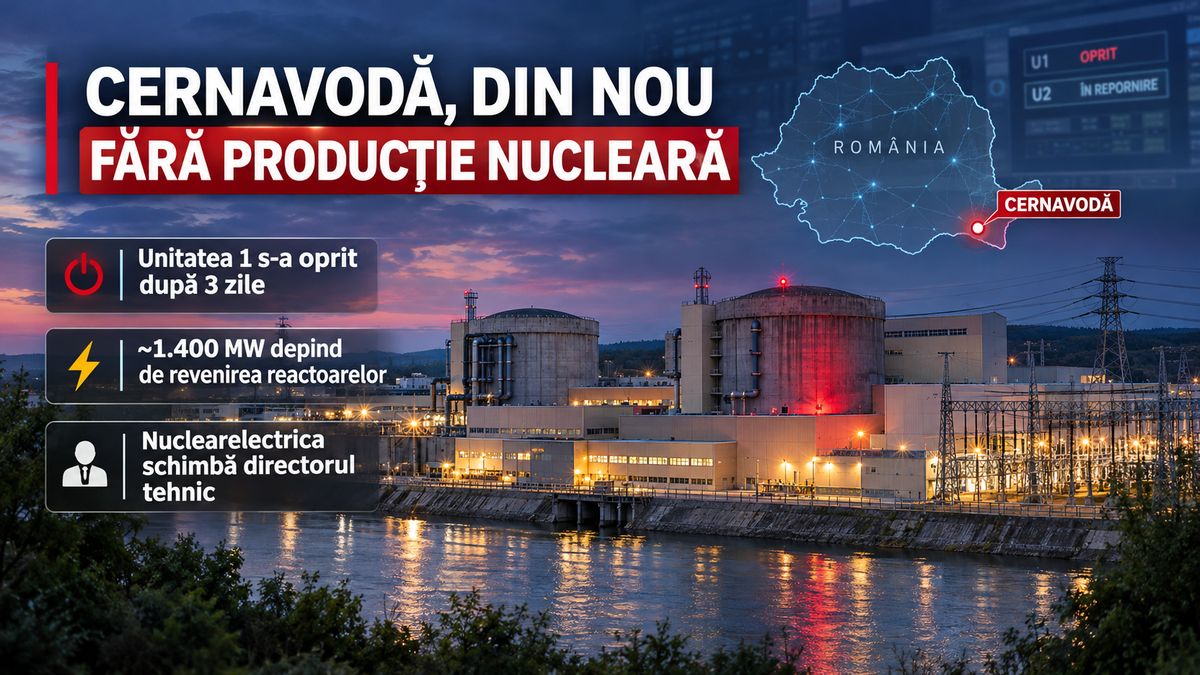
The Cernavodă Nuclear Power Plant was left without electricity generation once again on the evening of November 9, 2026, after Unit 1 disconnected from the National Power Grid (SEN), just three days after resuming operation. The fault occurred on the conventional side of the plant, prompting Nuclearelectrica to announce an unusually decisive measure: replacing the technical director effective December 1 and auditing maintenance activities. The incident came at a time when Romania was anticipating a full recovery in nuclear output following prolonged outages throughout this year's summer and autumn. Unit 2, unavailable since August 13 due to low water levels on the Danube, had entered restart procedures, with grid synchronization expected on November 10. On the morning of November 9, the operator had announced that both reactors would be fully operational by November 11. Just hours later, the new technical failure shattered those expectations. The two units at Cernavodă have a combined installed capacity of approximately 1,400 MW, supplying nearly a fifth of Romania's electricity under normal operating conditions. Their unavailability forces the power system to cover demand from alternative sources, including imports, at a time when wholesale prices have spiked above 2,000 RON/MWh. Three Days Between Reconnection and Another Outage Unit 1 was resynchronized with the National Power Grid on Friday, November 6, following an outage that began on July 28. The reactor returned to service after approximately 101 days, a period during which low water levels on the Danube prevented operation within required technical parameters. On Monday, November 9, at 11:20 AM, data from grid operator Transelectrica showed nuclear generation at 502 MW, accounting for 8.54% of domestic electricity output at that moment. Unit 1 was once again contributing to meeting demand, while plant engineers were preparing the restart of Unit 2. At 6:00 PM, Unit 1 disconnected due to a fault on the conventional side. According to the National Commission for Nuclear Activities Control (CNCAN), the reactor was brought to a safe shutdown state with no radiological consequences. Nuclearelectrica specified that the event posed no threat to nuclear safety, plant personnel, or the environment. Generation data reported on the evening of the incident indicated that the nuclear contribution to the grid had dropped back to zero. Unit 2 was still undergoing its restart sequence, while the operator had not provided a firm reconnection timeline for Unit 1. As of early November 10, official statements maintained that Unit 2 synchronization was estimated for later that day, with full nominal capacity scheduled for November 11. The sequence of events underscores ongoing operational availability challenges. On October 29, both reactors were still shut down due to hydrological conditions. Restart procedures for Unit 1 began on November 4, leading to grid reconnection on November 6, and by November 9, Nuclearelectrica announced preparations for Unit 2. The latest failure cut short this recovery before the plant could fully restore its total output. From Low Danube Levels to a Turbine Control Failure The outages during the summer of 2026 were driven by extreme hydrological conditions. Unit 1 underwent a controlled shutdown on July 28, followed by Unit 2 on August 13, after falling Danube water levels compromised cooling water intake. From that point until November 6, the plant generated no power for roughly 85 days. The issue persisted well into autumn. On October 29, Nuclearelectrica reported a 10-centimeter rise in water levels at the pump suction basin, but noted that the improvement was localized and insufficiently stable to justify restarting the reactors. The operator required sustained, adequate water levels to ensure safe operation. However, the November 9 trip was of a different nature. Nuclearelectrica traced the issue to the balance of plant (non-nuclear side) of Unit 1. According to Transelectrica data cited by HotNews, the incident was linked to a failure in the turbine condenser vacuum control system. The condenser is a critical component of the steam cycle. After steam drives the turbine, it is cooled back into water for recirculation. Maintaining proper condenser vacuum is essential for turbine performance. A control system malfunction can force a turbine trip and generator disconnection, even when the nuclear reactor and its safety systems remain fully secure. The operator will conduct a detailed root-cause investigation to determine the exact origin of the failure. Identifying the location of the fault does not, in itself, establish whether it stemmed from a component defect, maintenance shortfall, or another technical issue. Nuclearelectrica Replaces Technical Director and Audits Maintenance The executive response from Nuclearelectrica represents one of the most significant developments following the incident. In its November 9 press release, the…
Ioana Buzoaica — Independent Editorial Board
The NRG-IA newsroom continuously monitors Romanian energy markets, ANRE regulatory decisions, and national grid telemetry (SEN/SNT). We deliver independent intelligence anchored exclusively in official primary data.
Editorial Charter, Ethics & Verification Methodology →