Cernavodă: Unit 2 Restarts as Unit 1 Remains Under Repair — NRG-IA
Piața de Energie Author: Ioana BuzoaicaNuclearelectrica expects Cernavodă Unit 2 to reconnect on 11 November 2026, while Unit 1 remains offline following a non-nuclear fault.
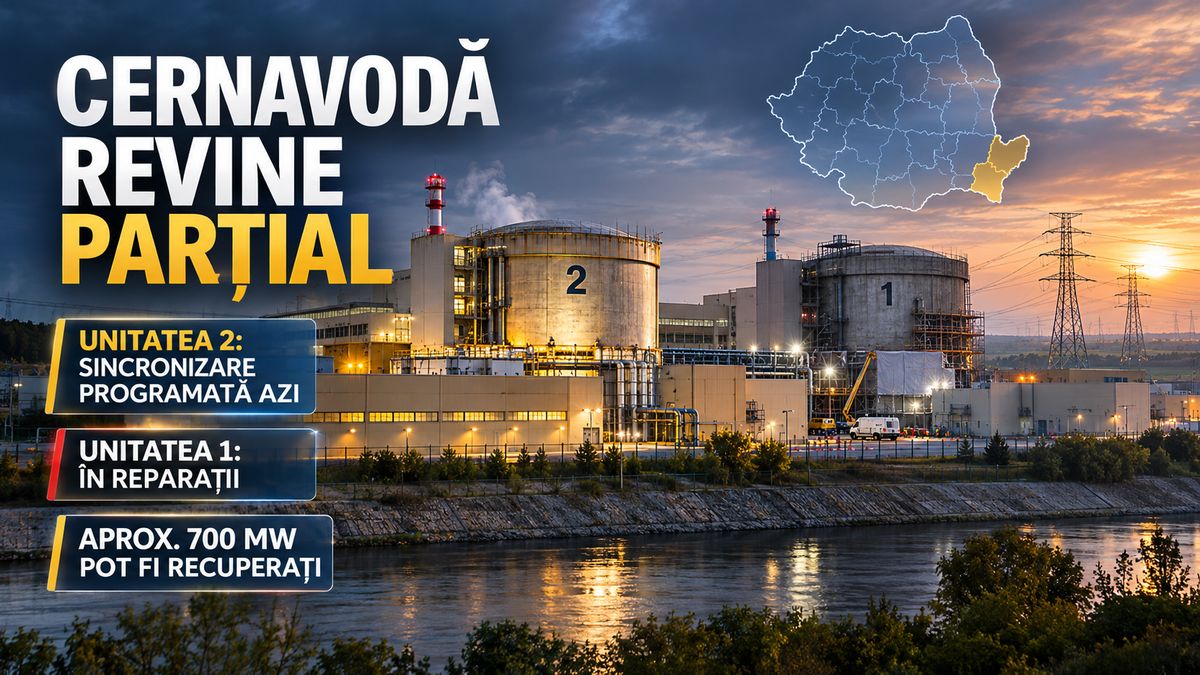
Romania is nearing the recovery of a significant portion of the nuclear generation lost in recent months. Operator Nuclearelectrica announced that Unit 2 of the Cernavodă Nuclear Power Plant is scheduled to synchronize with the National Power System on Wednesday, 11 November 2026, reaching nominal capacity on Thursday, 12 November. The schedule was officially filed with the Bucharest Stock Exchange on 10 November following revisions to initial restart estimates. However, the recovery remains partial. Unit 1, which reconnected to the grid on 6 November following an outage of over three months, was disconnected again on the evening of 9 November due to a fault in the plant's conventional (balance of plant) section. Nuclearelectrica estimates two to four days for maintenance and repair work, after which the procedures required for a fresh grid synchronization will begin. These two developments keep the plant in an unusual operational state: Romania has roughly 1,400 MW of installed nuclear capacity at Cernavodă, but its full recovery hinges on two separate technical processes. Unit 2 must complete its restart following an outage caused by hydrological conditions, while Unit 1 must resolve a malfunction that occurred immediately after returning to service. At the time of reporting, no public confirmation had been issued regarding the effective synchronization of Unit 2 during the day of 11 November. From July to November: How Cernavodă ended up without nuclear generation The current difficulties originated in the summer of 2026, when low Danube water levels and flow rates impacted the plant's operational conditions. Unit 1 underwent a controlled shutdown and was disconnected from the national grid on 28 July, while Unit 2 was gradually ramped down and taken offline in mid-August. As a result, Romania temporarily lost the contribution of both nuclear reactors—a situation with major ramifications for the structure of national electricity supply. The Cernavodă plant utilizes CANDU technology, and its operation relies heavily on cooling water availability. Hydrological conditions can impose operational constraints even when nuclear systems are functioning faultlessly. In this instance, the summer shutdowns were linked entirely to water resource availability, rather than any nuclear safety incident. Rising Danube water levels allowed restart procedures for Unit 2 to begin on 9 November. Nuclearelectrica had originally targeted grid synchronization for 10 November and full capacity by 11 November. The timeline was subsequently pushed back by one day, according to a market report filed on 10 November. The updated forecast expects synchronization on 11 November and nominal output on 12 November. Meanwhile, Unit 1 had managed to reconnect to the system on 6 November. Its return marked the first concrete step toward restoring nuclear output, but operations were halted after just three days. According to reports in the energy trade media, power reductions related to steam turbine operation preceded the disconnection. Unit 1: Conventional island fault with no nuclear safety impact Nuclearelectrica confirmed that the 9 November disconnection of Unit 1 was caused by a fault in the conventional (non-nuclear) side of the plant. This section houses the equipment that converts available thermal energy into mechanical energy and electricity, including the turbine and generator systems, which are separate from the nuclear island itself. The company stated that the shutdown was executed in accordance with standard procedures and had no impact on nuclear safety, plant personnel, or the environment. This distinction is key: a failure that halts power generation does not automatically imply an issue with the reactor or a compromise of nuclear safety standards. In its 10 November filing, Nuclearelectrica outlined an estimated window of two to four days for repairs and maintenance. This timeframe applies solely to technical work rather than guaranteeing a firm power resumption date. Once repairs are complete, the unit must undergo specific procedures for startup, testing, and grid synchronization. Consequently, full restoration of Cernavodă's generation remains contingent on both confirming Unit 2's stable operation and resolving the issues at Unit 1. The two timelines cannot be treated as equivalent, even if initial estimates suggested closely aligned return dates. Up to 20% of Romania's electricity supply hinges on the plant's return The significance of restarting these reactors extends far beyond a routine technical maneuver. Under normal operating conditions, Cernavodă's two units cover roughly 20% of Romania's electricity demand, according to Nuclearelectrica. This is a substantial share, valued particularly for the continuous baseload nature of nuclear energy, which operates independently of daily fluctuations in wind or solar radiation. Each of the two units has a gross installed capacity of approximately 700 MW, with net…
Ioana Buzoaica — Independent Editorial Board
The NRG-IA newsroom continuously monitors Romanian energy markets, ANRE regulatory decisions, and national grid telemetry (SEN/SNT). We deliver independent intelligence anchored exclusively in official primary data.
Editorial Charter, Ethics & Verification Methodology →