Cernavodă shuts down Unit 2 due to record low Danube levels — NRG-IA
Piața de Energie Author: Ioana BuzoaicaSevere drought and low Danube levels forced Cernavodă to shut down completely, leaving Romania's grid without nuclear power as Unit 2 goes offline.
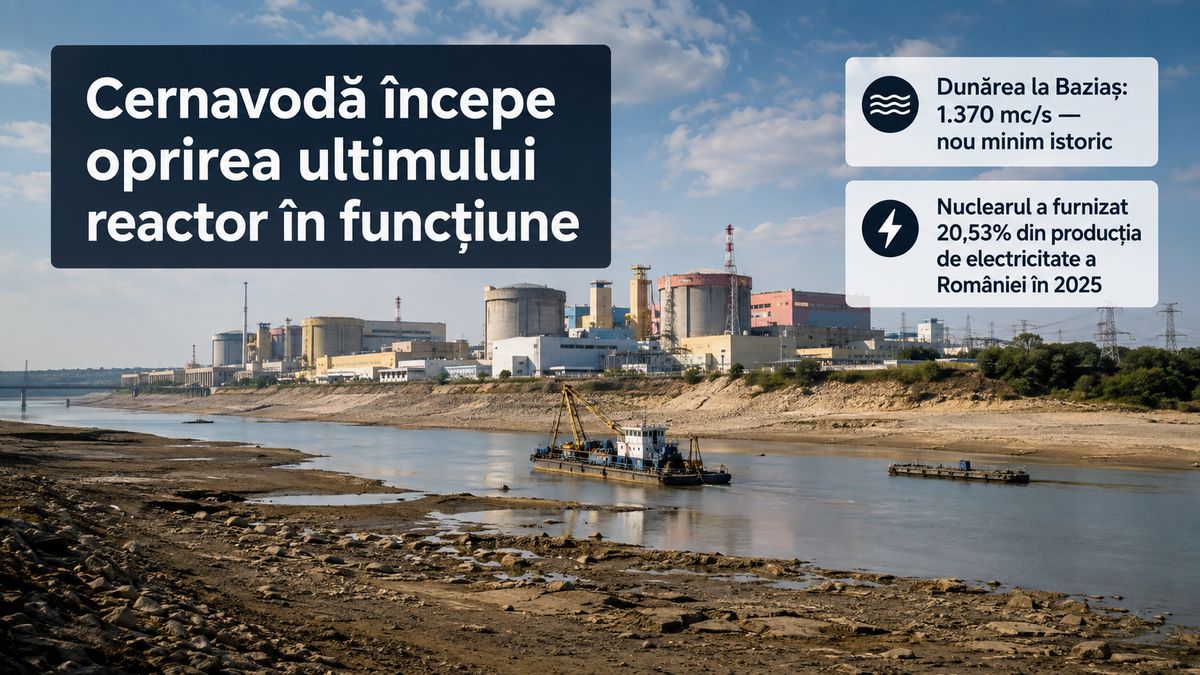
On Thursday, August 13, Nuclearelectrica began disconnecting Unit 2 of the Cernavodă Nuclear Power Plant from the National Energy System (SEN), the last remaining operational nuclear reactor in Romania. The decision comes as Danube water levels continued to drop despite emergency interventions to maintain the necessary cooling water for the plant. Unit 1 has been offline since late July, also due to extreme hydrological conditions. Shutting down Unit 2 removes the last available nuclear component from the grid during this drought episode. The two CANDU reactors at Cernavodă have a combined net reference capacity of 1,300 MW (650 MW each) and a cumulative gross electrical capacity of 1,411 MW. In 2025, nuclear energy supplied 20.53% of Romania's electricity generation , according to the International Atomic Energy Agency's PRIS database. The shutdown process is controlled and preventive. Nuclearelectrica had established in late July that the units must be taken offline when parameters related to the Danube's level approach operational limits, in order to preserve nuclear safety margins and equipment reliability. The Danube dropped from 1,600 to 1,370 cubic meters per second in less than two weeks Pressure on the plant has mounted rapidly. On July 30, the National Institute of Hydrology and Water Management measured a flow rate of 1,600 m³/s at Baziaș, already well below the multi-annual July average of 4,700 m³/s, with forecasts pointing to further declines. By August 11, the flow rate had fallen to just 1,370 m³/s , a value described as a new historic low. For comparison, the multi-annual average for August is approximately 3,900 m³/s . Consequently, the flow rate at the Danube's entry point into Romania had dropped to about one-third of its typical August average. However, the figure at Baziaș does not trigger an automatic shutdown for Cernavodă. The plant monitors local hydrological and technical parameters of its water supply systems, and Nuclearelectrica decides to shut down when these approach the operational limits established by the plant's procedures. Unit 1 had already undergone a controlled shutdown on the morning of July 28. A day later, Nuclearelectrica announced that Unit 2 was also scheduled for shutdown, but evolving parameters near the plant allowed it to remain temporarily operational. That delay proved critical for the national grid: for over two weeks, Unit 2 remained Romania's sole available nuclear power source. Barges, dredging, and rock blasting bought time for the reactor During this period, authorities resorted to unprecedented hydrotechnical interventions to maintain water flow in the Cernavodă area. Works included dredging the riverbed, blasting a rock obstruction, and using stone-loaded barges to redirect a larger volume of water toward the plant's intake. On August 10, authorities estimated that these interventions had raised local water levels by approximately 4 centimeters , allowing Unit 2 to operate for a few more days. However, hydrological forecasts indicated a continued decline of the Danube, and three days later, Nuclearelectrica initiated the shutdown process. While the interventions extended the operational window, they did not reverse the hydrological trend. The drought continued to deplete water resources to the point where keeping the reactor online was no longer compatible with the safety margins established by the plant's procedures. The grid must replace approximately 1.3 GW of net nuclear capacity The temporary loss of nuclear power immediately shifts pressure onto the rest of the National Energy System. The Ministry of Energy announced the startup of a 330 MW lignite-fired unit , alongside increased reliance on wind power and available hydropower from reservoirs. Slightly cooler temperatures could also help reduce peak evening demand. The 330 MW represents the capacity of the activated unit, not a guarantee that it will continuously generate at nominal capacity. Furthermore, this lignite capacity can only cover a fraction of the roughly 1,300 MW net capacity of the two nuclear units, leaving the grid to rely on a combination of alternative compensatory sources. Electricity imports will be key. The Ministry of Energy points to a cross-border capacity of approximately 4,000 MW for the Romanian grid, which can facilitate electricity imports. This figure represents the system's total transfer capacity, not the actual volume imported at any given moment, and commercial availability depends on regional grid conditions and generation. Pressure intensifies during evening hours when solar generation drops, forcing the grid to cover demand through dispatchable power plants, available hydropower, wind, storage, and imports. In this context, the temporary loss of a baseload source of Cernavodă's scale reduces the domestic margin available to the system operator to balance supply and demand. Industrial demand response remains the final safety net The government has also…
Ioana Buzoaica — Independent Editorial Board
The NRG-IA newsroom continuously monitors Romanian energy markets, ANRE regulatory decisions, and national grid telemetry (SEN/SNT). We deliver independent intelligence anchored exclusively in official primary data.
Editorial Charter, Ethics & Verification Methodology →