Cernavodă Unit 1 Restarts; Reconnection Expected Nov 6 — NRG-IA
Piața de Energie Author: Ioana BuzoaicaNuclearelectrica has begun restarting Cernavodă Unit 1, offline since July 28 due to low Danube levels. Unit 2 remains dependent on hydrology.
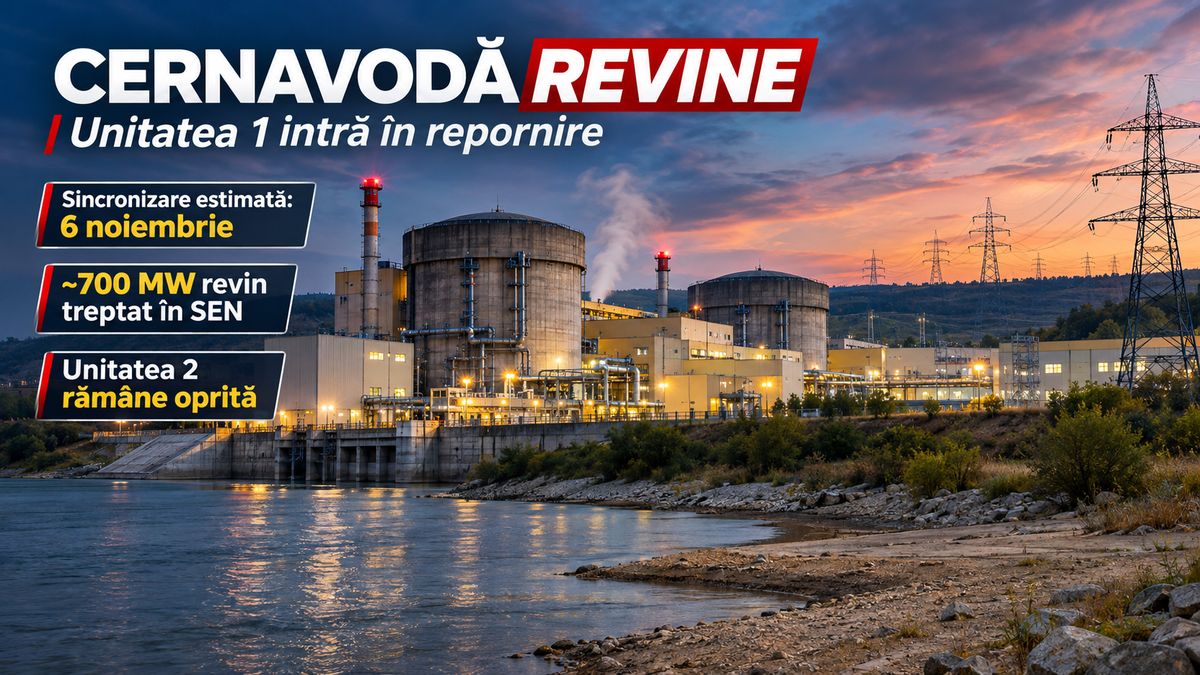
Romania is preparing to recover one of its most critical power generation assets after more than three months during which both nuclear reactors at Cernavodă were rendered unavailable by severe drought. Nuclearelectrica announced on November 4, 2026, the initiation of startup maneuvers for Unit 1, which has an installed capacity of approximately 700 MW. Its resynchronization to the National Power System (SEN) is estimated for Friday, November 6. The announcement marks the first major operational shift at the plant following months of hydrological deficit that forced the operator to shut down both units sequentially. Unit 1 was disconnected on July 28, followed by Unit 2 on August 13. Since then, the Romanian power grid has operated without Cernavodă's nuclear output, during a period marked by pressure on hydropower generation, high import reliance, and elevated energy price volatility. The return of the first reactor comes at a crucial moment for security of supply. The government projects national peak electricity demand could reach 8,500 MW in November, with the 17:00–21:00 window considered particularly vulnerable due to low availability from certain generation sources. Recovering a nuclear capacity of this scale can substantially improve the energy balance, even though the simultaneous operation of both reactors remains subject to Danube water levels. Unit 1 could gradually return to an output of 620 MW by Saturday According to Nuclearelectrica, startup maneuvers commenced after meeting the minimum required conditions for a safe operational resumption. The procedure involves a sequence of technical checks and stages to ensure grid reconnection and power ramp-up are executed in a controlled manner. The company communicated an estimated resynchronization date of November 6 without confirming a power output level already achieved. The tentative startup schedule attributed to grid operator Transelectrica, reported by financial media, outlines a phased increase in capacity. Following synchronization, the unit is expected to run initially at around 40 MW, before stepping up to 335 MW—a level to be maintained through Saturday. Subsequently, output is projected to rise to approximately 620 MW, with entry into normal operational mode estimated for November 7 at around 19:00. These figures outline the planned schedule for output resumption rather than power already fed into the grid. Furthermore, the reactor's installed capacity of approximately 700 MW should be distinguished from the 620 MW targeted for the final phase of startup. If the unit operates continuously at this latter output, corresponding generation would reach approximately 14.9 GWh over 24 hours—a significant contribution to Romania's daily electricity requirement. Danube river flow begins to recover, but remains nearly 64% below November average The restart of Unit 1 is made possible by an improvement in hydrological conditions, following a prolonged period during which water levels restricted plant operations. Data from the National Institute of Hydrology and Water Management show that Danube river flow upon entering Romania at Baziaș increased from 1,350 m³/s on October 29 to 1,700 m³/s on November 4. While this increase represents a positive trend, river flow remains severely depressed compared to seasonal norms. The multi-year average for November at Baziaș stands at approximately 4,700 m³/s. Consequently, the flow recorded on November 4 represented only 36% of this multi-year average, leaving a deficit of nearly 64%. For plant operations, however, the critical parameter is the actual availability of water at Cernavodă's intake facilities, rather than river flow recorded at the entrance into the country. Local water levels, their temporal evolution, and the capacity of water intake infrastructure dictate whether units can operate safely. Therefore, an increased flow at Baziaș does not automatically enable the simultaneous operation of both reactors. On October 29, Nuclearelectrica had already noted a local rise of approximately 10 centimeters in the pump suction basin, but deemed the trend insufficiently stable for a restart. The November 4 decision indicates that operational conditions for initiating Unit 1 startup have since improved sufficiently to proceed. Unit 2 remains offline: single-reactor operation consumes local water supply Recovering output from Unit 1 is only the first phase in restoring the plant to full operational capacity. Nuclearelectrica explained that running the reactor requires significant volumes of cooling water, which will lower water levels in the suction basin. Under these conditions, restarting Unit 2 remains dependent on a sustained rise in Danube levels capable of meeting the cooling requirements of both units. This constraint explains why improved hydrology currently allows for the resumption of only a single reactor. The two units have a combined installed capacity of approximately 1,400 MW, meaning the…
Ioana Buzoaica — Independent Editorial Board
The NRG-IA newsroom continuously monitors Romanian energy markets, ANRE regulatory decisions, and national grid telemetry (SEN/SNT). We deliver independent intelligence anchored exclusively in official primary data.
Editorial Charter, Ethics & Verification Methodology →