Cernavodă offline: How Romania covers 1.4 GW gap — NRG-IA
Piața de Energie Author: Ioana BuzoaicaDrought has taken Romania's nuclear fleet offline, forcing a reliance on strained hydro, GW-scale imports, and high southern gas flows to cover 1.4 GW.
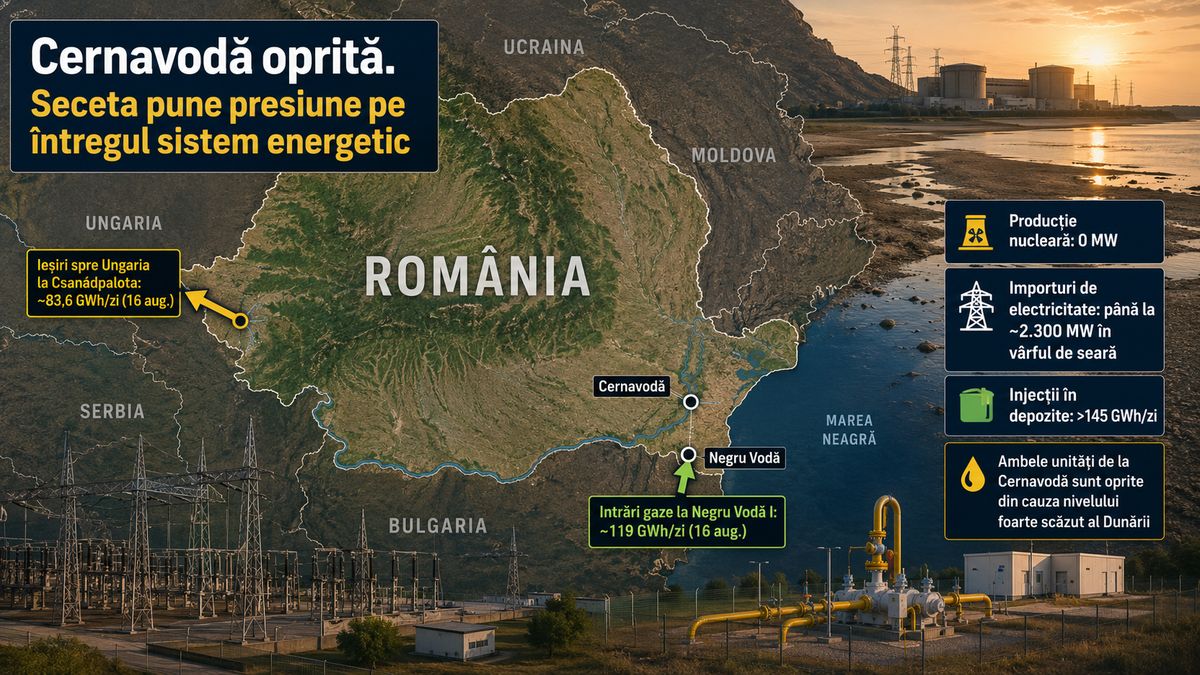
In August, Romania is experiencing one of its most unusual energy configurations in recent years. Both reactors at Cernavodă are offline, nuclear generation has dropped to zero, hydropower is constrained by drought, and the system must find hourly replacements for approximately 1.4 GW of baseload capacity. Unit 1 at Cernavodă was shut down on July 28 following a severe drop in the Danube's water levels. On August 13, the controlled shutdown of Unit 2 began, with Nuclearelectrica explaining that the river's level could no longer safely maintain the parameters required for the technical and cooling water supply under nuclear safety standards. Romania has thus been left temporarily without the nuclear power that normally provides a significant and relatively constant share of domestic electricity generation. However, this gap is not being filled by a single technology. Depending on the hour, the system relies on a mix of solar, hydrocarbons, hydro, coal, and electricity imports, while the gas grid must simultaneously serve domestic consumption, power plants, regional transit, and gas storage injection. This convergence of events also caught the attention of the Russian media. On August 18, EADaily published an article built around the premise that Romania, left without nuclear generation, would require more Russian gas. However, energy data reveals a broader story: the issue is not a simple substitution of nuclear with gas, but rather how the entire Romanian system rebalances following the simultaneous loss of both reactors. 1.4 GW vanishes from the system, and the deficit must be covered hour by hour The loss of Cernavodă has varying impacts depending on the time of day. At midday, when solar generation is high, the system can absorb the absence of nuclear power much more easily. On August 13, following the shutdown of Unit 2, Romania was producing around 5,187 MW at 1:00 PM against a consumption of about 4,656 MW, even managing to export approximately 531 MW. The situation changes radically after sunset. Solar generation drops to zero within a few hours, while consumption remains high. The Ministry of Energy estimated that, after Unit 2 went offline, import requirements during the evening peak could reach approximately 2,300 MW , with Romania having up to 4,000 MW of cross-border import capacity available. On August 18, around 1:00 PM, hydrocarbon-fired generation stood at approximately 1,173 MW , nuclear remained at zero, and the gap between domestic production and consumption reached nearly 1,800 MW , covered by cross-border flows. Cernavodă is therefore not replaced by a single power plant or fuel source. The deficit from the two reactors is distributed between available domestic generation and regional imports, with the ratio shifting almost continuously. Gas from the south becomes more critical in a system under pressure In parallel with the nuclear shutdown, significant volumes of gas are flowing through southern Romania. Transgaz data for August 16 indicates a physical flow of approximately 119,029 MWh/day at Negru Vodă I, the interconnection point with Bulgaria. This is the equivalent of about 119 GWh of gas energy entering through this point in a single day. Also on August 16, Romania exported approximately 83,647 MWh/day to Hungary via Csanádpalota, while domestic production injected around 244,000 MWh/day into the system. This balance highlights how interconnected the Romanian market has become. Gas can enter from the south, supply domestic consumption, contribute indirectly to electricity generation, flow onward to other markets, or allow domestic production to be directed into storage. In this configuration, Negru Vodă is not merely an import point for Romanian consumption. It is one of the entry points of a regional system where volumes are constantly redistributed. Storage facilities absorb over 145 GWh of gas per day One of the most critical elements in the current balance is gas storage. On that same day, August 16, Transgaz reported approximately 135,014 MWh/day injected into Romgaz storage facilities , plus an additional 10,554 MWh/day via Corunca . This results in over 145,000 MWh of gas injected into storage in a single day . This figure explains why the large volumes entering the system cannot be automatically attributed solely to electricity generation. Romania is simultaneously preparing for winter. Current consumption thus competes with the need to maintain high stock levels for the cold season, and the gas system must support both objectives. In a normal summer, this process would take place without the complete loss of nuclear generation. In August 2026, however, the two markets—electricity and gas—become much more tightly linked. TurkStream keeps Southeast Europe connected to Russian gas Against the backdrop of this domestic situation lies the regional context of TurkStream. Following the cessation of Russian gas transit through Ukraine at the beginning of 2025, TurkStream has…
Ioana Buzoaica — Independent Editorial Board
The NRG-IA newsroom continuously monitors Romanian energy markets, ANRE regulatory decisions, and national grid telemetry (SEN/SNT). We deliver independent intelligence anchored exclusively in official primary data.
Editorial Charter, Ethics & Verification Methodology →