Cernavodă Unit 2 shutdown risk: How Romania covers 700 MW — NRG-IA
Piața de Energie Author: Ioana BuzoaicaRomania faces its toughest grid test this summer: the potential loss of all Cernavodă nuclear power, requiring coal, gas, hydro, and imports to fill the gap.
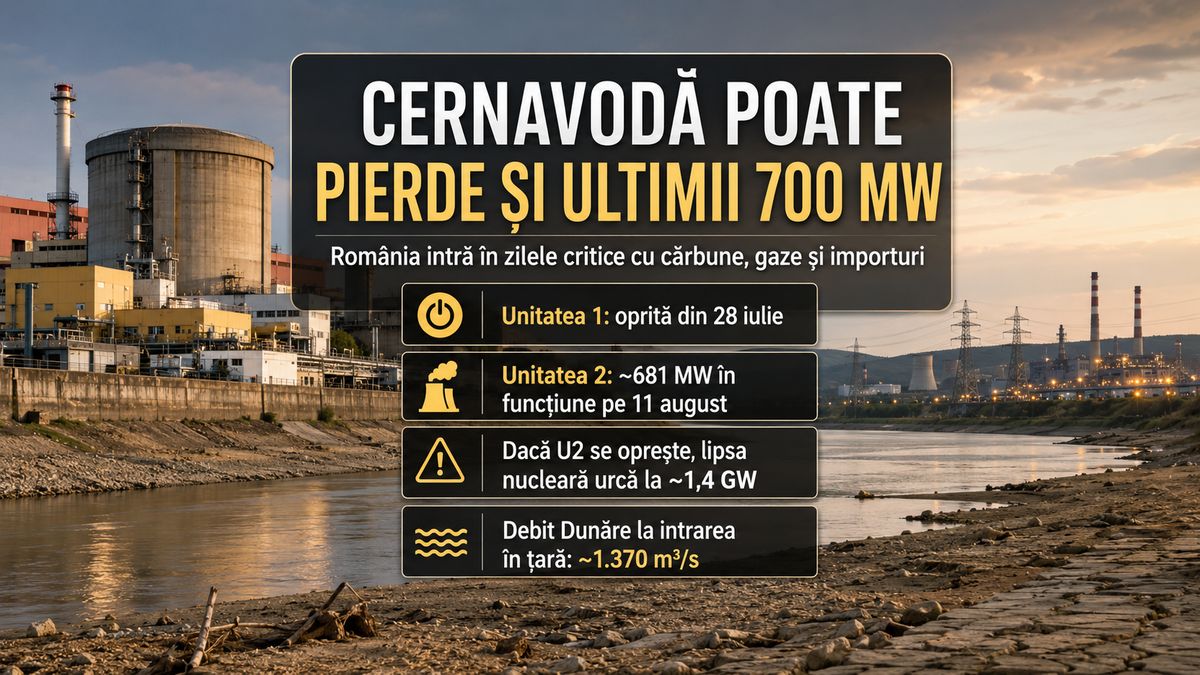
Romania could lose the last remaining ~700 MW produced by the Cernavodă Nuclear Power Plant starting August 13. Unit 1 has been offline since July 28 due to extremely low Danube water levels, and Nuclearelectrica has flagged August 13 as a potential date for a controlled shutdown of Unit 2 if hydrological conditions and operating parameters no longer allow for safe operation. The stakes for the National Energy System (SEN) are considerable. Under normal conditions, the two CANDU reactors jointly provide nearly 1.4 GW of baseload capacity, covering a significant portion of Romania's electricity demand. With Unit 1 already offline, the grid has been operating without approximately 700 MW of nuclear power for over two weeks. Shutting down Unit 2 would double this deficit. The latest production data available before August 12 confirmed that Unit 2 continued to operate close to its usual capacity. On the evening of August 11, nuclear output stood at approximately 681 MW, a level consistent with the operation of a single reactor at Cernavodă. The issue is not just the scale of the capacity that could go offline, but the timing of when Romania must replace it. The drought affecting the nuclear plant's cooling system simultaneously reduces the resources available for hydropower, and the grid is already heavily reliant on thermal generation and imports during the hours when solar output rapidly declines. Danube dredging and interventions prolonged Unit 2 operations Authorities and the plant operator have spent recent days trying to keep Unit 2 online for as long as possible. Dredging and riverbed clearing operations were carried out, and four stone-laden barges were scuttled to alter local water flows and direct a larger volume toward the plant's intake. The intervention raised local water levels by approximately four centimeters and, according to the Ministry of Energy, could extend the reactor's operation by about nine days. This period represented the estimated additional operating time gained from the hydrotechnical works, not the duration of a potential shutdown. Restarting a reactor offline due to hydrological reasons depends on the recovery of Danube water levels and meeting the parameters required for safe operation. The Danube's flow rate at the entry point into the country had dropped to approximately 1,370 cubic meters per second, and available forecasts indicated that hydrological pressure would persist until at least around August 16. Unit 2 was also close to shutting down in late July. Nuclearelectrica had announced plans for a controlled shutdown on July 29, but an analysis of parameters the following morning allowed operations to continue. However, subsequent developments on the Danube have once again pushed the reactor close to its operational limit. The grid is already compensating for the absence of Unit 1 Data from August 11 illustrates the mechanism by which Romania is currently covering the roughly 700 MW lost with the shutdown of Unit 1. Around 18:05, national consumption stood at approximately 6,682 MW, while domestic generation was around 5,873 MW. Nuclear provided about 681 MW, hydropower around 1,388 MW, hydrocarbon-fired plants approximately 1,243 MW, coal around 851 MW, and solar PV about 1,544 MW. The deficit was covered by net imports of approximately 809 MW. Just a few hours earlier, the situation was almost reversed. During the afternoon, solar PV generation neared 3,000 MW, hydropower was heavily dialed back, and Romania was able to export electricity. However, the transition from afternoon to evening rapidly shifts the balance. As solar generation drops, the grid must ramp up hydro, thermal generation, and imports within a window of just a few hours. This difference explains why a potential shutdown of Unit 2 would exert the greatest pressure not at noon—when solar PV can supply several gigawatts—but during the evening, night, and morning, when the ~700 MW of nuclear power must be replaced by dispatchable sources or imported electricity. Shutting down Unit 2 would increase the compensation requirement by another 700 MW Based on the situation on the evening of August 11, if the 681 MW provided by nuclear power had been missing and all other sources remained unchanged, the gap between consumption and domestic production would have widened from approximately 809 MW to nearly 1,490 MW. This calculation is not a forecast of imports following a Unit 2 shutdown. The system operator can adjust the output of other units, utilize more hydropower within the limits of available water resources, call for additional thermal generation, and utilize cross-border capacity. However, the calculation highlights the scale of the challenge: a ~700 MW nuclear reactor delivers baseload power continuously, regardless of the time of day, and replacing it requires an equivalent amount of firm capacity. Romania would thus find itself simultaneously compensating for the absence of both Cernavodă units—a…
Ioana Buzoaica — Independent Editorial Board
The NRG-IA newsroom continuously monitors Romanian energy markets, ANRE regulatory decisions, and national grid telemetry (SEN/SNT). We deliver independent intelligence anchored exclusively in official primary data.
Editorial Charter, Ethics & Verification Methodology →