Cernavodă Offline: Romania Extends Energy Safety Measures — NRG-IA
Piața de Energie Author: Ioana BuzoaicaRomania has run without Cernavodă's 1,400 MW for 2 weeks. The grid is stable, but Transelectrica wants emergency tools kept for September demand peaks.
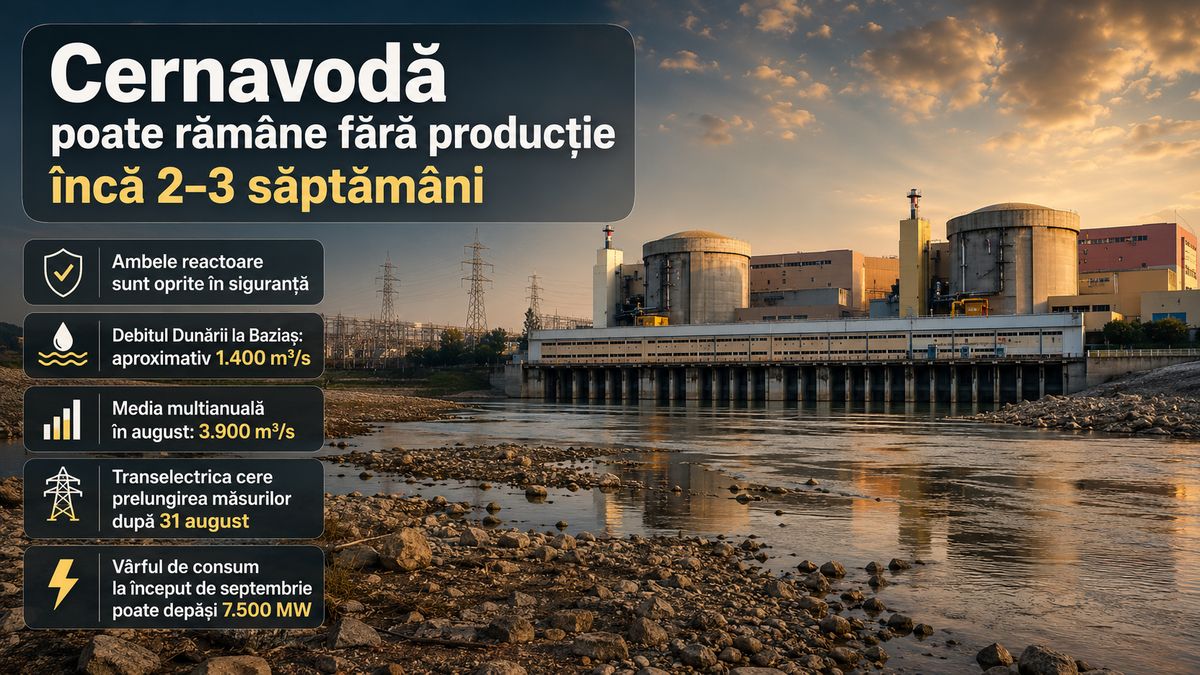
Romania is preparing to maintain into September the extraordinary mechanism through which Transelectrica can protect the power grid in the event of a severe generation deficit, while both reactors at Cernavodă remain offline due to the extremely low flow of the Danube. On August 27, Transelectrica sent a briefing to the Ministry of Energy requesting the analysis of a new Government Decision to allow the continued application of the Consumption Limitation Regulation. The current framework, established by Government Decision 603/2026, is valid until August 31. The mechanism does not mean that industry will be automatically curtailed starting September 1. Instead, it provides the National Energy Dispatcher (DEN) with additional tools in the event that domestic generation and imports are no longer sufficient to safely maintain the National Power Grid (SEN). On August 28, in Chișinău, President Nicușor Dan stated that the current risk of industrial operators being disconnected is "very low." At the same time, based on hydrologists' estimates, he indicated a window of another two to three weeks before there might be enough water to restart at least one of the Cernavodă reactors. However, Nuclearelectrica has not announced a reconnection date. The company specified that the return of the units will be decided based on hydrological developments and the technical parameters required for safe operation. Romania operates without approximately 1,400 MW of nuclear generation Unit 1 at Cernavodă, with a capacity of approximately 700 MW, underwent a controlled shutdown on July 28 after the Danube's water level neared the limits required for safe operation. Unit 2 initially remained online, but deteriorating hydrological conditions prompted Nuclearelectrica to initiate its controlled shutdown on August 13. Since then, Romania has been operating without any nuclear generation from Cernavodă—about 1,400 MW of capacity that, under normal conditions, is continuously available and independent of wind or solar radiation. On August 24, Nuclearelectrica confirmed that both reactors were in a safe shutdown state and that there was no operational or nuclear safety risk associated with the situation. The nuclear plant's absence has not caused any supply issues so far. On August 18, Transelectrica stated that the national grid was operating stably, with available generation and import capacities compensating for the unavailability of the two units. This stability explains why the immediate risk of industrial curtailment is currently assessed as low. However, the request to extend the mechanism addresses what could happen in September if multiple unfavorable conditions occur simultaneously. The evening peak becomes the system's vulnerability The issue identified for early September is not a lack of energy throughout the day, but rather the amount of dispatchable capacity available during intervals when consumption is high and solar generation drops rapidly. Transelectrica points to the evening peak between 18:00 and 22:00 as the sensitive window. The Ministry of Energy estimates that with people returning from vacations, the resumption of economic activity, and the start of the school year, consumption could exceed 7,500 MW on hot days. At the same time, available generation may remain limited. Coal-fired plants are estimated to have a maximum capacity of around 1,200 MW, given limited fuel reserves. Wind generation is forecasted within a very wide range, between approximately 200 and 800 MW. Solar power can continue to provide high output in the middle of the day, but its contribution declines just before the evening peak. For early September, daily peaks are estimated below 3,000 MW, with the possibility of dropping to around 2,300 MW between September 3 and 6. As days grow shorter, the gap between declining solar generation and sustained high consumption becomes harder to bridge without sufficient dispatchable plants, hydropower, or imports. Cernavodă would eliminate a significant portion of this vulnerability. Until a unit returns, the roughly 700 MW from each reactor is missing from the exact category of continuous, dispatchable generation that the system needs. The Danube remains at about one-third of its normal flow for August Hydrological conditions remain the decisive factor. On August 26, the Danube's flow at the entry point into the country, at Baziaș, was approximately 1,400 cubic meters per second , compared to the multi-annual average of 3,900 cubic meters per second for August. The forecast for the period leading up to early September indicated a temporary increase to around 1,600 cubic meters per second, followed by another decline to 1,500 cubic meters per second. For September, the multi-annual average is about 3,800 cubic meters per second. The Government described the current episode as hydrologically exceptional and has resorted to physical interventions to improve water supply in the Cernavodă area. Dredging…
Ioana Buzoaica — Independent Editorial Board
The NRG-IA newsroom continuously monitors Romanian energy markets, ANRE regulatory decisions, and national grid telemetry (SEN/SNT). We deliver independent intelligence anchored exclusively in official primary data.
Editorial Charter, Ethics & Verification Methodology →