EVs: China Hits 67%, Norway 98.8% — Costs & Home Charging — NRG-IA
Tehnologie & Inovație Author: Ioana BuzoaicaPlug-in cars hit 67% in China as Norway reaches 98.8% pure EVs. Meanwhile, home charging, maintenance, and battery life reshape ownership economics.
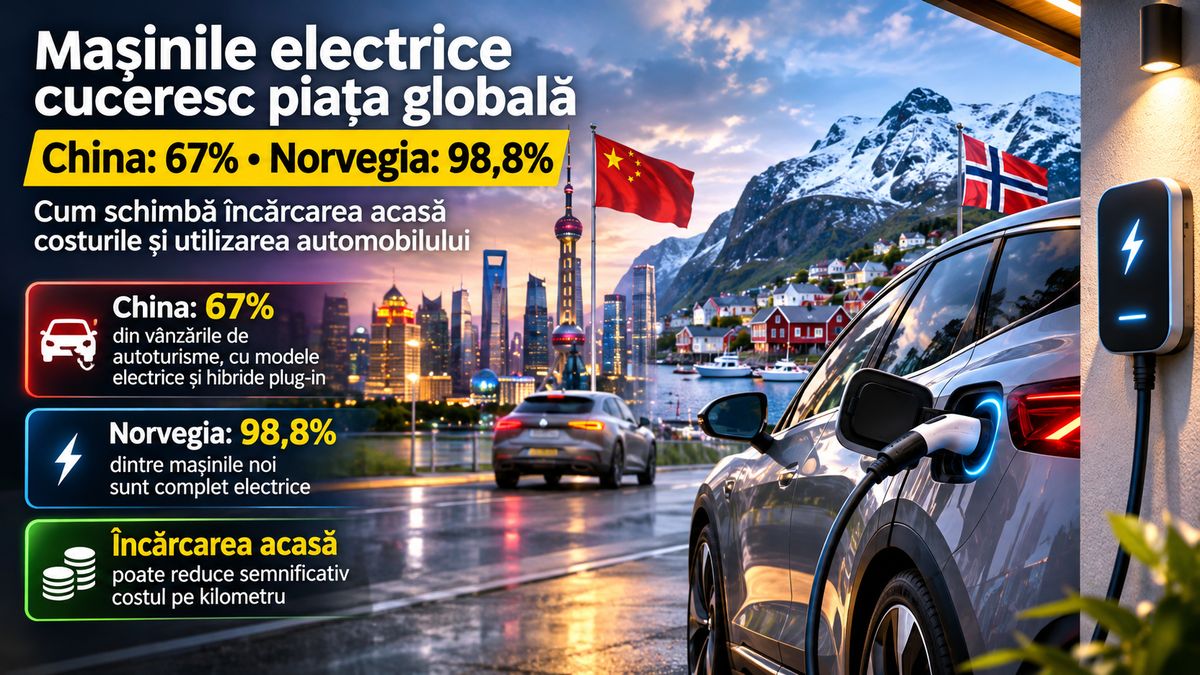
Electric cars are approaching total dominance in some of the world's most critical automotive markets. In September 2026, plug-in vehicles accounted for 67% of passenger car sales in China, according to data from industry association CPCA. A month later in Norway, fully electric cars reached 98.8% of all new passenger car registrations, official OFV statistics show. These two figures highlight markets at different stages of transition. In China, the 67% share includes both battery-electric vehicles (BEVs) and plug-in hybrids (PHEVs), which also feature an internal combustion engine. In Norway, the 98.8% figure refers exclusively to battery-powered vehicles. Beyond this distinction, the overarching trend is clear: electric powertrains are playing an increasingly decisive role in purchasing decisions. However, the auto market's transformation extends far beyond showrooms. Overnight home charging, reduced maintenance needs, and growing confidence in battery longevity are fundamentally altering how drivers compare the total cost of owning an electric vehicle against conventional petrol or diesel cars. China Hits 67%, but Record Hides Sharp Overall Market Contraction In September, approximately 1.084 million passenger cars with electric or plug-in hybrid powertrains were sold in China out of a total 1.618 million retail passenger vehicle sales. The 67% market share marks a record for the Chinese market, up 9.1 percentage points compared to September 2025 levels. Fully electric cars accounted for roughly 45% of total sales, while plug-in hybrids made up another 22%, according to an analysis by CleanTechnica. This distinction is crucial: while the Chinese market is shifting rapidly toward vehicles capable of running on electricity, pure EVs do not yet constitute two-thirds of total sales. The record market share also masks a surprising market dynamic. Total passenger car sales in China dropped 28% compared to September 2025, and plug-in vehicle sales themselves fell by around 17%. However, conventional internal combustion engine sales registered a far steeper decline, estimated by CleanTechnica at 49%. Consequently, reaching the 67% milestone reflects both the strengthening market standing of electrified vehicles and a sharper drop in ICE sales. Market share can expand even as absolute sales numbers fall, provided the rest of the market contracts at a faster rate. Cumulative data for the first nine months of 2026 shows plug-in vehicles representing approximately 58% of China's new passenger car market. China thus remains a prime example of how rapidly electric tech can dominate a high-volume market, even as sales trajectories remain tied to pricing, subsidies, fuel costs, and fierce automaker competition. Norway: Nearly All New Cars Are Electric, but Two-Thirds of the Fleet Still Uses Other Powertrains Norway paints a picture of a market at a far more advanced stage of electrification. In October 2026, 15,725 new passenger cars were registered, of which 15,536 were fully electric. The 98.8% share fell just shy of the record 98.81% registered in September. Across the first ten months of the year, electric vehicles accounted for 98% of new registrations, compared to roughly 95.2% during the same period in 2025. Statistics published by Opplysningsrådet for veitrafikken (OFV) show that in October, only 189 newly registered passenger cars featured alternative powertrains. However, transforming new car sales does not equate to the instant electrification of the entire vehicle fleet. As of October 31, 2026, Norway had approximately 1.062 million fully electric passenger cars in operation, representing 36.1% of the national fleet. Diesel and petrol cars continue to make up the majority of existing vehicles on the road. The gap between these two figures underscores how rapidly the new car market can pivot compared to the gradual turnover of the existing fleet. Vehicles remain in service for many years after purchase, meaning the impact of electrification on national fuel consumption relies heavily on the pace of fleet renewal. Norway's experience offers valuable lessons for other European nations, but its model cannot simply be copied. Tax policy, aggressive EV incentives, high household incomes, robust charging infrastructure, and market structure have all played decisive roles in driving Norway's results. Home Charging Transforms EV Running Costs One of the main practical advantages of an electric vehicle is the ability to restore range while parked. For drivers with dedicated parking and appropriate electrical infrastructure, charging becomes a routine overnight process, eliminating the need for trips to public charging stations. The difference compared to refuelling with petrol or diesel extends well beyond convenience. Residential electricity tariffs can be significantly lower than fast public charging rates, meaning where and when a driver charges dramatically impacts the per-kilometre cost. In the United States,…
Ioana Buzoaica — Independent Editorial Board
The NRG-IA newsroom continuously monitors Romanian energy markets, ANRE regulatory decisions, and national grid telemetry (SEN/SNT). We deliver independent intelligence anchored exclusively in official primary data.
Editorial Charter, Ethics & Verification Methodology →