China Builds 100 MW Solar Plant at 4,650m with 8h Storage — NRG-IA
Tehnologie & Inovație Author: Ioana BuzoaicaChina is building a 100 MW solar thermal plant on the Tibetan Plateau with 8 hours of molten salt storage, showing how solar can power the grid after dark.
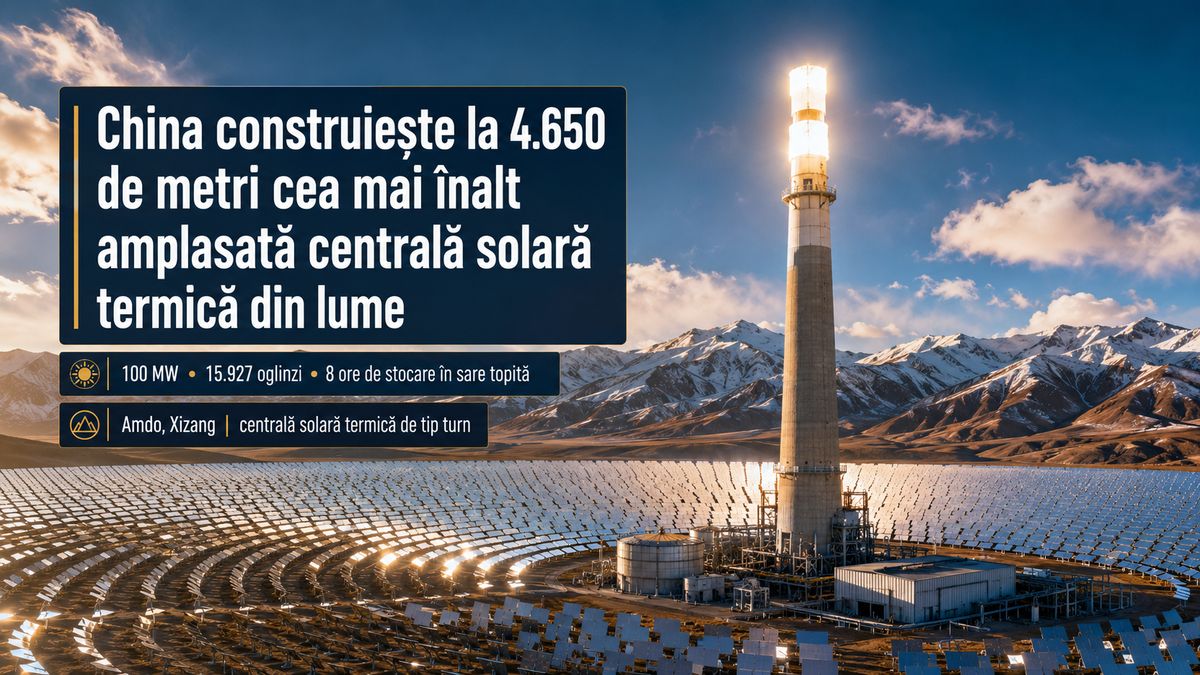
At an altitude of approximately 4,650 meters on the Tibetan Plateau, nearly 16,000 mirrors form a solar field of about 800,000 square meters around a tower with a receiver positioned at approximately 210 meters. The mirrors track the Sun and simultaneously direct radiation toward the same point, where the energy is converted into heat and stored in molten salt at temperatures of around 560°C . This is the 100 MW solar-thermal component of the Amdo Tuosuo project in Xizang, built in Amdo County, Nagqu. The facility is presented by the involved stakeholders and SolarPACES as the world's highest-altitude tower-type solar thermal power plant . The geographical record provides a spectacular visual. However, the storage technology is the aspect that could matter far more for the energy system. The plant is designed with at least eight hours of molten salt thermal storage . This means that a portion of the energy captured while the Sun is shining can be stored as heat and converted into electricity later, including after sunset. At a nominal capacity of 100 MW, eight hours conceptually correspond to an order of magnitude of approximately 800 MWh electric-equivalent . This is not an 800 MWh electrochemical battery: the energy resides in the temperature of the salt, and electricity is generated later by producing steam to drive a turbine. This difference transforms the project from a spectacular solar farm into an example of dispatchable solar power . 15,927 mirrors turn light into a heat reservoir The 15,927 heliostats are individually controlled mirrors, each with approximately 50.23 square meters of reflective surface . Throughout the day, control systems adjust their orientation so that light remains focused on the central receiver. The cumulative reflective surface reaches approximately 800,000 square meters . The mirrors do not generate electricity directly, as photovoltaic panels do. Instead, they concentrate solar energy as radiation, and the receiver transfers this energy to the thermal fluid. The heated salt can then be sent to a storage tank and kept until the plant decides to use the energy. When electricity is needed, the heat is transferred to water. The resulting steam drives a turbine coupled to a generator. The energy chain thus becomes: sunlight is converted into heat, heat is stored, and electricity is produced at the chosen time, within the limits of the energy available in the system. For the grid, the difference compared to photovoltaics is essential. The moment of energy capture and the moment of electricity generation no longer need to coincide. Eight hours of storage shift solar energy to the evening The Amdo Tuosuo project is sized for a minimum of eight hours of thermal storage , and the developer estimates that the facility can support approximately 15–16 hours of generation per day , depending on available solar energy and the operating mode. This allows the plant to extend beyond the traditional solar generation window. During the day, part of the concentrated energy can power electricity generation, while another part heats the salt in the storage tank. Once solar radiation decreases or disappears, the accumulated thermal energy continues to feed the steam generator and turbine. The technology thus addresses one of the biggest challenges created by the massive expansion of solar power: abundant generation occurs primarily during the day, while a significant portion of demand remains after sunset. Molten salt shifts energy through time without first converting it via an electrochemical reaction. For Amdo, this feature holds additional value. The project is built in a region with weaker electrical infrastructure, where local sources have reported supply difficulties during winter periods. A power plant capable of shifting solar generation to other hours can provide the system with a more controllable resource than instantaneous solar output. Tanks for approximately 20,000 tons of salt pass a major test The heliostat field was fully installed by the end of April 2026. Over the summer, construction advanced toward the central systems that will actually enable storage and generation. On August 9 , the molten salt circuit tanks passed water-filling testing, a procedure used to verify integrity and tightness prior to the commissioning phases. The two tanks are approximately 30.8 meters in diameter and 15 meters high , and project data indicates a maximum capacity of around 20,000 tons of molten salt . This step brings the plant closer to the stage where the entire thermal circuit can be tested as a system. Grid connection is scheduled for October 2026 . 100 MW of solar-thermal works alongside 800 MW of photovoltaics The tower-type plant is not being built in isolation. It is part of an integrated project that combines 100 MW of concentrated solar power (CSP) with 800 MW of photovoltaics (PV) . The two technologies play different roles. The 800 MW of PV can generate large volumes of…
Ioana Buzoaica — Independent Editorial Board
The NRG-IA newsroom continuously monitors Romanian energy markets, ANRE regulatory decisions, and national grid telemetry (SEN/SNT). We deliver independent intelligence anchored exclusively in official primary data.
Editorial Charter, Ethics & Verification Methodology →