China's economy slows, but battery and EV exports surge — NRG-IA
Geopolitică & Energie Author: Ioana BuzoaicaChina's economy slowed to 4.3% in Q2 2026. While domestic consumption and real estate drag, clean tech and EV exports are keeping growth afloat.
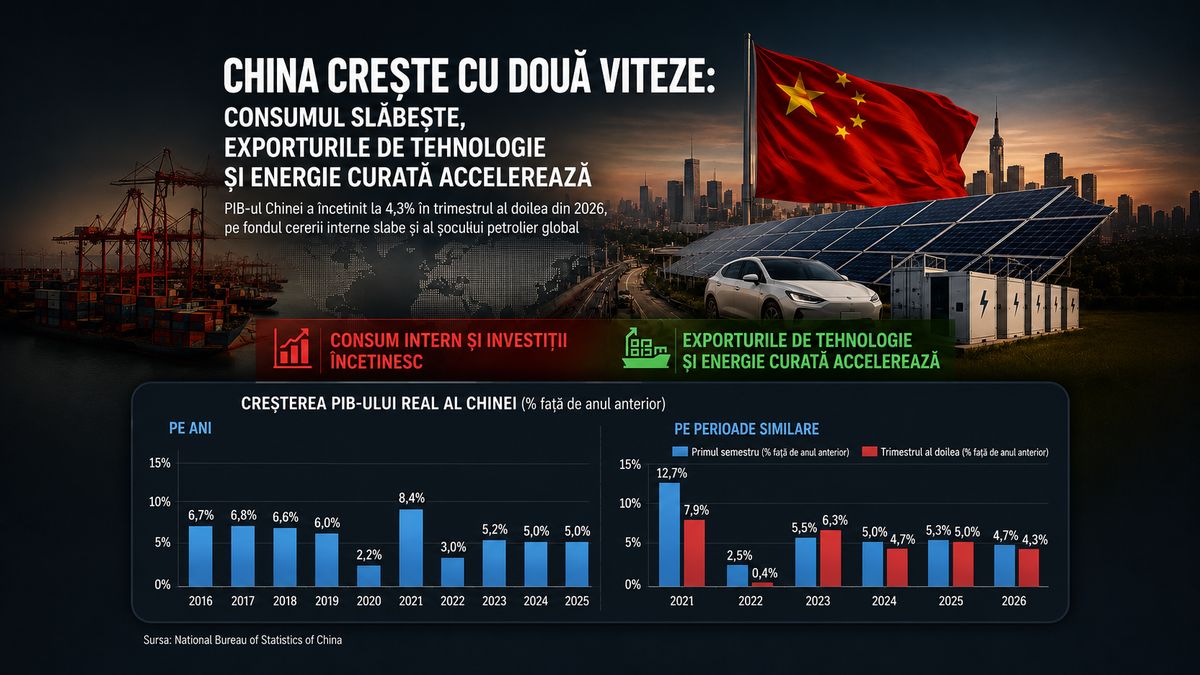
China's economy slowed to 4.3% in the second quarter of 2026, down from 5% in the first three months of the year. The result fell short of market expectations, marking the slowest quarterly growth rate since late 2022. For the first half of the year as a whole, gross domestic product grew by 4.7%, keeping the economy within Beijing's target annual range of 4.5–5%. While China remains on its official trajectory, the figures indicate a clear loss of momentum. The issue is not a lack of production. Factories continue to churn out vehicles, batteries, chips, industrial robots, and electrical equipment at a rapid pace. Instead, the weakness lies within the domestic economy: households are spending cautiously, the real estate sector continues to contract, and private companies are scaling back investments. China is producing increasingly more for a domestic market that is failing to keep pace. The gap is being bridged by exports. Factories accelerate, consumption lags behind Industrial production grew by 5.4% in the first half of the year, outstripping the broader economy. The high-tech sector surged by 13.3%, with certain industries recording even stronger growth. Lithium-ion battery production rose by nearly 40%, industrial robots by 28%, and equipment used in advanced technologies continued to expand. These figures depict an industrial economy capable of rapidly shifting capital, raw materials, and labor toward sectors deemed strategic by Beijing. Meanwhile, retail sales grew by just 1.3% in the first six months. Fixed-asset investment fell by 5.7%, private investment dropped by 8.5%, and real estate investment plunged by 18%. The contrast is becoming increasingly difficult to ignore. China boasts modern factories, extensive infrastructure, and massive production capacity, yet households remain cautious. Falling home prices, income uncertainty, and high savings rates continue to constrain consumption. The real estate sector, which for two decades drove investment, local government finances, and household wealth, can no longer play that role. Fewer construction projects mean reduced demand for steel, cement, machinery, and services, as well as lower revenues for local governments that relied heavily on land sales. Exports have become the primary buffer against the slowdown In June, China's exports surged by 27% year-on-year, comfortably beating forecasts. Imports rose by 36%, pushing the monthly trade surplus to approximately $125.6 billion. A significant portion of this momentum was driven by technology. Global demand for data centers, artificial intelligence, and digital infrastructure is supporting Chinese exports of chips, electronic components, computers, and power equipment. At the same time, China surpassed the milestone of one million exported vehicles in a single month for the first time. Electric vehicles, batteries, and renewable energy equipment are playing an increasingly prominent role in foreign trade. This model is effective in the short term. Factories maintain their order books, jobs are protected, and economic growth remains positive. However, reliance on external demand is growing heavier. Approximately a quarter of manufacturing sales now come from exports, the highest share since China joined the World Trade Organization. When the Chinese consumer buys less, production is diverted to Europe, Asia, Africa, and Latin America. While this strategy keeps the economy moving, it amplifies trade tensions. Countries receiving large volumes of Chinese vehicles, batteries, solar panels, and industrial equipment are facing mounting pressure on their domestic manufacturers. Clean energy shields China from high oil prices The expansion of clean technologies is not just an export strategy; it also reduces China's energy vulnerability. Beijing is the world's largest importer of crude oil, and conflict surrounding Iran and the Strait of Hormuz has driven up shipping costs and supply risks. In June, Chinese oil imports fell to approximately 7.12 million barrels per day, down more than 40% year-on-year and reaching their lowest level in nearly a decade. Refineries scaled back operations due to weak margins, expensive crude, and sluggish domestic fuel demand. Part of the demand was met by drawing down previously accumulated stockpiles, while domestic production provided an additional buffer. China produces roughly 4.3 million barrels of oil per day and holds substantial strategic and commercial reserves. Pipeline gas imports, including those from Russia, further limit its dependence on maritime shipments. However, the most significant buffer is electrification. The country's massive fleet of electric vehicles reduces gasoline and diesel consumption, while the expansion of solar, wind, and nuclear power limits the use of imported fuels in electricity generation. An economy with more electric vehicles, batteries, and renewable energy sources remains exposed to oil prices, but reacts far less violently than one…
Ioana Buzoaica — Independent Editorial Board
The NRG-IA newsroom continuously monitors Romanian energy markets, ANRE regulatory decisions, and national grid telemetry (SEN/SNT). We deliver independent intelligence anchored exclusively in official primary data.
Editorial Charter, Ethics & Verification Methodology →