China Tests 2.3 MW Offshore Wind Underwater Data Center — NRG-IA
Tehnologie & Inovație Author: Ioana BuzoaicaChina launched a 2.3 MW underwater data center in Shanghai, powered by offshore wind and cooled by seawater, testing AI co-location with green energy.
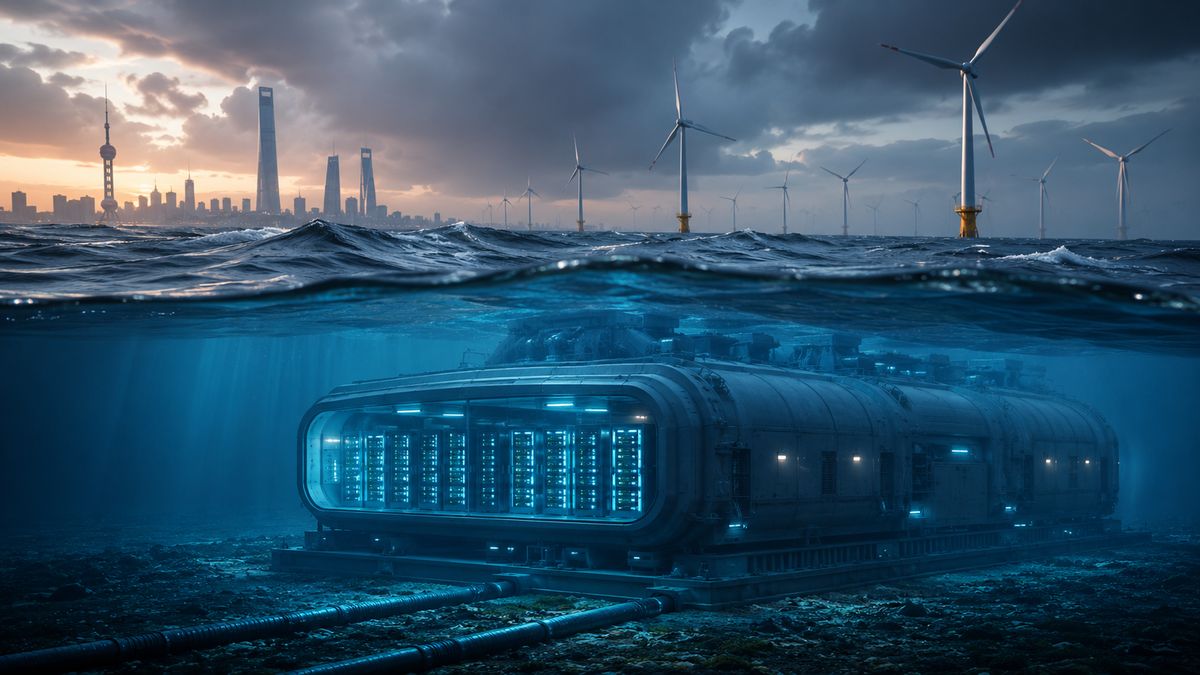
China is attempting to relocate part of its AI infrastructure to where power and cooling can be sourced without the traditional expansion of onshore data campuses: out to sea, adjacent to offshore wind turbines. In Shanghai's Lingang area, an underwater data center directly connected to a nearby offshore wind farm has been commissioned. Chinese authorities are presenting the project as the first facility to combine direct offshore wind power with natural seawater cooling. The first phase has a capacity of 2.3 MW, with the full project planned at 24 MW across two stages. The total investment is estimated at 1.6 billion yuan. The phase already in operation includes a vertical data module, an onshore control center, and two main 35 kV submarine cables to transport power to the underwater infrastructure. However, this development goes beyond an exotic technological demonstration. Lingang is a test case for a problem that is becoming structural across the economy: AI requires stable electricity, continuous cooling, land, transformers, grid connection lines, and network capacity. All of these resources are becoming increasingly difficult to secure in major urban centers. 2.3 MW operational, 24 MW planned The project's capacity must be read carefully. Some international reports have presented the facility as an already operational 24 MW data center. However, Chinese institutional documents describe a two-stage structure: the project has a total planned capacity of 24 MW, while the commissioned demonstration phase stands at 2.3 MW. This distinction is not a minor detail. A 2.3 MW module can demonstrate the cooling system's functionality, the durability of the marine structure, submarine cable power supply, and integration with offshore energy. However, validation at 24 MW requires a completely different scale of operation: more servers, more power, more heat dissipated into the environment, higher maintenance requirements, and a different investment economic model. Local authorities claim the project achieves over 95% green energy share, energy savings of 22.8%, the elimination of freshwater consumption for cooling, and a land-use reduction of over 90% compared to a conventional data center. These figures represent estimates and indicators declared by the project developers and local authorities, rather than independent, long-term published results. Offshore wind becomes direct power for computing The Lingang model is referred to by Chinese authorities as "direct connection between offshore wind and underwater computing." Power generated by nearby wind turbines is sent via dedicated cables to the data modules located underwater. This architecture shifts the traditional logic of a data center. In the classic model, power is generated in one location, transmitted through high-voltage grids, stepped down successively, and consumed at a campus located near cities, office buildings, or telecom hubs. At Lingang, the data center is moved closer to the renewable source and the marine infrastructure capable of absorbing the heat. Reducing transmission losses is a potential benefit, but direct wind power does not automatically solve the issue of continuity. AI servers, communication networks, and cloud services require high availability. Offshore wind is variable, and publicly available information does not fully detail the backup mechanism, grid connection regime, energy storage, or the flexibility of computing workloads during periods of low wind generation. Consequently, while the project may reduce pressure on the terrestrial grid and absorb a portion of renewable generation locally, it does not yet demonstrate grid-independent, 24/7 operation solely powered by offshore wind. Seawater reduces cooling consumption, but does not eliminate the heat issue The underwater data center uses seawater as a natural cooling source. Instead of chillers, cooling towers, and HVAC systems sized for terrestrial campuses, the sealed modules transfer heat to the marine environment through a heat exchange system. The project also utilizes a refrigerant circuit and copper piping to dissipate heat inside the hermetic structure. The metric presented by the project is a PUE of approximately 1.15. PUE, or Power Usage Effectiveness, compares the total energy consumed by a data center with the energy actually used by the IT equipment. A PUE of 1.15 means that for every 1 MWh consumed by servers and IT infrastructure, the facility would use an additional 0.15 MWh for cooling, electrical conversions, pumps, control, and other auxiliary systems. This is a competitive value for a data center, but it must be treated as a project-declared indicator. Real performance validation requires data spanning multiple seasons, including periods of warmer water, storms, waves, marine biofouling, and high IT workloads. Seawater cooling reduces freshwater consumption and can lower the energy used by cooling equipment. However, the heat generated by the servers does…