China-Turkey: $15B Plan for 7 GW Renewables and Industry — NRG-IA
Geopolitică & Energie Author: Ioana BuzoaicaChina and Turkey signed a $15B renewables agreement to add 7 GW of solar and wind capacity while expanding energy equipment manufacturing near the EU.
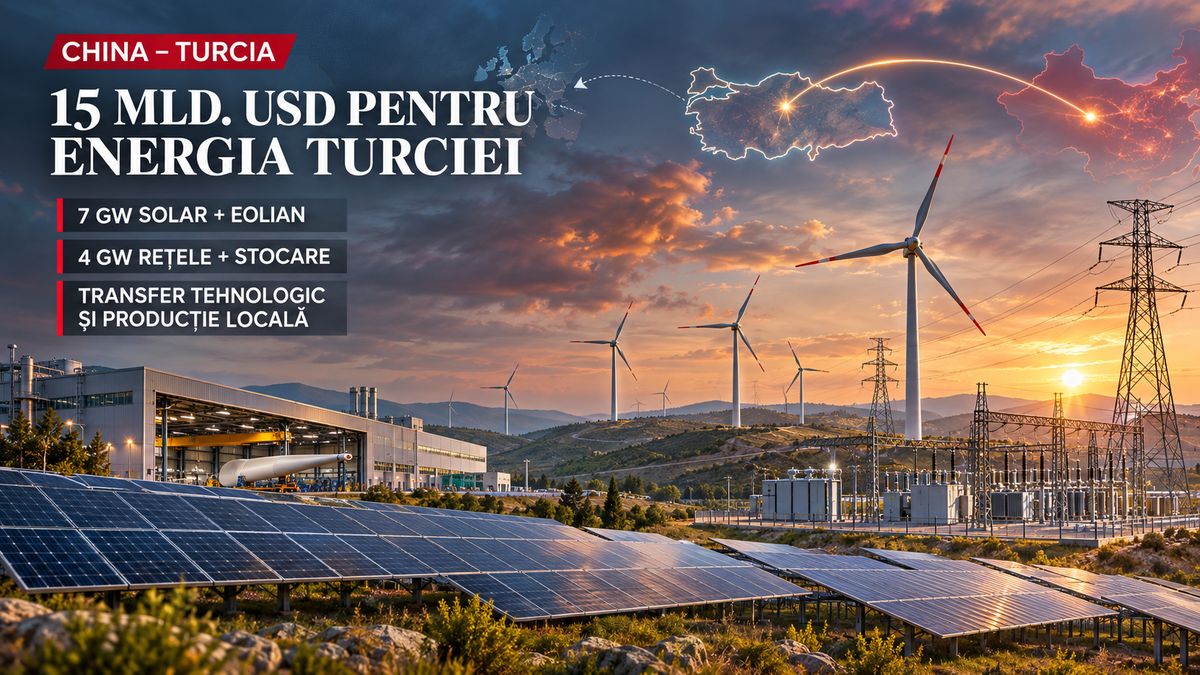
On November 12, 2026, China and Turkey signed a memorandum of cooperation targeting investments of approximately $15 billion in the development of Turkish renewable energy and power grid infrastructure. Reached on the sidelines of the COP31 climate conference in Antalya, the agreement sets a goal of building solar and wind power plants with a combined capacity of 7,000 MW, alongside energy storage systems and 4,000 MW of electricity transmission infrastructure. The announcement marks a new stage in energy rapprochement between the two countries. Turkey's Ministry of Energy and Natural Resources and China's National Energy Administration are pursuing cooperation that goes beyond plant financing and installation. According to Turkish Energy Minister Alparslan Bayraktar, the plan includes technology transfer and local manufacturing of wind turbine equipment in Turkey—goals that could extend the economic value of the investments far beyond the power sector. The scale of the agreement is significant both for the transformation of the Turkish energy system and for China's industrial positioning in a region adjacent to the European market. Turkey already possesses a wind equipment manufacturing industry, maintains extensive trade relations with the European Union, and is pursuing rapid expansion of renewable capacity. Combining Chinese capital and technology with this industrial base could create manufacturing and export opportunities at a time when competition to produce energy transition equipment is intensifying globally. A 7 GW Plan, Equivalent to 16% of Turkey's Current Solar and Wind Capacity The 7,000 MW of power generation outlined in the memorandum would mark a substantial increase for the Turkish power system. At the end of September 2026, Turkey had 28,222 MW of solar PV and 15,540 MW of wind power installed, according to official Ministry of Energy data. The combined capacity of the two technologies stood at 43,762 MW, meaning the full deployment of the new package would add the equivalent of roughly 16% to this existing base. Relative to the country's total installed capacity of 127,355 MW as of the same date, the planned investment represents roughly 5.5%. While this comparison illustrates the magnitude of the objective, actual annual generation will depend on the split between solar and wind plants, their locations, and weather conditions. The memorandum does not yet specify the distribution of the 7 GW between the two technologies or the specific regions where the facilities will be constructed. The development aligns with Turkey's 2040 energy strategy, which focuses on electrifying the economy and expanding low-emission generation capacity. In this context, renewable investments are closely tied to security of supply and reducing reliance on imported fossil fuels. Greater domestic generation from wind and solar can lower the need for fossil fuel-fired power during specific periods, depending on demand dynamics and resource availability. The agreement signed in Antalya is a memorandum of understanding between the two nations' energy institutions, establishing the overarching goals of their cooperation. The $15 billion figure represents the estimated total investment under the plan, and its realization will require identifying specific projects, securing financing, and executing implementation contracts. Nevertheless, the announced scale provides a clear indication of the economic and industrial ambitions behind the partnership. 4,000 MW of Power Grid Infrastructure and New Storage Systems A key feature of the memorandum is the integration of grid transmission infrastructure and energy storage into the same investment framework as power plant development. Turkey and China are targeting 4,000 MW of electricity transmission capacity alongside new energy storage systems. While the announcement does not detail technical configurations, battery energy capacities, or line routes, their inclusion demonstrates that renewable expansion is being addressed in tandem with grid integration requirements. For solar and wind farms, grid access is a critical prerequisite for monetizing power output. Power generated in a given region must reach demand centers, and rapid renewable deployment can trigger network congestion if grid networks are not expanded and modernized simultaneously. The 4,000 MW grid transmission capacity stated in the memorandum indicates the scale of the targeted infrastructure, though it should not automatically be construed as new cross-border export capacity or dedicated grid connection capacity for individual projects. Energy storage systems could complement this grid infrastructure by absorbing surplus power generated during peak renewable availability. Stored electricity can subsequently be dispatched based on demand and market conditions, enhancing system flexibility. The technical and economic viability will depend on the installed power capacity of the batteries, their energy storage…
Ioana Buzoaica — Independent Editorial Board
The NRG-IA newsroom continuously monitors Romanian energy markets, ANRE regulatory decisions, and national grid telemetry (SEN/SNT). We deliver independent intelligence anchored exclusively in official primary data.
Editorial Charter, Ethics & Verification Methodology →