China Builds 400 km 'Solar Great Wall' in Kubuqi Desert — NRG-IA
Energie Regenerabilă Author: Ioana BuzoaicaChina is transforming the Kubuqi Desert into a massive 400 km PV corridor, targeting 100 GW by 2030, combining solar power with desertification control.
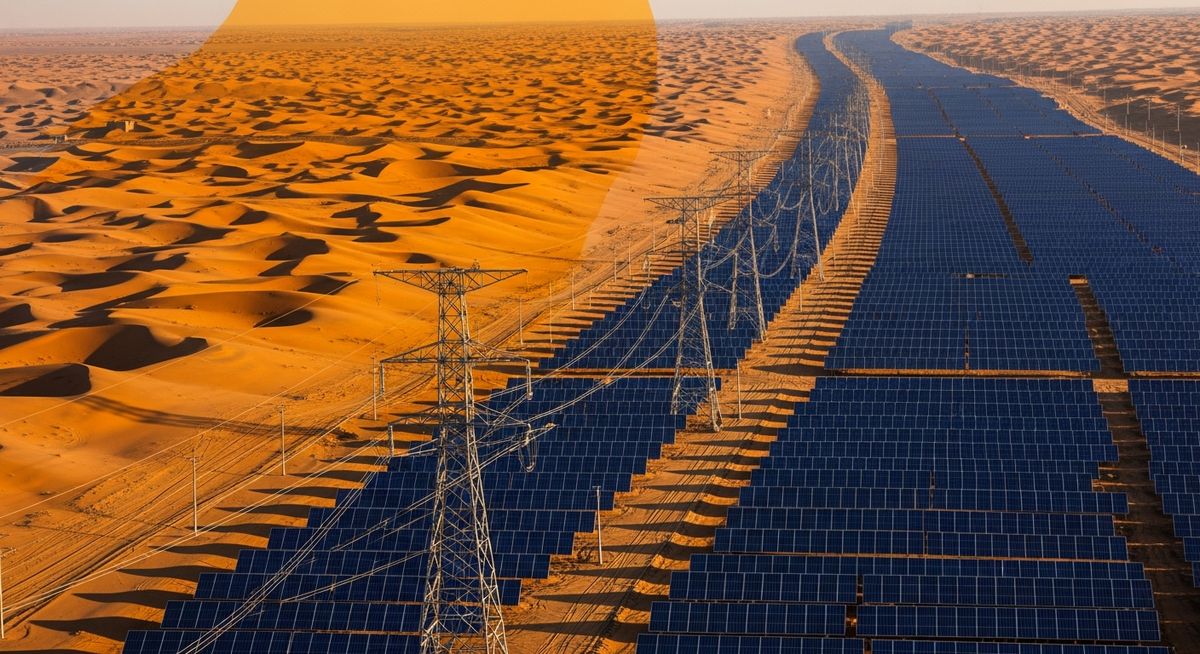
China is transforming the Kubuqi Desert in Inner Mongolia into one of the world's most spectacular solar projects: a photovoltaic corridor approximately 400 km long, 5 km wide, with a planned capacity of 100 GW by 2030. Known as the "Solar Great Wall," the name should be understood in terms of scale rather than structure: it is not a solid wall, but a massive succession of solar farms built across the desert, forming an energy belt clearly visible in satellite imagery. The NASA Earth Observatory has published comparative Landsat images from 2017 and 2024 showing the rapid expansion of solar arrays in the Kubuqi Desert, south of the Yellow River, between the Baotou and Bayannur regions. The overall picture is striking: where sand once dominated, vast geometric expanses of panels, access roads, substations, and power transmission infrastructure have now emerged. From Desert to Energy Corridor The Kubuqi Desert is China's seventh-largest desert and one of the key areas where Beijing is testing an ambitious formula: utility-scale renewable energy production combined with desertification control measures. The solar corridor stretches across the Ordos region in northern China, from Jungar Banner in the east to Hanggin Banner in the west, passing through Dalad Banner. Data cited by NASA and regional Chinese sources point to the same baseline dimensions: approximately 400 km in length, an average width of about 5 km, and a target of 100 GW of installed capacity by 2030. This scale redefines the nature of the project. This is not just another solar farm added to the grid, but the transformation of an entire desert region into a regional-scale energy infrastructure. China is deploying solar arrays where land has limited agricultural value but boasts high solar irradiance and ample space for industrial development. 100 GW by 2030: A Game-Changing Figure The 100 GW target represents installed capacity, not continuous generation. This distinction is crucial: a solar plant does not constantly operate at its peak nameplate capacity. Output depends on solar irradiance, weather, season, efficiency, grid connection, and the system's absorption capacity. Even so, the scale is staggering. Regional Chinese sources estimate that the project could generate approximately 180 billion kWh per year by 2030. By comparison, the same sources note that Beijing's annual electricity consumption was 135.8 billion kWh in the previous year. The math is clear: at its planned capacity, the project could generate more electricity annually than the entire city of Beijing consumes in a year. The project is still a work in progress. NASA reported approximately 5.4 GW of installed capacity at the time of its December 2024 publication. This detail is important for objective analysis: China does not yet have a fully operational 100 GW "solar wall," but is gradually building an energy corridor slated to reach this capacity by the end of the decade. What is Visible from Space The phrase "visible from space" must be used precisely. To be accurate, the expansion of the solar farms is visible in satellite imagery. NASA documented this transformation using Landsat images, rather than making sensationalist claims about visibility to the naked eye from orbit. The most photogenic feature of the area is the Junma Solar Power Station, a solar plant arranged in the shape of a galloping horse. Completed in 2019, the project entered the Guinness World Records for the largest image made of solar panels. Guinness lists 196,320 panels covering an area of 1,398,421 m². While Junma is key to the project's public image, it should not be confused with the entire 400 km solar corridor. It is merely a visible and symbolic piece of a much larger transformation: the desert is being repurposed for industrial-scale PV infrastructure, not just a spectacular PR showcase. Solar Power as a Tool Against Desertification The stakes of this project go beyond electricity generation. China also presents the Kubuqi solar development as a tool for desertification control. The elevated panels can reduce wind speeds at ground level, provide shade, limit water evaporation, and stabilize shifting sands. In certain areas, the space beneath the panels can support grasses, hardy plants, or managed grazing. This is one of the project's most compelling aspects: the solar panel is no longer just energy equipment, but an active tool for land management. Instead of treating the desert merely as empty space for capacity installation, China is attempting to combine energy production with partial soil restoration and sand stabilization. However, this strategy has its limits. While panels can create more favorable microclimates and mitigate some local wind and evaporation effects, they do not automatically turn a desert into an oasis. Desertification remains a complex challenge tied to climate, water resources, soil quality, vegetation, economic land use, and human pressure. The solar project can…