Coal Drops Below 50% of China's Power Mix as Demand Rises — NRG-IA
Geopolitică & Energie Author: Ioana BuzoaicaChina's coal power fell below 50% for the first time amid rapid green growth, but rising demand from industry and EVs keeps absolute consumption high.
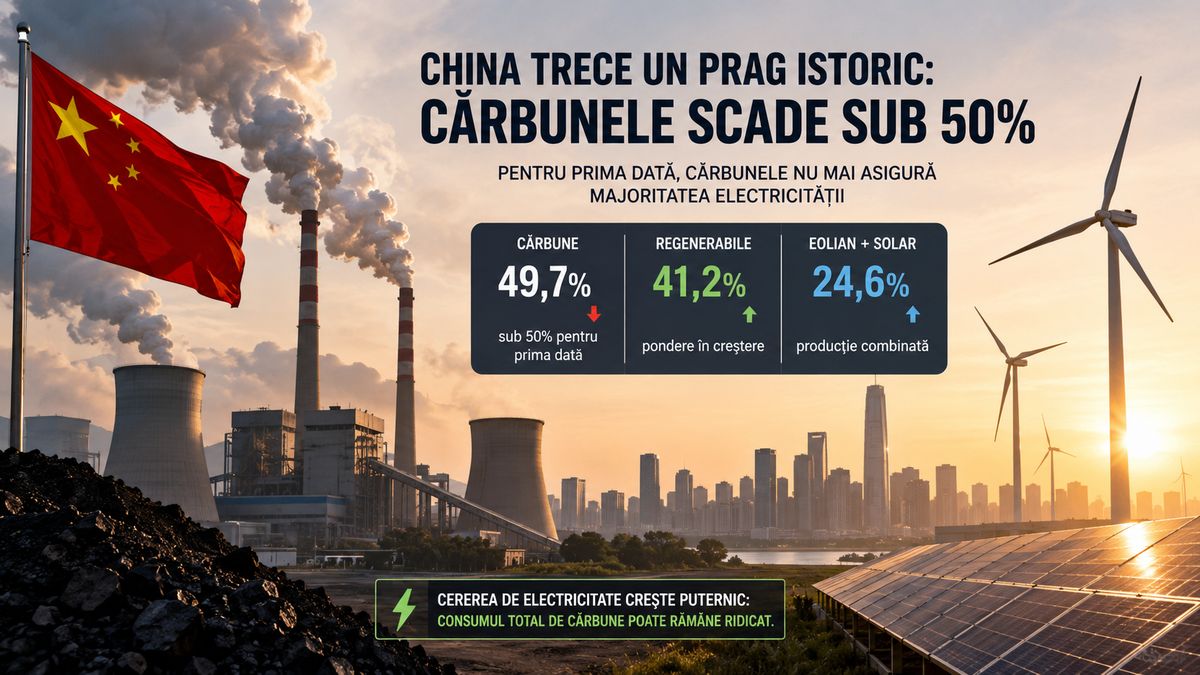
Coal no longer supplied the majority of China's electricity in the first half of 2026. Its share fell to 49.7%, while renewables reached 41.2%, and wind and solar combined contributed 24.6%. This threshold marks a major shift in the world's largest power system. For the first time, the energy source that fueled China's industrialization and manufacturing dominance no longer generates more than half of the country's electricity. However, this declining share does not equate to a rapid phase-out of coal. Total electricity consumption continues to rise, and renewables must simultaneously meet the economy's new demand and displace a portion of existing fossil fuel generation. The real test is not coal's percentage share, but when the absolute volume of electricity generated from this fuel begins a sustained decline. A historic milestone, limited to the power sector The 49.7% figure refers exclusively to power generation from January to June 2026. It does not reflect coal's share in China's total primary energy consumption, nor its use across the wider economy. The fuel remains essential for steelmaking, cement, chemicals, and other heavy industries. China can drop below 50% in power generation while continuing to consume vast amounts of coal outside of power plants. Above all, this milestone indicates that wind, solar, hydro, and other low-emission sources are growing faster than thermal power generation. In 2025, coal still supplied around 51% of China's electricity. Dropping below the halfway mark in a single year highlights the speed at which the system's structure is changing, rather than the sudden disappearance of the dominant source. Wind and solar approach a quarter of generation Wind and solar energy combined supplied 24.6% of China's electricity in the first half of the year. The two technologies are thus closing in on the official target of 30% set for 2030. By the end of June, installed solar capacity had reached approximately 1,270 gigawatts, up 15.8% from the previous year. Wind capacity grew by 18.5% to around 680 gigawatts. Together, the two sources totaled nearly 1,950 gigawatts, accounting for almost half of China's entire installed power capacity. However, installed capacity cannot be directly compared to actual generation. Solar panels only generate during daylight hours, and wind turbines depend on weather conditions. Coal, nuclear, and gas plants can operate for more hours and are far easier to dispatch. For this reason, while wind and solar make up nearly half of installed capacity, they generate only about a quarter of actual electricity. Demand is growing fast enough to support all sources China's electricity consumption reached nearly 5,100 terawatt-hours in the first six months of the year, up 5.3% compared to the same period in 2025. Such an increase is large enough to simultaneously absorb record amounts of renewable energy and still-massive volumes of coal-fired electricity. Industry remains the primary consumer. Industrial and construction activities accounted for nearly two-thirds of the country's electricity use, with high-tech and equipment manufacturing sectors recording a 9.8% increase. In parallel, the electrification of transport and the expansion of the digital economy are reshaping the demand profile. EV charging and battery-swapping services consumed 56.9% more electricity, while internet data services saw consumption surge by 44%. While these activities reduce direct oil consumption in transport and support digital development, they raise the overall demand threshold that the power system must meet. A lower share does not automatically mean less coal A source's share can decline even if its actual output remains stable or increases. If total power generation grows faster than coal-fired generation, the fossil fuel's percentage drops without its absolute volume decreasing to the same extent. First-half data shows that thermal power generation by major Chinese utilities rose by 2.9%. This category includes gas and other fuels, but is heavily dominated by coal. At the same time, renewable power generation grew at a faster rate, shifting the proportions of the national mix. This dynamic explains the apparent contradiction: China can report a record-high share for renewables while maintaining, in absolute terms, some of the highest levels of coal-fired generation in history. To confirm a structural decline, analysts must track actual coal plant output, fuel consumption, operating hours, and power sector emissions separately. Domestic coal production falls, but imports can compensate China mined approximately 2.37 billion tonnes of raw coal in the first half of the year, down 1.7% compared to the same period last year. In June, the decline was more pronounced, dropping 9.7% to around 380 million tonnes. This reduction was partly influenced by shutdowns and safety inspections in the mining sector. Lower domestic production alone does not prove an equivalent drop in…