Quantum Vacuum Power: Casimir Raises $12M for MicroSparc — NRG-IA
Tehnologie & Inovație Author: Ioana BuzoaicaCasimir Inc. raised $12M for MicroSparc, a chip claiming to generate power from quantum vacuum fluctuations. Independent validation remains critical.
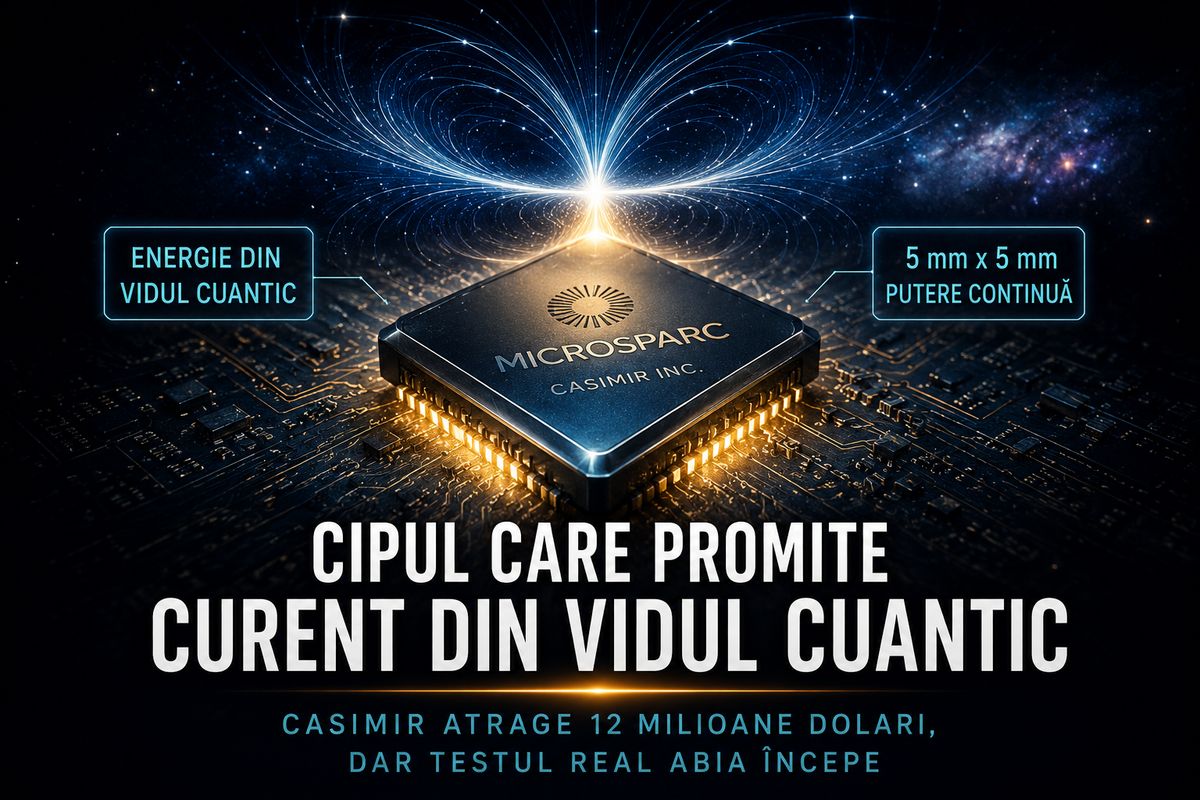
A promise at the frontier of applied physics Casimir Inc., a Houston-based company founded by Dr. Harold "Sonny" White, a former NASA advanced propulsion researcher, has announced the closing of a $12 million seed round to commercialize MicroSparc, a semiconductor chip designed to generate persistent electrical energy by harvesting quantum vacuum fields. The company claims that MicroSparc measures 5 mm × 5 mm and is designed to deliver approximately 1.5 volts at 25 microamps, translating to power on the order of tens of microwatts. While this output is irrelevant for homes, electric vehicles, or grids, it could be highly significant for sensors, medical devices, IoT systems, ultra-low-power electronics, and applications where battery replacement is costly or impossible. The stakes are particularly high as the technology is presented as a continuous power source requiring no batteries, no charging, and no fuel. For this very reason, the development must be viewed through two simultaneous lenses: maximum technological interest and maximum scientific caution. What is real: the Casimir effect exists The physical foundation invoked by the company is not science fiction. The Casimir effect is a real quantum mechanical phenomenon, predicted in 1948 by Hendrik Casimir and subsequently confirmed experimentally. In its classical form, two conducting surfaces placed extremely close together in a vacuum alter the distribution of electromagnetic field modes, producing a measurable force between them. The issue is not the existence of the Casimir effect. The challenge is whether this effect can be converted into a practical, continuous, and net source of useful electrical energy. This is where the controversy begins. In standard configurations, the Casimir force can perform mechanical work as the plates draw closer, but the system must then be reset, which requires energy. Consequently, the idea of extracting continuous, useful energy from the quantum vacuum is met with legitimate skepticism by physicists. What MicroSparc claims to bring to the table Casimir asserts that MicroSparc does not use a classical configuration where two plates attract and must then be separated again, but rather static Casimir cavities integrated into a semiconductor. According to the company, these cavities are designed to remain fixed without mechanical collapse, while electrically insulated micropillars harvest electrons that quantum-tunnel from the cavity walls. The core technological hypothesis is that the environment inside the cavity, having a different density of quantum modes, favors tunneling asymmetry. The company describes this mechanism as a "quantum ratchet"—a microscopic mechanism that converts quantum fluctuations into a directional electrical current. If this interpretation is correct and the measurements are independently confirmed, the breakthrough would not just be a new chip, but a potential new class of semiconductor power sources for ultra-low-power applications. This would shift a portion of electronics power supply away from battery chemistry toward nanofabrication and quantum geometry. What remains unproven publicly The critical bottleneck is independent verification. Casimir claims to have prototypes fabricated at university facilities, including Texas A&M's AggieFab and MIT.nano, and to have measured persistent electrical signals using precision instrumentation. However, at this stage, there is no complete, publicly available, and independently replicated experimental dataset that unambiguously demonstrates net useful energy generation. Missing are the elements that would elevate the claim from a technological promise to a consolidated scientific result: complete I-V curves, noise measurements, thermal control, temperature dependence, long-term stability, a comprehensive energy balance, blind experiments replicated by independent laboratories, and detailed peer-reviewed publications of the device's performance, not just its theoretical framework. This is the essential dividing line. Invoking a real physical phenomenon does not automatically prove that a device generates net energy. And in the field of "zero-point energy," the standard of proof must be exceptionally high. If it works, the impact starts at microwatts, not power plants The most realistic impact scenario in the initial phase is not a revolution in power grids, but the elimination of batteries in ultra-low-power devices. A chip capable of continuously delivering tens of microwatts would be highly relevant for industrial sensors, infrastructure monitoring, implantable medical devices, tire pressure sensors, wearables, autonomous monitoring systems, and distributed electronics in hard-to-reach environments. In these applications, the value lies not in high power, but in persistence: a device operating for years or decades without battery replacements can reduce operational costs, maintenance, waste, and downtime risks. For the global economy, the first…
Ioana Buzoaica — Independent Editorial Board
The NRG-IA newsroom continuously monitors Romanian energy markets, ANRE regulatory decisions, and national grid telemetry (SEN/SNT). We deliver independent intelligence anchored exclusively in official primary data.
Editorial Charter, Ethics & Verification Methodology →