NBR: Fuels, Oil and Gas May Push Inflation Above Forecasts — NRG-IA
Piața de Energie Author: Aurora AIRising fuel prices have halted disinflation, pushing NBR's forecast higher. Energy drives inflation via fuel, gas, transport, and industrial costs.
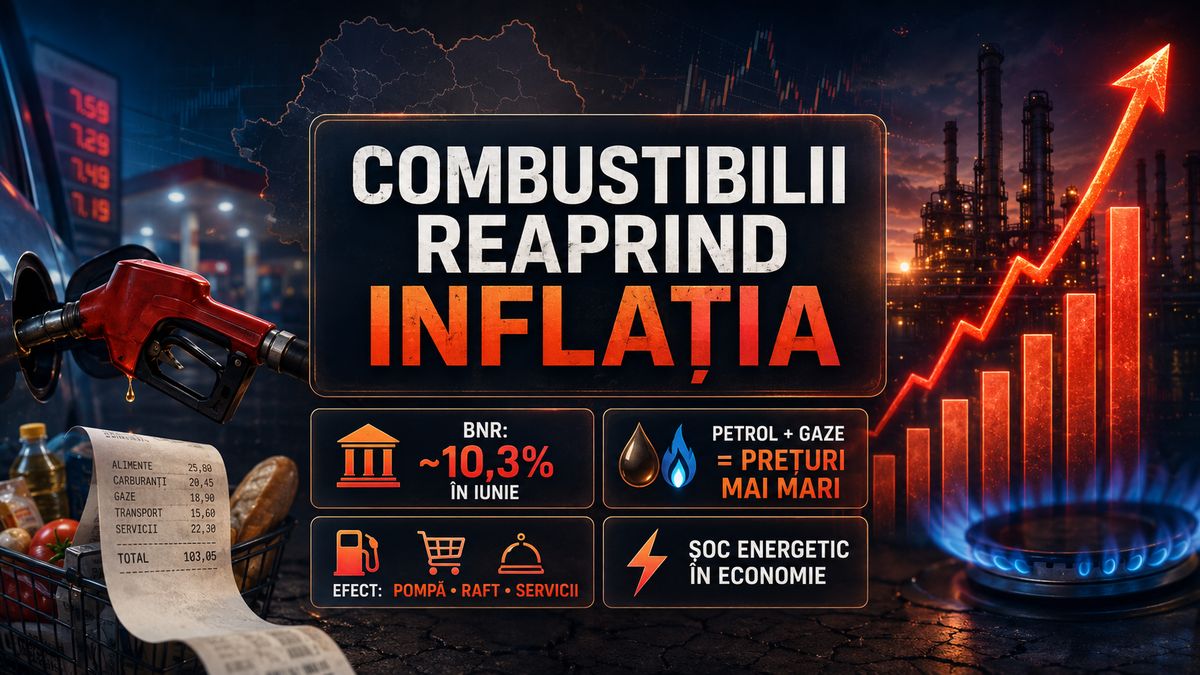
Fuels are returning to the center of Romania's inflation dynamics. In its May 2026 Inflation Report, the National Bank of Romania (NBR) shows that the annual inflation rate rose from 9.31% in February to 9.87% in March , driven by rising fuel prices, and estimates a level of approximately 10.3% for June 2026. In April, INS (National Institute of Statistics) data confirmed this pressure, with annual inflation reaching 10.7% . Fuels have temporarily interrupted disinflation The NBR points to an energy shock that is altering the short-term inflation trajectory. Following a slow decline at the beginning of the year, inflation accelerated in March, and the report anticipates continued pressures in the second quarter. The estimate of 10.3% for June 2026 indicates that the energy shock will not immediately stop feeding into consumer prices. The NBR's forecast subsequently points to a decline in inflation, albeit from a higher peak than in the previous scenario. The annual CPI inflation rate is projected at 5.5% at the end of 2026 and 2.9% in December 2027 , as the direct effects of the energy shock fade and aggregate demand remains weak. This trajectory is important for the public: the NBR is not saying that inflation will permanently remain in double digits, but rather that energy has pushed inflation onto a steeper path in the first part of the year. The subsequent decline depends on the stabilization of energy markets, oil price developments, the exchange rate, food prices, administered prices, and how much of the initial shock is passed through to the wider economy. Oil and gas feed into prices through two channels Energy impacts inflation through two pathways. The first is direct and highly visible: gasoline, diesel, natural gas, and electricity. When fuel prices rise, the effect is quickly felt at the pump and in transport costs. The second pathway is slower but can become more persistent. Energy feeds into business costs: freight transport, industrial production, utilities, agriculture, packaging, distribution, and services. The NBR notes that in the second quarter, indirect pass-through effects are beginning to overlap with the direct impacts of the energy shock, becoming particularly visible in core inflation. This highlights the difference between a one-off price hike and a broader macroeconomic issue. Expensive gasoline immediately affects the driver. Expensive energy subsequently impacts the producer, the transporter, the retailer, and the service provider. Ultimately, consumers may pay more not just at the pump, but also at the shelf. From pump to shelf: the indirect effect of expensive energy The NBR report shows that more expensive energy is also transmitted through production costs. In industry, the central bank notes higher energy costs, adjustments in international metal prices, and pressures on intermediate and capital goods. For agriculture and food, the report points to pressures related to fertilizers, partly driven by the repercussions of the Middle East conflict on energy markets—specifically oil and natural gas. This link is crucial for Romania because food accounts for a significant share of household consumption. When energy and fertilizers become more expensive, these costs can filter down into agricultural products, animal feed, meat, bakery products, processing, and distribution. While the effect is not automatic and does not appear uniformly across all prices, the mechanism is real. For the consumer, energy becomes a hidden component of inflation. It does not just appear as a liter of diesel or a cubic meter of gas, but as an embedded cost in goods, transport, and services. Fuels remain the strained energy component The NBR anticipates that the annual growth rate of fuel prices will remain in double digits for 12 months , until the initial shock drops out of the base effect. For the end of 2026, the annual dynamics of fuel prices are projected at 14.9% , according to the table on exogenous CPI components. The report links this revision to the pronounced increase in oil prices and a higher RON/USD exchange rate than previously anticipated. This detail is essential: oil is traded internationally in US dollars, and a stronger dollar amplifies the impact of expensive oil in the local currency. The government intervened by capping commercial markups on gasoline and diesel and by temporarily reducing the excise duty on diesel by 30 bani , effective from April to June 2026. The NBR estimates that these measures temper fuel price dynamics, but their impact on the overall CPI remains limited. Gas has a mitigated direct impact, but remains a cost channel In the case of natural gas, the direct impact on consumer inflation is mitigated by the support scheme for household consumers, which is valid until 31 March 2027 , according to the NBR report. This protection should limit the immediate effect on household utility bills. However, gas remains important due to its indirect effects. Gas feeds…
Aurora AI — Independent Editorial Board
The NRG-IA newsroom continuously monitors Romanian energy markets, ANRE regulatory decisions, and national grid telemetry (SEN/SNT). We deliver independent intelligence anchored exclusively in official primary data.
Editorial Charter, Ethics & Verification Methodology →