EC preliminary approval for Italy's power-sector gas cap — NRG-IA
Piața de Energie Author: Ioana BuzoaicaThe EC granted preliminary approval for Italy's gas price cap on power generation to cut bills by 10% from Jan 2027, creating a key precedent.
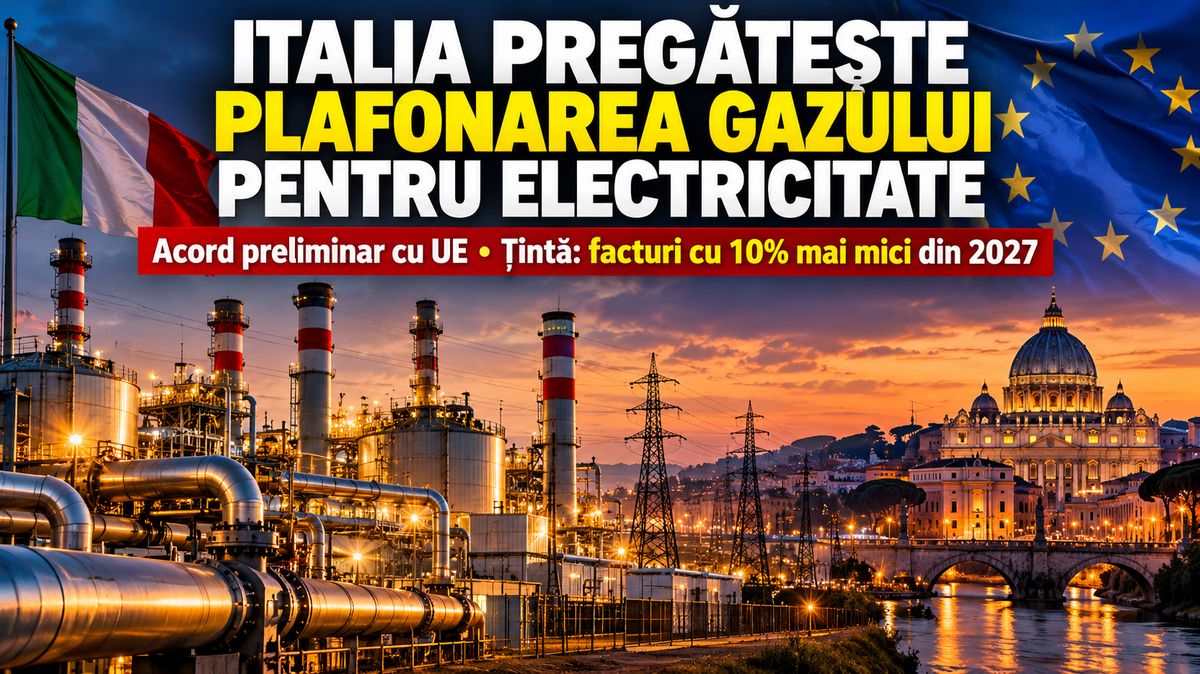
The European Commission has granted preliminary approval for the Italian Government's plan to cap the price of natural gas used in thermal power plants for electricity generation, a wholesale market intervention mechanism directly inspired by the "Iberian exception" implemented by Spain and Portugal during the 2022 crisis. Italian Energy Minister Gilberto Pichetto Fratin confirmed on October 21, 2026, that the EU executive supports accelerating the state aid authorization procedure so that the new scheme becomes operational starting in January 2027, aiming to reduce electricity bills for households and industry by approximately 10%. The agreement in principle from Brussels marks a major paradigm shift in European Union energy policy in the autumn of 2026. Following two years during which European institutions insisted on phasing out national support schemes and returning to the free operation of the single market, the recent shock in international hydrocarbon markets—which pushed European natural gas prices above the €90/MWh threshold, the highest level in nearly four years—forced the Commission to once again accept the temporary decoupling of electricity prices from gas prices. The stakes of this decision extend beyond Italy's borders, affecting the entire architecture of the European energy market. By granting preliminary validation for a national cap on fuel used in power plants by the euro area's third-largest economy, the European Commission establishes an institutional precedent that Central and Eastern European states, including Romania, can invoke to protect their energy-intensive industries and households from spot market price spikes. How decoupling gas prices from electricity prices works under the Iberian model To understand why Italy's intervention hits the exact core of energy market price increases, one must analyze how prices are formed on European electricity exchanges, including the Day-Ahead Market. Across the European Union, short-term wholesale trading operates under the marginal pricing rule, known in the energy sector as the merit order. In every hourly interval, the power exchange operator stacks producers' bids from cheapest to most expensive—starting with solar, wind, hydro, and nuclear energy, which have very low marginal operating costs, up to coal and natural gas power plants—until the total consumption demand for that hour is met. The last power plant called upon to clear demand sets the single price received by all producers selling energy in that hour, regardless of how low their actual production cost was. In Italy, where natural gas plants generate nearly 50% of all electricity, these units are the ones clearing the market for most hours of the day. When European gas prices surge above €90/MWh, the production costs of gas-fired power plants rise sharply—taking into account both fuel costs and carbon emission allowances—and drag up the price of the entire volume of electricity traded in the economy. The mechanism preliminarily approved for Italy intervenes right at the root of this transmission chain. The state establishes a maximum reference price for gas burned in thermal power plants, and plant operators receive financial compensation for the difference between the actual market purchase price of gas and the regulated cap. In return, thermal power plants are required to bid electricity on the exchange at a cost reflecting the capped gas price, thereby lowering the market's marginal clearing price for all consumers. Why the Italian precedent is a game-changer for Romania and Southeast Europe Although Romania boasts a far more diversified energy mix than Italy, with significant shares of hydro, nuclear, and renewable energy, the marginal pricing mechanism causes severe impacts on the local market during peak consumption hours. Every evening after sunset, when thousands of megawatts from photovoltaic panels simultaneously drop off the grid, Romania and neighboring Southeast European nations are forced to ramp up natural gas and coal units or import electricity produced by such facilities across the region. During those four to six critical evening hours, gas-fired plants become the marginal technology dictating prices on Bucharest's Day-Ahead Market. This is the technical reason why, even in a country that covers most of its annual electricity needs from domestic, emissions-free sources, evening hourly prices frequently spike to very high levels, inflating daily procurement averages for suppliers and, ultimately, end-user bills. Until now, Brussels' official stance toward national governments held that lowering prices depended exclusively on signing long-term power purchase agreements and expanding grid infrastructure and battery storage, rather than subsidizing fossil fuels. The fact that the EU executive is now accepting the fast-tracking of a state aid scheme to cap gas used in electricity generation signals that industrial competitiveness pressure has overcome market…
Ioana Buzoaica — Independent Editorial Board
The NRG-IA newsroom continuously monitors Romanian energy markets, ANRE regulatory decisions, and national grid telemetry (SEN/SNT). We deliver independent intelligence anchored exclusively in official primary data.
Editorial Charter, Ethics & Verification Methodology →