Three Romanian Energy Cases Escalated by European Commission — NRG-IA
Legislație & Reglementări Author: Ioana BuzoaicaOn October 1, the EC escalated three energy infringement cases against Romania. Two have reached the reasoned opinion stage, the final step before CJEU.
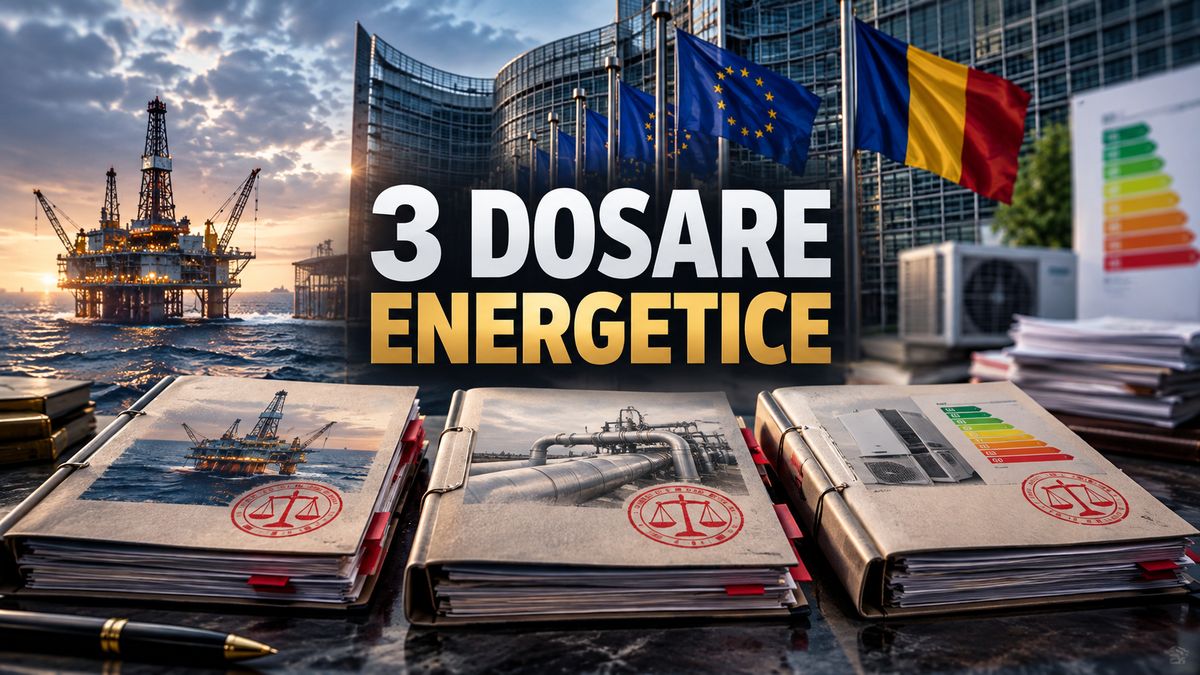
The European Commission has simultaneously escalated three of Romania's energy infringement cases to a more severe procedural stage. For two of them, the next step could be a referral to the Court of Justice of the European Union (CJEU) if Romanian authorities fail to provide a satisfactory response and address the identified shortcomings within the next two months. The two reasoned opinions concern the safety of offshore oil and gas operations and progress reporting on the implementation of the National Energy and Climate Plan (NECP) . In a third case, regarding market surveillance of ecodesign and energy labeling for products , the Commission sent Romania an additional letter of formal notice. These three decisions do not represent fines, nor are they newly opened infringement procedures. They are ongoing cases initiated at different times, which the Commission escalated simultaneously on October 1. The procedural distinction is important: for offshore safety and NECP reporting, Romania has already received a reasoned opinion , the final formal step before a potential referral to the CJEU; for ecodesign and energy labeling, the next possible step is the issuance of a reasoned opinion. Under EU infringement procedures, the Commission can refer a member state to the Court if it fails to comply after a reasoned opinion has been issued. Beyond the legal mechanism, these cases touch upon three highly concrete areas of the Romanian energy system: the safety of Black Sea offshore operations, the control of energy products and information provided to consumers, and the state's capacity to demonstrate actual progress toward its own energy and climate targets. Offshore Case Reaches Reasoned Opinion Stage After Five Years The oldest of the three cases also carries the highest strategic stakes. The infringement procedure regarding the safety of offshore operations, INFR(2021)2150 , began in September 2021. On October 1, 2024, the Commission sent Romania a reasoned opinion, concluding that the country has failed to fully comply with certain EU obligations on preventing and managing accidents at offshore oil and gas installations. The EU Directive aims to reduce the risk of major accidents and limit their consequences on human life, the marine environment, and coastal economies. The Romanian framework is primarily built around Law No. 165/2016 on the safety of offshore oil operations , which establishes requirements for preventing major accidents and limiting their effects in the Black Sea areas under Romania's jurisdiction. However, in its October 1 decision, the Commission did not publish the exact list of provisions that Romania continues to violate. The official wording states that Romania does not fully comply with "some of the obligations" under EU law regarding the prevention of and response to offshore accidents. Consequently, it cannot be factually claimed that Brussels is targeting a specific technical deficiency of a particular installation or operator. This distinction is also essential in the case of Neptun Deep. Neptun Deep Makes the Timing Far More Significant, But Is Not the Target of the Procedure The reasoned opinion comes at a time when Romania is approaching its most significant increase in offshore gas production. OMV Petrom and Romgaz announced on September 28 that the first gas from Neptun Deep is expected in the first half of 2027 , with peak production estimated for the end of the third quarter of 2027 at approximately 8 billion cubic meters per year . The development investment is estimated at around €4 billion . The European Commission does not claim that Neptun Deep is unsafe, nor does the procedure target the project directly. The case concerns the regulatory framework through which Romania must apply EU safety rules for offshore oil and gas operations. However, the context makes the issue far more relevant than it was in 2021. Romania is transitioning from a period of relatively low offshore production to one where the Black Sea is set to become one of its primary domestic gas sources. At this stage, the state's ability to demonstrate that its entire prevention, surveillance, and response system complies with European standards becomes a direct component of national energy security. Romania now has two months to respond to the reasoned opinion and address the identified shortcomings. If the response is deemed unsatisfactory, the Commission may decide to refer the matter to the CJEU. In the NECP Case, the Issue Is Reporting Results, Not the Existence of the Plan The second reasoned opinion can easily be misunderstood. Romania does have a National Energy and Climate Plan. The case opened by the Commission does not concern the absence of the NECP, but rather the reporting of progress made in its implementation . EU rules require member states to submit an integrated progress report on their national energy and climate targets every two years. For the current cycle, the deadline was March 15,…
Ioana Buzoaica — Independent Editorial Board
The NRG-IA newsroom continuously monitors Romanian energy markets, ANRE regulatory decisions, and national grid telemetry (SEN/SNT). We deliver independent intelligence anchored exclusively in official primary data.
Editorial Charter, Ethics & Verification Methodology →