EU Package 22: Ban on Russian Refinery Repairs & Tankers — NRG-IA
Geopolitică & Energie Author: Ioana BuzoaicaThe EU proposed its 22nd sanctions package, banning Russian refinery repairs, power services, and Russian-insured tankers, pending unanimous EU approval.
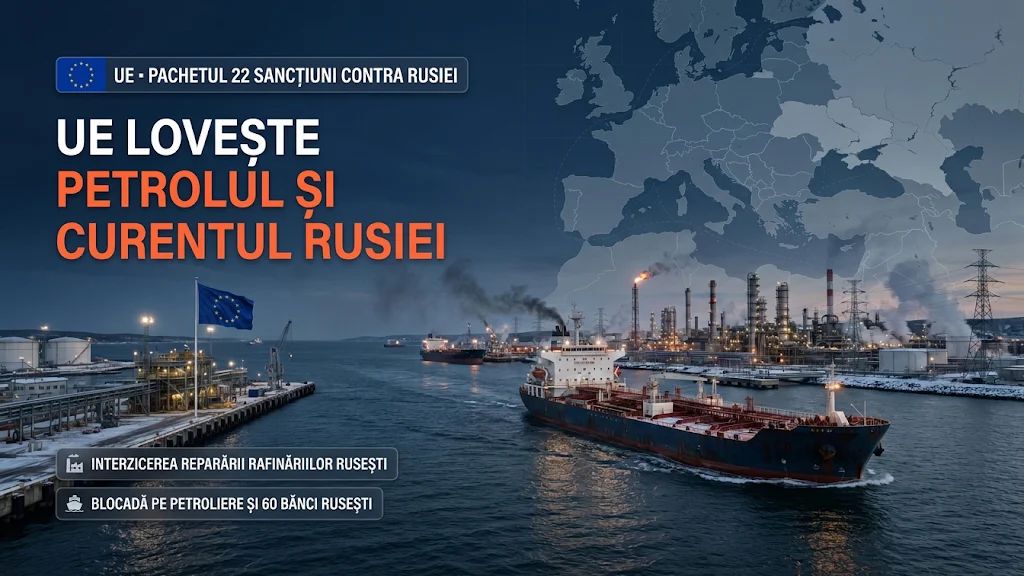
The European Commission officially presented on Monday, November 23, 2026, its proposal for the European Union's 22nd sanctions package against Russia, shifting the center of gravity of the economic war from restricting goods and equipment to crippling Moscow's capacity to repair and insure its energy infrastructure. Announced by Commission President Ursula von der Leyen, the package prohibits European companies from providing services and technical assistance for repairing Russian energy facilities—directly targeting oil refineries—extends this ban for the first time to power sector services, and proposes a blanket block on all Russian-insured oil tankers, alongside sanctioning over 70 new "shadow fleet" vessels and disconnecting around 60 Russian banks from the SWIFT system. The timing of the Brussels proposal relative to developments on the ground multiplies its strategic significance. The unveiling took place just hours after Ukraine's General Staff and Russian regional authorities confirmed that an overnight long-range drone strike hit Lukoil's Perm refinery, located in the Ural Mountains region over 1,500 kilometers from the border, damaging two primary distillation units and the isomerization plant at a complex that processes over 13 million metric tons of crude oil per year. On the same day, the Novoshakhtinsk refinery in the Rostov region suspended operations following an earlier attack, while the main crude pumping and blending station at Kaleykino in Tatarstan was engulfed in flames. The European Commission's proposal, officially welcomed Tuesday morning by Ukraine's new Prime Minister, Serhii Koretskyi, now enters negotiations among member state ambassadors, requiring the unanimous vote of all 27 governments in the Council of the EU before the conclusion of the Irish presidency on December 31. At the same time, Brussels' regulatory offensive marks a clear transatlantic divergence from Washington, where President Donald Trump signed a waiver in October suspending new secondary tariffs passed by the US Congress and attempted to negotiate a partial resumption of Russian diesel shipments onto international markets. The Kinetic and Technological Pincer Movement on Refineries Losing Nearly Half Their Daily Processing The true impact of the ban on repair services is visible in the physical data of the Russian oil industry this autumn. According to industry estimates compiled by Reuters in mid-November, the near-daily wave of Ukrainian drone strikes temporarily knocked out or disrupted 15 of Russia's 35 major refineries, representing a nameplate capacity of approximately 500,000 metric tons per day—or 54% of the country's total primary refining capacity. At the peak of the outages in the latter half of the month, daily crude throughput plummeted by 45%, falling from over 700,000 metric tons per day in late October to roughly 400,000 metric tons per day, even as the monthly average remained higher due to partial restarts. Until now, Moscow had managed to limit the duration of these shutdowns precisely through such emergency repairs. Russia's major refineries, modernized over the past two decades—including Lukoil's Perm complex—rely on atmospheric and vacuum distillation columns such as the AVT-2 and AVT-5 units hit on Monday, but crucially on secondary isomerization, catalytic cracking, and hydrotreating units built on Western licenses, automation, compressors, and catalysts. While previous sanctions targeted only the physical delivery of spare parts and transactions with three refineries designated in July's 21st Package, Russian operators could still access reverse-engineering services, remote software recalibration, or specialized technical assistance via intermediaries. Completely severing European maintenance services converts multi-week outages into structural bottlenecks lasting months, particularly in the high-octane gasoline segment. The cumulative impact has already flipped Russia's commercial standing in its domestic fuel market. After summer outages affecting over 40% of capacity forced most Russian regions to ration fuel at the pump during peak agricultural season, data analyzed by the Financial Times shows that Russia was forced in October to resort to record gasoline imports, including from Kazakhstan. Although these emergency imports had narrowed active rationing by November to the Rosneft retail network—which accounts for about 10% of Russian retail fuel—the new strikes at Perm and Novoshakhtinsk, combined with the European repair ban, reignite the risk of widespread winter shortages and physically cancel out the diesel volumes the US administration was counting on during its October discussions with Moscow. Extending the same ban for the first time to power sector services and companies opens a second front of industrial attrition. Russia's high-voltage grid and gas-fired power plants rely heavily on European-made turbines, high-capacity transformers, switchgear, and digital protection…
Ioana Buzoaica — Independent Editorial Board
The NRG-IA newsroom continuously monitors Romanian energy markets, ANRE regulatory decisions, and national grid telemetry (SEN/SNT). We deliver independent intelligence anchored exclusively in official primary data.
Editorial Charter, Ethics & Verification Methodology →