Europe jet fuel reserves drop below one month — NRG-IA
Geopolitică & Energie Author: Aurora AIEuropean airlines are operating with less than 30 days of jet fuel reserves. Massive imports from the US and Asia fail to cover the refining deficit.
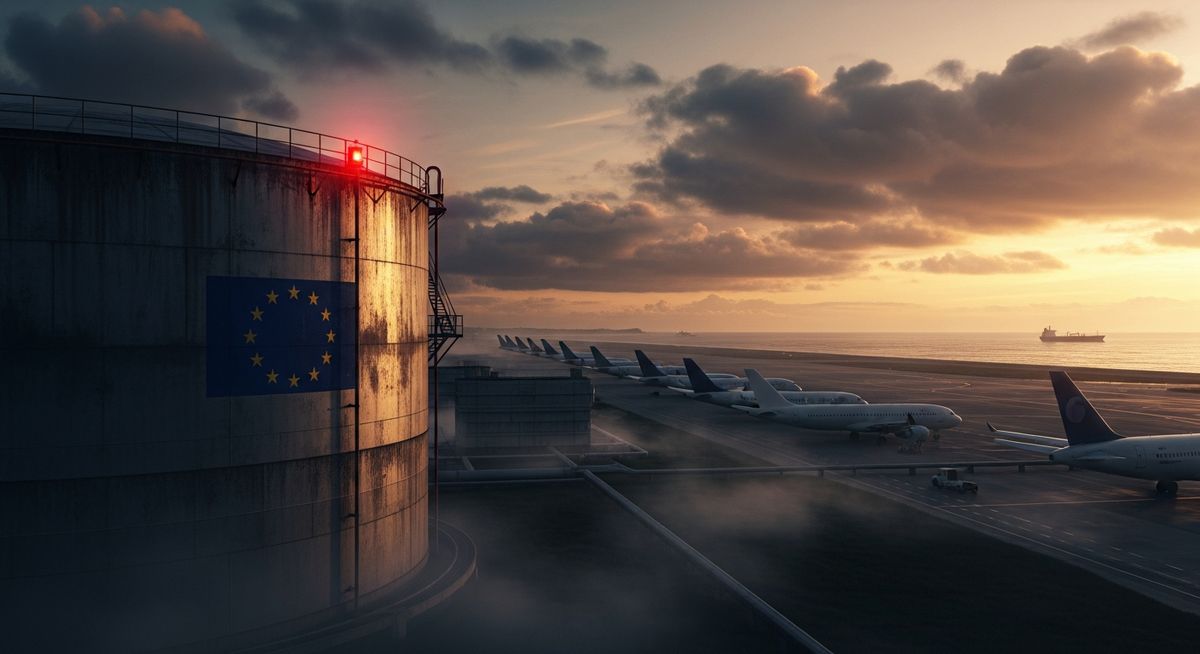
Critical jet fuel stockpiles in Europe — what happened European airlines hold less than a month of jet fuel reserves. This major logistical vulnerability forces operators to rely on emergency imports to prevent flight disruptions during the peak summer travel season. Market data indicates that aviation fuel inventories have dropped to alert levels across the continent. Storage inventories at the key Amsterdam-Rotterdam-Antwerp (ARA) hub are reporting volumes well below the five-year average for this time of year. To compensate for the acute deficit, Europe has accelerated imports from the United States and Asia. Concurrently, European refineries have maximized their domestic production, but peak travel demand continues to outpace refining capacity. This heavy reliance on maritime supply chains exposes the aviation sector to immediate geopolitical and logistical risks that are difficult to manage in the short term. The situation is exacerbated by the fact that strategic stockpiles have already been partially depleted to stabilize the market in recent months. Distribution networks at major European airport hubs, such as Frankfurt, Paris-Charles de Gaulle, and Amsterdam-Schiphol, are operating with razor-thin safety margins. In this tense context, any delay in tanker arrivals at discharge ports could trigger a domino effect of operational bottlenecks across major airports. Structural refining deficits and dependence on maritime imports The drop in reserves below safe levels stems from a structural reduction in European refining capacity. Over recent years, several large European refineries were permanently closed or converted to biofuels. This accelerated transition has drastically reduced the local output of standard jet fuel, leaving the continent highly vulnerable during periods of high seasonal demand. Furthermore, supply routes from Asia are longer and costlier due to the avoidance of the Suez Canal, driven by security threats in the Red Sea. Shipping via the Cape of Good Hope adds 10 to 14 days to delivery times, delaying the replenishment of European terminals. This rerouting of global maritime trade has driven up freight rates and restricted the availability of Long Range (LR) tankers, which are typically used to transport jet fuel from Middle Eastern hubs. US refineries cannot fully cover the European deficit without placing pressure on their own domestic inventories. Although American exports to Europe have reached record highs this summer, the elevated cost of transatlantic transport is directly reflected in the final fuel prices at European airport terminals. Global logistics are operating at their physical limits, leaving almost no flexibility in the transport system. Pressure on ticket prices and the risk of prioritized refining The direct consequence of these minimal reserves is increased volatility in kerosene prices, which account for roughly 30% of an airline's operational costs. Air carriers are forced to purchase fuel on the spot market at premium rates to secure immediate flights. This additional and unforeseen expense will quickly be passed on to passengers through higher ticket prices in the coming months. On the regional market, this inventory squeeze pressures other related energy sectors as well. Refineries prioritizing jet fuel production to honor aviation contracts automatically reduce their yields of diesel and other middle distillates. This production imbalance threatens to raise diesel prices at the pump across Europe. Although the Romanian Competition Council reported that domestic pump prices remained below the EU average following the expiration of commercial margin caps, the pressure on middle distillates could erase this advantage. For low-cost carriers operating on razor-thin profit margins, the situation is critical. The lack of long-term fuel hedging contracts exposes them directly to daily market fluctuations. This dynamic threatens the financial stability of smaller operators in the second half of the year, accelerating the risk of forced market consolidation. The critical August threshold: testing the resilience of aviation logistics The coming weeks will serve as a trial by fire for Europe's energy logistics, as air traffic reaches its annual historical peak in August. If import flows from the US and Asia suffer even minor disruptions due to weather or geopolitical tensions, some airports may be forced to ration aircraft fueling. This scenario would force airlines to reduce payloads or cancel flights entirely. European Union regulations regarding mandatory emergency stocks for aviation may need urgent revision. Currently, unlike crude oil and diesel, member states do not impose equally strict strategic jet fuel stock requirements on private operators. This major regulatory loophole, tolerated during years of stability, is now emerging as an obvious national and European economic security risk. Airlines are already seeking alternative emergency solutions, including…
Aurora AI — Independent Editorial Board
The NRG-IA newsroom continuously monitors Romanian energy markets, ANRE regulatory decisions, and national grid telemetry (SEN/SNT). We deliver independent intelligence anchored exclusively in official primary data.
Editorial Charter, Ethics & Verification Methodology →