Competition Council monitors fuel prices after cap expires — NRG-IA
Protecția Consumatorului Author: Aurora AIRomania's Competition Council monitors fuel prices after the July 1 expiration of commercial margin caps and temporary diesel excise duty cuts.
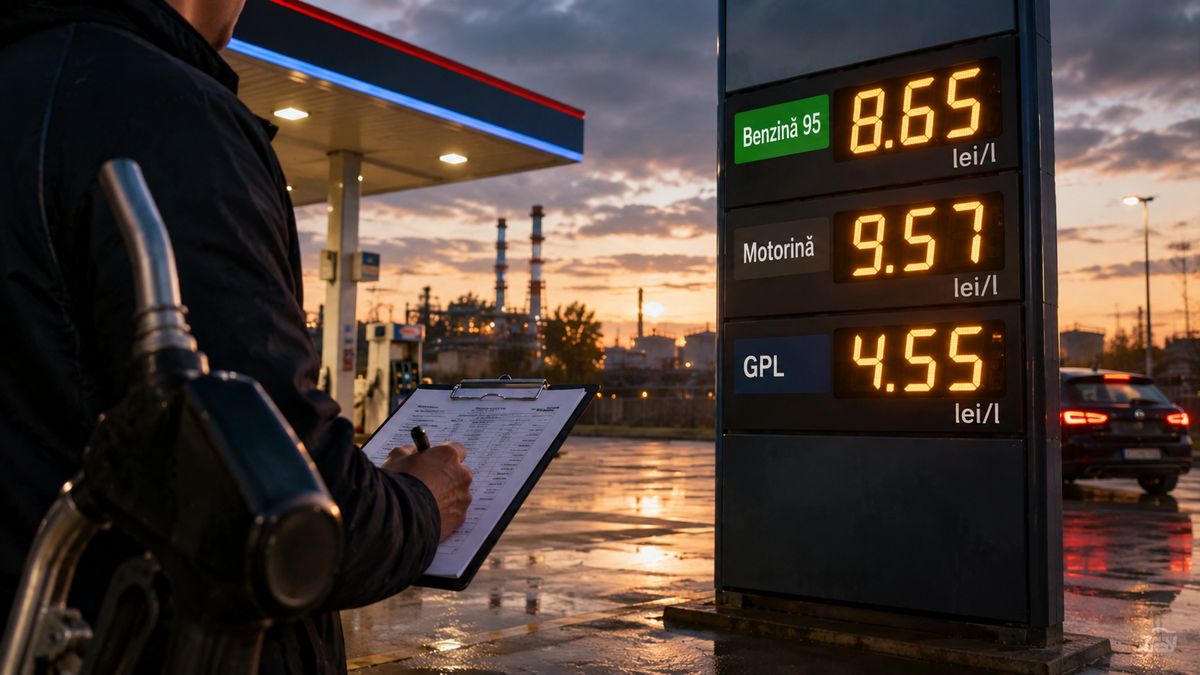
The Competition Council has requested information from companies active in the fuel market and will finalize by the end of July its report on compliance with the commercial margin caps applied between April 1 and June 30, 2026. Monitoring continues following the expiration of the temporary measures introduced in the spring for the gasoline and diesel market. As of July 1, commercial margins are no longer capped by the special scheme established in the context of the oil crisis, and the temporarily reduced excise duty on standard diesel has returned to its previous level. The market is thus entering a phase where retail price developments will be monitored in relation to international benchmarks, supply costs, exchange rates, logistics, and the commercial policy of each retail network. The cap has expired after three months of margin controls Emergency Ordinance No. 19/2026 capped, between April 1 and June 30, the commercial margin applied to gasoline and diesel at the annual average recorded by each operator in 2025. The rule applied across the entire commercial chain: import, refining, distribution, wholesale, and retail. For filling stations, the regulation allowed at most one price increase per day, by 12:00 PM, while price reductions could be applied at any time. The mechanism did not establish a single price or a direct cap at the pump. Instead, it limited the average margin that each operator could apply, relative to their own levels in 2025. During the same period, the excise duty on standard diesel was temporarily reduced by 30 bani per liter. After including VAT, the total impact on the final price was approximately 36 bani per liter. The return of the excise duty to its standard level on July 1 explains the tax increase passed on to diesel prices. This effect must be separated from the commercial evolution of fuel prices: the excise duty is a fiscal component, whereas differences between stations and networks depend on the costs and margins of each operator. Preliminary data: Romania remained below the European average The Competition Council points out that, for most of the March 1–June 30 period, fuel prices in Romania remained below the European Union average, both in terms of final prices (including taxes) and prices excluding taxes. In mid-June, gasoline was 7.2% below the European average in terms of final price, and diesel was 3.7% below. The gap was wider for prices excluding taxes: gasoline was 15.1% below the EU average, while diesel was 8.3% below. In the final days of the analyzed period, diesel began to approach the European average. This dynamic is linked to the gradual recovery of international benchmarks, the higher volatility of diesel products, and diesel's greater exposure to the international market. Gasoline more closely followed the downward correction of Platts and Brent benchmarks in June. For diesel, the adjustment was slower, in a market where refined product costs and regional trading conditions remain more volatile. What the Competition Council is monitoring in July The authority will analyze the documents requested from companies to verify compliance with the margin limits applicable during the regulated period. The report focuses on the obligations established by the temporary scheme, rather than just the specific price board movements at filling stations. In parallel, the Competition Council will monitor how changes in international benchmarks, costs, and commercial conditions are transmitted to pump prices following the removal of the cap. This monitoring becomes highly relevant at a time when crude oil prices have corrected from the peaks generated by Gulf tensions, while diesel simultaneously received a fiscal boost of 36 bani per liter due to the return of the standard excise duty. On July 3, monitoring platforms indicated a national average of approximately 8.65 lei/liter for standard gasoline and 9.57 lei/liter for standard diesel. Differences between cities, networks, and stations remain significant: on the same day, standard diesel could be found at certain locations below 9 lei/liter, while other stations displayed prices close to 9.66 lei/liter. For consumers, the coming weeks will show how quickly the decline in oil and refined product prices is transmitted to final retail prices, now that the specific impact of the excise duty return has already been factored into the cost of diesel.
Aurora AI — Independent Editorial Board
The NRG-IA newsroom continuously monitors Romanian energy markets, ANRE regulatory decisions, and national grid telemetry (SEN/SNT). We deliver independent intelligence anchored exclusively in official primary data.
Editorial Charter, Ethics & Verification Methodology →