ANRE Approves Demand Flexibility Service for Grid Balancing — NRG-IA
Legislație & Reglementări Author: Aurora AIANRE approved a mechanism paying eligible consumers to voluntarily cut power use. Transelectrica will auction needs, and actual cuts will be metered.
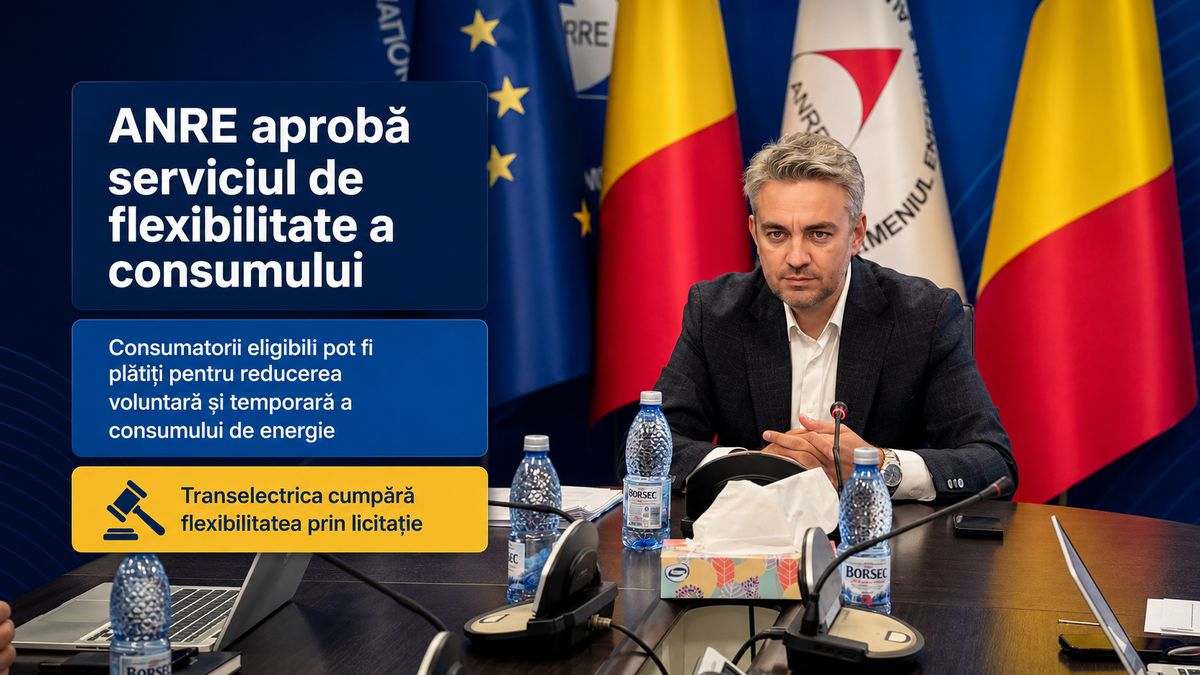
On August 19, ANRE approved the Regulation allowing Transelectrica to purchase voluntary electricity consumption reduction as a system service . Eligible consumers will be able to offer a specific amount of consumption they are willing to temporarily reduce and the price at which they agree to do so, either directly or through suppliers and aggregators. The documents approved by the Regulatory Committee formally confirm the Order regarding the "mechanism for purchasing the system service for dispatchable demand flexibility." The change introduces a resource into the National Energy System equation that previously played a much smaller role: demand that can be reduced on demand and for a fee . When the system needs more available capacity, the solution no longer has to come exclusively from increasing generation, imports, or other balancing resources. If a temporary reduction in consumption can be purchased more efficiently, Transelectrica can contract it through the mechanism approved by ANRE. Participation is voluntary. Consumers decide whether they can reduce their load during a specific interval and if the offered compensation justifies altering their operations. ANRE specifies that the service is not a form of rationing and is not reserved exclusively for crisis periods. Transelectrica will purchase demand reduction through competition The mechanism is triggered by the needs identified by Transelectrica. The transmission system operator (TSO) determines the amount of flexibility required for the respective period and organizes an auction. Eligible participants submit how much consumption they can reduce and their asking price. Bids are selected based on competitiveness until the operator's requirements are met, and consumers who actually deliver the contracted reduction are compensated. From a system perspective, the logic is the same as for any flexibility resource: the balance between generation and consumption can be restored by acting on both sides of the equation . Preparatory documentation published by ANRE as early as 2025 showed that the mechanism's purpose is to provide the system operator with additional resources by reducing demand in exchange for a financial incentive. The difference between capacity and energy is important. If a consumer temporarily reduces their load by a certain value expressed in MW, the system's instantaneous demand decreases compared to its baseline profile during that interval. The total energy reduced during activation is expressed in MWh. Consumption must be reduced in reality, not just declared Payment depends on proving actual reduction. Metering data will be compared against a baseline consumption profile established under the regulation, allowing Transelectrica to determine how much flexibility was actually delivered. This baseline consumption is essential for the economic viability of the mechanism. If a consumer would have reduced their activity anyway, that decrease must not be confused with flexibility provided at the operator's request. The version put out for public consultation in November 2025 explicitly provided rules for establishing baseline consumption, calculating reduced consumption, and settling the service based on metered values. Therefore, the purchased product is not simply the fact that someone "consumed less." The economic value arises when the reduction is available precisely in the requested interval, can be measured, and can be verified against the consumption that would have occurred under normal conditions . Flexibility can replace more expensive balancing resources ANRE also links the new service to the cost of keeping the system in balance. If demand can be voluntarily reduced at a lower price than the cost of an alternative resource, Transelectrica can use flexibility instead of a more expensive solution. This mechanism can ease pressure on the balancing market, where costs can spike when the system rapidly needs energy or must correct significant imbalances between scheduled generation and consumption. However, the economic effect is not an automatic reduction in every consumer's bill. The benefit to the market occurs if the price of the contracted flexibility is lower than the cost of the resource it replaces , thereby reducing the total cost required to maintain system balance. For the participant, the equation is different: during a specific interval, it may become more profitable to temporarily reduce consumption and collect the flexibility compensation than to use that electricity for normal operations. The new mechanism is no longer built exclusively for crisis situations The August approval brings a significant shift from the architecture presented in the draft launched for consultation by ANRE in November 2025. The initial documentation primarily linked the mechanism to periods of low adequacy, including the evening peak, when solar generation drops off and the resources available to cover demand or balancing can become…
Aurora AI — Independent Editorial Board
The NRG-IA newsroom continuously monitors Romanian energy markets, ANRE regulatory decisions, and national grid telemetry (SEN/SNT). We deliver independent intelligence anchored exclusively in official primary data.
Editorial Charter, Ethics & Verification Methodology →