Romania Household Power Use Down 11.2%, Offers at 1.20 RON — NRG-IA
Piața de Energie Author: Ioana BuzoaicaRomanian household power demand fell 11.2% in 9M 2026, dragging national consumption down 4.1%. Retail offers have now dropped to 1.20 RON/kWh on ANRE.
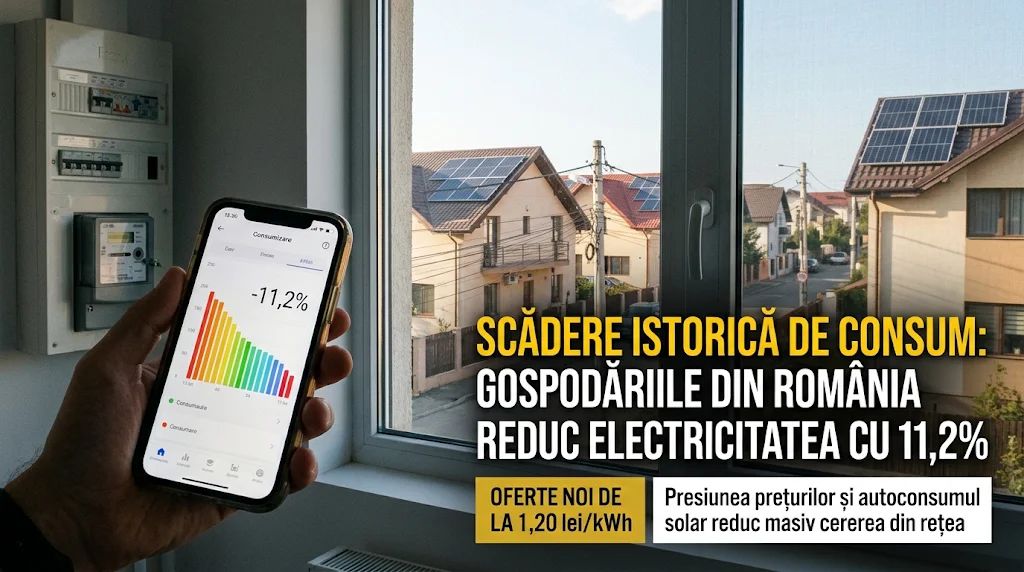
Electricity consumption among Romanian households dropped by 11.2% in the first nine months of 2026 compared to the same period last year, according to official data released on November 16 by the National Institute of Statistics. The sharp contraction in the residential sector was the main driver behind the 4.1% decline in total national final electricity consumption, which fell to 35.718 billion kWh between January and September 2026. This trend marks one of the most substantial structural adjustments in household demand in recent years, unfolding alongside a repositioning of commercial offers in the retail market, where final prices in the official energy regulator's (ANRE) price comparison tool have reached 1.20–1.22 RON/kWh. Statistical data highlights a clear decoupling between residential dynamics and the rest of economic activity. While broader economic power consumption contracted by 1.8% in the first three quarters of the year, households drew over a tenth less electricity from the national grid than in 9M 2025. This divergent pace indicates that the adjustment stems not from a widespread economic slowdown, but from a direct transformation in how the population meets and manages its daily electricity needs during the first full year under a deregulated market regime. Countering perceptions of a market locked into high tariffs, Energy Minister Dumitru Chisăliță indicated on November 16–17 that competitive offers with final prices between 1.20 and 1.22 RON/kWh are available in the ANRE comparator, while pointing to spring 2027 as the timeline for a broader decline in utility bills. The juxtaposition of steeply declining statistical consumption and commercial offers priced below what many passive consumers currently pay reveals a divided residential market: households forced to curb spending, self-generating prosumers, and customers continuing to pay elevated rates due to contractual inertia. Households Dragged Down National Power Demand Six Times Harder Than the Economy The structure of the energy balance for the first nine months of 2026 confirms that primary pressure on domestic electricity demand has shifted from industrial to residential users. Against total final consumption of 35.718 billion kWh, the 1.8% decline recorded across the broader economy reflects relative stabilization among non-residential consumers following successive shocks in previous years, when major energy-intensive industrial plants had already curtailed operations. By contrast, the 11.2% drop in the residential sector is over six times larger in percentage terms than the broader economic contraction, altering the load profile that suppliers and distribution system operators manage nationwide. This contraction aligns with a broader trend of shrinking energy volumes moving through the Romanian economy in 2026. According to the same reporting by the National Institute of Statistics, Romania's total primary energy resources declined by 8.2% from January to September 2026 compared to the same period last year. The simultaneous drop in primary resources and electricity delivered to end consumers indicates both lower aggregate commercial demand and a shift in physical flows measured across public grid meters. For the power market, a double-digit decline in residential deliveries carries direct financial and operational consequences. Lower electricity volumes distributed over low-voltage networks mean a smaller volumetric base over which grid operators recover fixed infrastructure costs. Meanwhile, suppliers with large residential portfolios face reduced revenue from lower volumes and must recalibrate forward hedging to avoid costly imbalance penalties between forecast and actual consumption. Post-Deregulation Bills and Prosumer Self-Consumption Drive Statistical Decline The 11.2% reduction in residential consumption reported by the INS stems from two distinct economic mechanisms producing identical statistical effects on grid deliveries. The first is voluntary or forced demand reduction among households exposed to full market prices following the phase-out of price cap schemes. Higher utility bills have prompted a significant portion of the population to limit the use of heavy appliances, postpone switching to electric heating or cooling systems, and replace aging devices with energy-efficient models. The second mechanism remains invisible in standard grid delivery statistics, arising from the rapid expansion of solar prosumers. Power generated on residential rooftops and consumed immediately on-site—or stored in home batteries for evening hours—does not pass through the public distribution network and is not logged as billed consumption by suppliers. The January–September window covers the peak spring and summer months when solar yield reaches annual highs, heavily offsetting the grid electricity these households previously bought from the National Power System. Distinguishing between these two drivers is essential to…
Ioana Buzoaica — Independent Editorial Board
The NRG-IA newsroom continuously monitors Romanian energy markets, ANRE regulatory decisions, and national grid telemetry (SEN/SNT). We deliver independent intelligence anchored exclusively in official primary data.
Editorial Charter, Ethics & Verification Methodology →