€22B Black Sea Green Corridor Adds Subsea Hydrogen Pipeline — NRG-IA
Tehnologie & Inovație Author: Ioana BuzoaicaPartner states in the €22B Green Corridor are discussing adding a subsea green hydrogen pipeline alongside power cables from Georgia to Constanța.
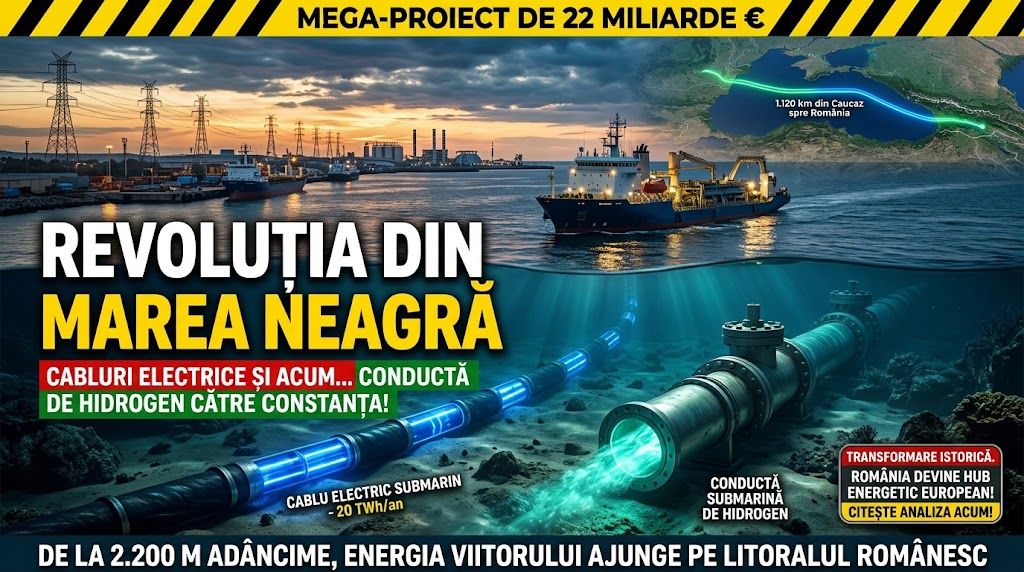
The €22 billion Green Energy Corridor, originally conceived as a subsea power highway connecting the South Caucasus to the European Union, is entering a new phase of technological expansion. During recent technical and ministerial talks in late October and early November 2026, Romania and its partner states analyzed adding a subsea green hydrogen pipeline along the same Black Sea route, running parallel to the high-voltage direct current (HVDC) power cables connecting Georgia to the Constanța Sud substation. This expanded scope fundamentally alters the geostrategic and industrial significance of the investment for Romania. Rather than serving purely as a transit route for green electrons generated by Caspian wind and solar farms, the corridor is evolving into a hybrid energy infrastructure capable of simultaneously delivering baseload electricity and green hydrogen tailored for European heavy industry decarbonization. For Romania's energy sector, this dual infrastructure directly integrates both strategic transmission system operators, Transelectrica and Transgaz, into a major energy hub on the Black Sea coast. Discussions on the hydrogen component build on a technical foundation already validated for the power segment. Following the approval of the feasibility study in July 2026, the key parameters for the power interconnector were set at a length of 1,120 kilometers across the Black Sea bed, enabling the transfer of 8 TWh of electricity per year in the initial phase, scaling up to 20 TWh per year at full capacity. From a 20 TWh/Year Power Cable to Combined Electron and Molecule Transport The baseline architecture of the Green Corridor was designed to address a major regional energy asymmetry: surplus wind and solar potential in Azerbaijan and the Caspian Basin versus a structural deficit of clean, affordable power in Southeastern and Central Europe. An annual inflow of 20 TWh at the Constanța Sud landfall equates to over one-third of Romania's current annual electricity consumption, supplying a massive volume of zero-emission power to the broader region. However, transmitting energy purely as electricity over thousands of kilometers runs into physical limits and grid absorption constraints across continental high-voltage networks. Integrating a subsea green hydrogen pipeline within the same infrastructure corridor allows part of the Caspian renewable surplus to be converted into hydrogen molecules via electrolysis at the source. Hydrogen offers long-term storage capabilities and bulk transport advantages without placing additional stress on already congested overhead power lines in Dobrogea and across the country. For the European economy, the synergy between the power cable and the hydrogen pipeline addresses hard-to-abate industrial sectors that cannot be easily electrified. Steel mills, chemical plants, fertilizer producers, and refineries in Romania, Hungary, and Austria require green hydrogen as both a feedstock and a high-temperature process fuel; piping it directly into the Constanța port and energy hub establishes a continuous, competitive supply chain. Extreme Engineering Challenges of the 2,200-Meter Black Sea Crossing Deploying HVDC cable bundles and a hydrogen pipeline across 1,120 kilometers between the Georgian and Romanian coasts represents one of the most complex subsea engineering projects ever attempted globally. The route must descend to depths of up to 2,200 meters on the Black Sea bed, operating in a marine environment whose unique physical and chemical profile demands cutting-edge metallurgy and insulation technologies. Beyond hydrostatic pressures exceeding 220 atmospheres at maximum depth, the Black Sea is the world's largest anoxic marine basin. Below 150–200 meters, the water is entirely depleted of oxygen and contains high concentrations of hydrogen sulfide—a compound highly corrosive to standard steels and protective metallic sheathing on subsea cables. Any seabed infrastructure must withstand decades of severe chemical exposure without relying on easy maintenance interventions. For the subsea hydrogen pipeline, technical complexity is compounded by the physical properties of the molecule itself. As the smallest chemical element, high-pressure hydrogen penetrates steel's crystal lattice at the atomic level, causing hydrogen embrittlement—a phenomenon that reduces metallic ductility and can trigger structural microcracks. Designing a pipeline that can simultaneously endure high internal hydrogen pressures, extreme external hydrostatic loads at 2,200 meters, and a corrosive anoxic environment requires specialized micro-alloyed steels, internal polymer or composite barrier liners, and advanced welding and pipelay technologies from specialized vessels. Constanța Sud Becomes a Dual Hub for Transelectrica and Transgaz Networks Bringing both components of the Green Corridor ashore near Constanța cements the Dobrogea region as the premier energy hub for Romania and Southeastern…
Ioana Buzoaica — Independent Editorial Board
The NRG-IA newsroom continuously monitors Romanian energy markets, ANRE regulatory decisions, and national grid telemetry (SEN/SNT). We deliver independent intelligence anchored exclusively in official primary data.
Editorial Charter, Ethics & Verification Methodology →